Well that’s a relief! Facebook has taken out ads in three national newspapers with a list of tips on how to spot fake news.
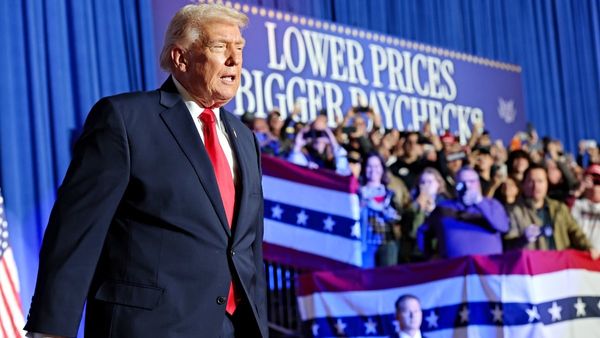
Shame it omitted the obvious one - anything that comes out of Donald Trump’s mouth - but I suppose that's understandable.
What's fascinating about this is how the star of the new media - and the operator of a platform that has become the prime method of news consumption for an increasing number of people - has chosen the old school print media as the venue for an apparent attempt to combat what is a very real problem.
The ads have been published in The Times, the Guardian and the Daily Telegraph. They urge readers to be sceptical of headlines, to check article dates, and the website addresses of things they might read on Facebook. Consider the evidence, readers are urged, look at the source of the story. Some articles, it also points out, are intended as satire.
Sensible stuff, you might think. Naming no names, but some of that advice could actually serve as a handy lens through which to view some the “real news” published in those newspapers. Or any newspapers.
Perhaps, as has been suggested, Facebook chose to use the old media for this intervention as a reflection of the older age profile of its user base. The kids don't think Facebook is cool because it's used by their parents, although some of the websites that are in vogue with them (like Instagram) are owned by Facebook.
But perhaps there was another reason.
Fake news played an important, and damaging, role in the US Presidential election, the EU referendum in the UK and in other polls around the world. As such, it has started to get sensible politicians worried.
Conservative MP Damian Collins, chairman of the Culture, Media and Sport Committee, correctly described the phenomenon as “a threat to democracy”. He said that at the launch of an investigation into the “widespread dissemination, though social media and the internet, and acceptance of fact of stories of uncertain provenance or accuracy”.
Now, it isn’t only Facebook’s user base that skews older. So does the membership of the House of Commons. Ditto opinion formers and people with power and influence.
A lot of those people still read broadsheet newspapers, or formerly broadsheet newspapers, and pay attention to what is in them. As such, it's fair to ask whether the ads are intended more to convey the impression that Facebook takes the issue seriously to them than they are a serious attempt to tackle the problem.
If this were the latter, then why focus on just those three newspapers, all regarded as among what is sometimes described as "the quality press"? Why not also target "the popular press" too, the tabloid newspapers that have bigger readerships?
It’s notable that the ads also stress Facebook’s “work to limit the spread” of dodgy stories.
That is a message that it wants to get heard, needs to get heard.
I wouldn’t go far as to describe what it has done here as an example of, shall we call it "Fake Concern"? But Facebook needs to do a lot more than publishing a few ads that will be forgotten about in a few months time.
It makes huge amounts of money. How about deploying it on more meaningful, long term efforts to educate its user base? Not to mention spending a lot more on, you know, hiring people to take the bad stuff of its platform (a start has been made, but it's not enough).
That would do more to convince me that it is serious.
The publication of these ads? It has the look of a PR stunt.