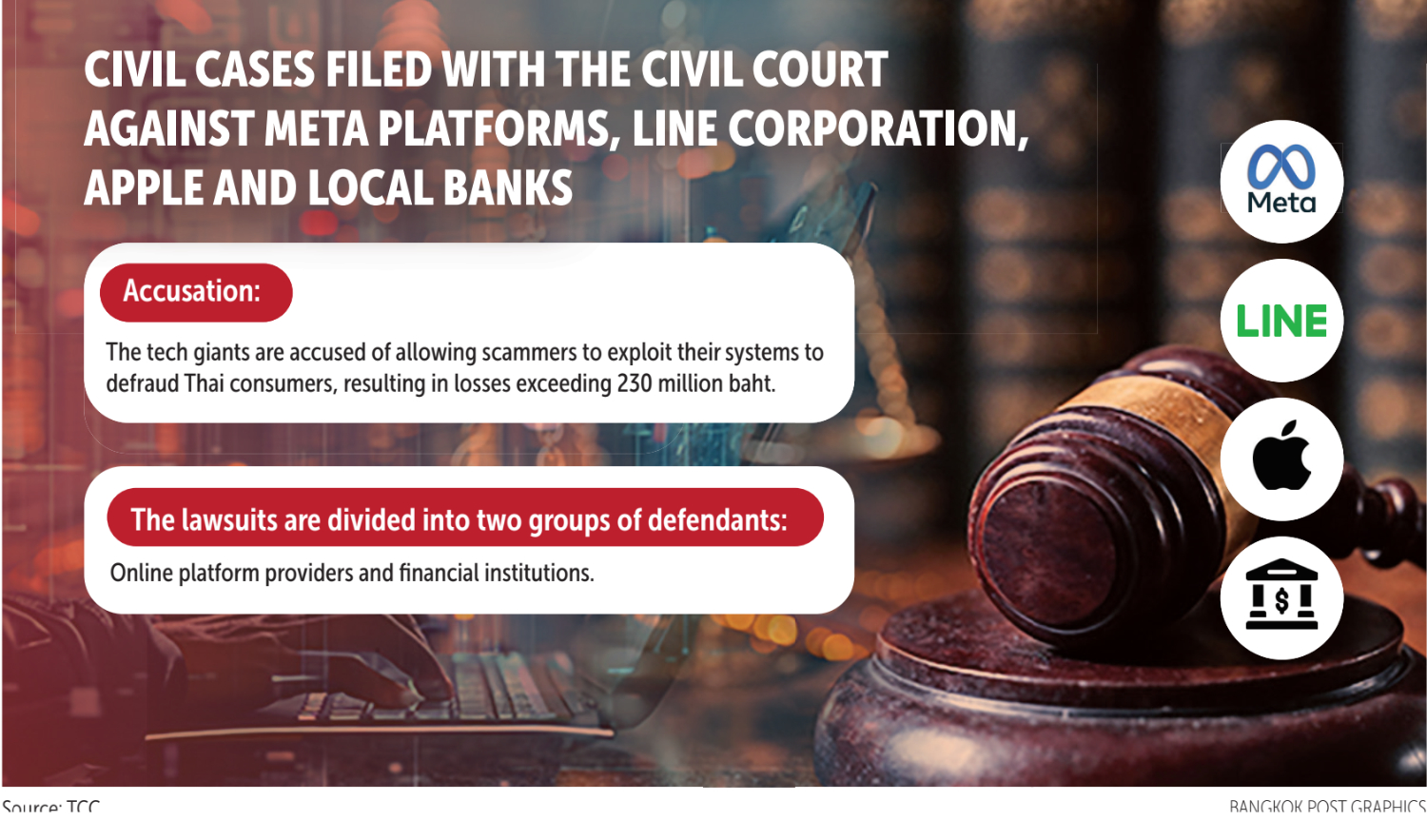
A Thai consumer watchdog has launched civil lawsuits against Meta Platforms, Line Corporation, Apple and local banks, accusing them of allowing scammers to exploit their systems to defraud Thai consumers, resulting in losses exceeding 230 million baht.
On June 8, the Thailand Consumers Council (TCC), together with lawyers and representatives of affected victims, filed the civil cases with the Civil Court on Ratchadaphisek Road.
The lawsuits are divided into two groups of defendants: online platform providers accused of violating consumer rights, and financial institutions accused of breaching service agreements, deposit obligations and consumer protection duties.
The plaintiffs are seeking compensation and damages, arguing that the platforms and banks failed to prevent fraudsters from exploiting their systems to deceive consumers, despite having legal and professional obligations to detect and mitigate such risks.
Nannaphatsorn Techapanyapipat, the lawyer overseeing the litigation, said all 10 victims involved in the initial lawsuits fell victim to similar schemes.
Victims were allegedly lured through scam advertisements and fake investment education pages appearing on the online platforms before being persuaded to transfer money into accounts controlled by fraudsters.
As a result, every case names platform companies as defendants, alongside banks linked to the victims' financial transaction routes. Combined damages among the 10 complainants exceed 230 million baht.
Ms Nannaphatsorn described the lawsuits as "strategic litigation", noting that while many victims share similar experiences, the factual circumstances of each case differ, preventing the lawsuits from being filed as a class action under Thai law.
Instead, the council has chosen to pursue separate pilot cases.
The lawsuits target two main groups of companies. The first includes platform operators such as Meta, the parent company of Facebook, Line Corporation and Apple. The second group comprises financial institutions linked to the transactions.
According to the complaints, the fraudulent schemes began when victims searched Facebook for stock trading education and investment-related information.
Facebook's algorithm allegedly displayed scam advertisements and fake pages impersonating legitimate stock trading influencers and investment educators.
Victims were then directed into Line chat groups containing hundreds of members. The scammers reportedly used authentic audio clips and real stock market data to establish credibility before encouraging victims to invest through a brokerage firm falsely presented as legitimate.
The victims were instructed to download investment applications through Apple's App Store or the Google Play Store before eventually transferring funds into fraudulent accounts.
Ms Nannaphatsorn argued that the fraud relied on a chain of interconnected systems spanning advertising platforms, messaging applications, mobile app distribution channels and banking infrastructure.
She said that if all these systems had properly fulfilled their professional duties, the damage would not have occurred.
The TCC argues that scammers were able to continuously exploit the platforms and banking systems because of failures in oversight, monitoring and consumer protection measures.
Saree Aongsomwang, TCC secretary-general, said the lawsuits differ from previous cases because they directly target overseas parent companies that control the platforms' global advertising systems, revenue structures and operational policies.
She said their local subsidiaries in Thailand largely serve marketing and coordination functions and do not control the core systems responsible for screening fraudulent adverts or regulating platform operations.
The lawsuits therefore include both the parent companies that oversee these systems and the Thai subsidiaries responsible for collecting service fees domestically.
Ms Saree also identified banks as a critical part of the transaction chain, arguing that they should have detected suspicious activity through their professional expertise.
The council said the legal action is intended not only to secure justice for victims but also to encourage platforms and financial institutions to strengthen consumer protection standards and support legal reforms.
- Company replies -
Meta said it was not in a position to comment on this legal matter.
But it added that over the past two weeks, Meta had joined leading tech companies and law enforcement to disrupt criminal scam networks in Southeast Asia.
"More than a million online assets were disrupted as a result of the operation, including 1.4 million accounts, pages and groups across Facebook and Instagram, 20,000 Microsoft accounts, and thousands of Starlink kits, and the Royal Thai Police arrested 63 individuals involved in scam operations," the company said in a statement.
Meta met with the TCC as recently as April 2026 to align on anti-scam education campaigns. Through these collaborative efforts, it continued to work closely with local authorities to protect users and strengthen platform integrity in Thailand, according to the statement.
"We work hard to keep scammers off our platforms," the company said. "We are investing in new technology, working with experts, and partnering with other companies so that people can feel safe when they use our platforms."
LINE Thailand has issued a statement regarding the lawsuit filed by the TCC against online platform providers and financial institutions over online scams.
The company stated it has received initial notification of the lawsuit and expressed its deep concern for those affected, while affirming its full respect for the ongoing legal process.
LINE Thailand is currently investigating the facts and stands ready to cooperate with all relevant parties to ensure the continued safety of its platform.
According to the statement, LINE Thailand has always prioritized user safety and has never been complacent about fraudulent activities on its platform. The company has consistently provided educational resources to users on how to navigate the application safely.
Furthermore, it has maintained close and continuous cooperation with law enforcement agencies and relevant government bodies to mitigate risks, prevent cybercrime, and crack down on online scammers.