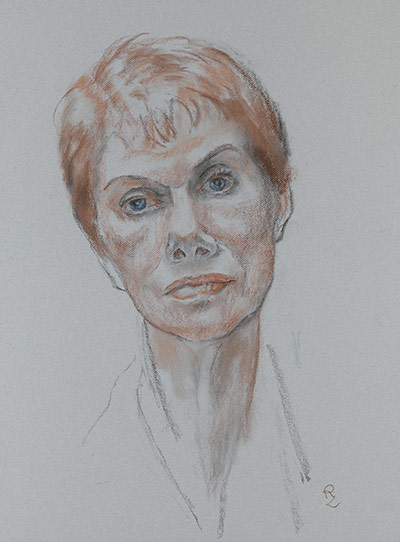
In the past, my portrait projects have focused on characters from the arts: dance, music, theatre, and the visual arts. Writers, however, posed an entirely new set of challenges: those who are accustomed to scrutinising others here became the subject of scrutiny. In the case of my meeting with Anita Brookner, I felt this was an occasion for mutual observation; she didn't miss a thing and seemed to be storing up every detail of my character and appearance as much as I was hers. The 'face to face' project was, in a sense, a series of duels between myself and the sitter, and also an occasion to witness the observer observed. Photograph: Zsuzsi Roboz, courtesy Messum's
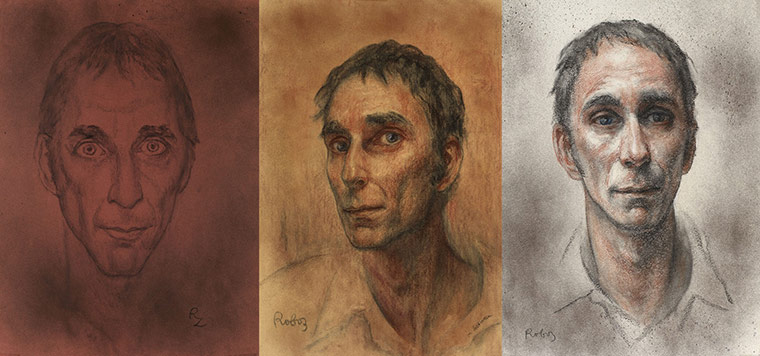
Will Self was one of the most publicly familiar figures I chose to portray. I have always been fascinated by images I've seen of him on the television and in magazines, yet when he arrived his character was far less saturnine than the images I'd seen would suggest. So merciless in print, he was gentle and passionate in person; however, I felt it would be a betrayal not to present the many different attitudes and moods he demonstrates, and so I produced this triptych, entitled 'Before', 'In between' and 'After'. Photograph: Zsuzsi Roboz, courtesy Messum's
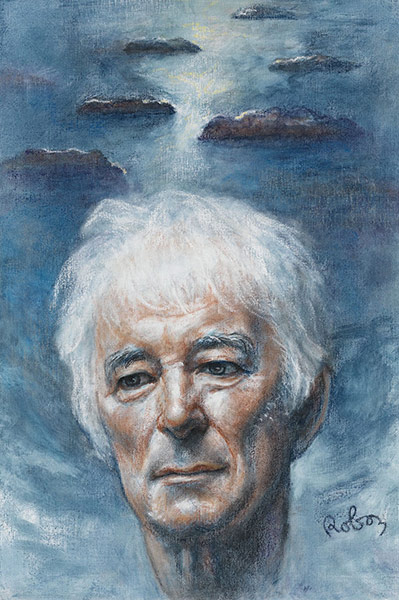
After our meeting, Seamus Heaney sent me a copy of the book Stepping Stones, a collection of detailed interviews he gave Dennis O'Driscoll. In the inscription he writes that he admired the work I did when 'faced with an older face'. The letter that accompanied this gift described his portrait as 'frank and firmly decided', and I do try to portray the sitter as I see them, and not 'do an injury to them' (a description Francis Bacon once applied to his work). In this portrait I drew on Seamus Heaney's own words (from his 1995 Nobel prize address), and chose to portray his face beneath a series of stepping stones. Photograph: Zsuzsi Roboz, courtesy Messum's
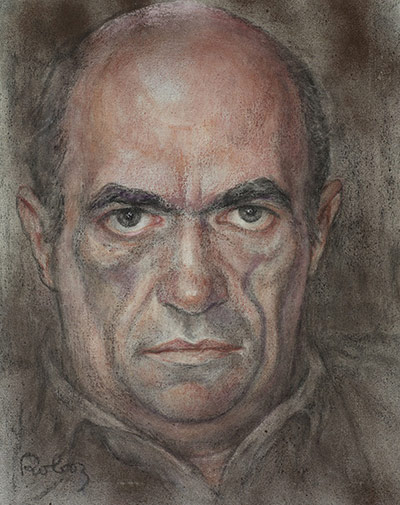
I prefer to be silent while I work – too much chit-chat can be fatal – and instead like to listen to music. I always ask the sitter what they would like to hear, and was delighted when Colm Tóibín chose the Hungarian composer Kodály. However, I needn't have worried that anything might distract Colm or I from the sitting, for Colm held this astonishing and unflinching pose for hours. He is a godsend to any artist! Photograph: Zsuzsi Roboz, courtesy Messum's
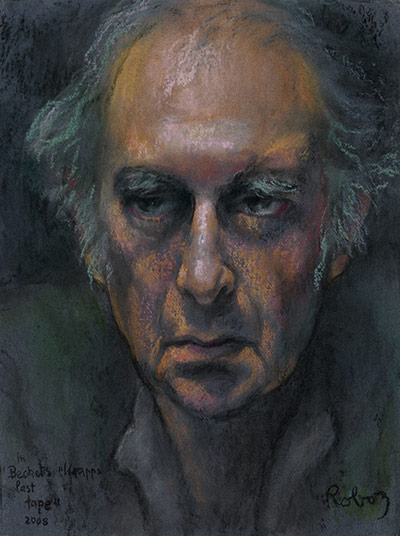
Though I had met him several times, I decided to create this portrait of Harold Pinter based on his astonishing performance in the televised production of Samuel Beckett's one-man play, Krapp's Last Tape. He was an extraordinary character and I admire his work enormously, but when I saw his performance as Krapp I was completely dumbfounded by its power, and I was very, very moved. Photograph: Zsuzsi Roboz, courtesy Messum's
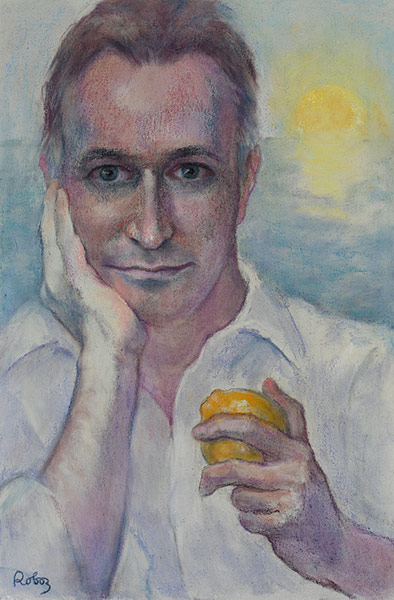
Andrew O'Hagan arrived on my doorstep with a bowl of oranges, and so I incorporated this into his portrait. However, I have been described as a 'symbolist' painter, and for me the orange in his hand symbolizes his sunny, positive outlook. Andrew talked in detail about his underprivileged childhood in Glasgow and his deliberate decision to 'run for the sun': to put his difficult background behind him. Instead of brooding over the things that once done could not be undone, he chooses to think positively, which produced this portrait, one of the brightest and sunniest of the series. Photograph: Zsuzsi Roboz, courtesy Messum's
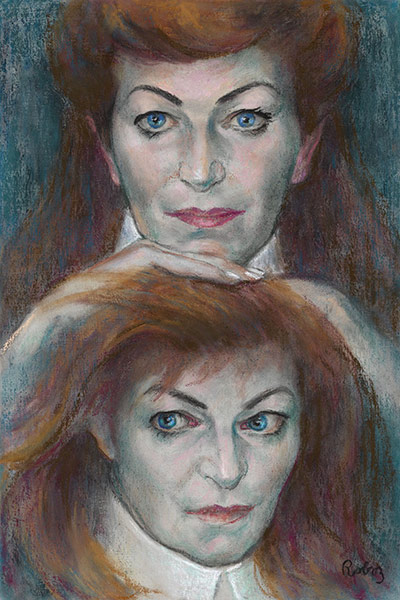
Of all the sitters I have drawn, the difference between the author's character and the books they have written was never greater than with Josephine Hart. For this reason, I could only paint her as a double portrait, which I entitled 'Dichotomy'. One shows Hart as one would meet her: calm, balanced, confident, happy, a mother, a grandmother, a successful bestselling author. The other is the inner woman as I imagine her: the beautiful Irish lady with wild hair, whose imagination has been shaped by a traumatic childhood, and who is therefore all too well acquainted with the cruel and dangerous side of life. In a letter written to me after she had seen the portrait, Josephine said that I had 'revealed [her] to herself'. Photograph: Zsuzsi Roboz, courtesy Messum's