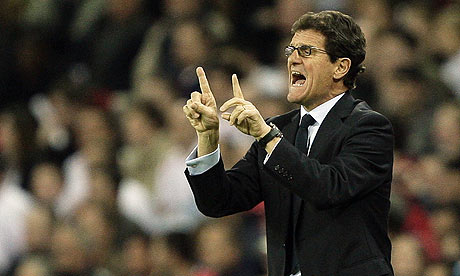
The difference this time, real or imagined, is the Fabio Capello effect. It goes like this: England are a perennial quarter-final team, with incurable defects, but Brigadier Capello can add the extra 5% that will make England win the big World Cup knockout games rather than traipse home on the old trail of tears.
This seductive theory has been embraced by the England players. This week at the Khayelitsha township outside Cape Town I asked David Beckham about England's mental block around the quarter-final stage and whether Capello could help them overcome it. Beckham had been playing the 2018 diplomat all week, but suddenly he went into serious football man mode and bit on the subject.
Can Capello get England past the old brick wall of the last eight, or last four? "Without a doubt, yes," Beckham said. "He's made us not scared of teams. Players have that through their clubs, but it's been put into us as an England side.
"I do believe we're in the right situation and everything's right for us now. All the way through from the manager to the coaching staff. We've had great managers in the past, but I think what this manager's brought into this team is instilling the confidence into the players.
"Over the years going to Croatia has been difficult, but we went there and performed, and did that all the way through [qualifying]. So he's instilled that confidence and winning mentality and steel that's maybe been missing."
Steel. Good word. Brings a tear to John Bull's eye. In this context steeliness is best defined as the ability to prevail in suffocatingly close games, as England's 2003 Rugby World Cup winners could. It means a refusal to lose, implacability in the face of stress, especially in penalty shoot-outs, not getting yourself sent off, holding on to leads, coming from behind to win and possessing the humility to feel one small part of a World Cup instead of its unofficial royal family.
It means a meritocracy, too. Even Beckham, whom Sven-Goran Eriksson was too star-struck to drop, embraces Capello's egalitarian ethos: "I respect the system of having the best players in the team and that's the way I think it should be," the former captain said.
But here comes the counter-weight of historical evidence, which Capello has chosen to ignore. Ask him whether he will look back over the last 20 years of near misses and anti-climaxes and he winces at the thought. It's not that he dislikes history, more that he wants his players to escape the ghosts of Turin, St‑Etienne, Shizuoka and Gelsenkirchen. The implication is that England are not congenitally flawed, just misguided, even though there is an unmistakable pattern of errors and deficiencies in the 12 World Cups they have contested since 1950.
Prepare for an ice bath. In those dozen World Cups, England have been ko'd in the quarter-finals six times. They have reached one semi-final (1990) and won it once, on home soil, in 1966. The last eight has been their stopping point in the last two tournaments, and three of the last five they have contested.
Now for penalty shoot-outs. England have crashed out on spot-kicks in three of the last four World Cups for which they have qualified: 1990, 1998 and 2006. The same applies to two of their last three European Championship finals: 1996 and 2004. That's five times in the 16 years of international combat starting in 1990. This word should not be used lightly, but England's penalty shoot-out record is, in the Oxford dictionary sense, pathetic.
No one at the Football Association has ever demonstrated an appetite to study this vast web of failure to determine common threads, or try to correct them, but there are others, much commented on at the time, but seldom ever integrated into a grander scheme of analysis.
First: indiscipline. In two of the past three World Cups, England have had major players sent off through a lack of self-control. Beckham, against Argentina in 1998, and Wayne Rooney, for stamping on Ricardo Carvalho's groin in Germany three years ago. Paul Gascoigne, in 1990, also threw a yellow card/suspension drama into a semi-final, which hardly helped. At a push it could be said that England's superstar self-image (or in Rooney's case, biting frustration at Eriksson's ineptitude) worked as a kind of dry rot throughout the Noughties.
Next: taking and fielding injured players has been a frequent boo-boo throughout the so-called Golden Generation years. Its most graphic expression was Beckham jumping out of the way of a tackle to protect his suspect metatarsal to allow Ronaldinho to race away and set up Brazil's equaliser in first-half added time in 2002, which broke England's spirit. In Gelsenkirchen in 2006, a half‑fit Rooney started as the lone striker in a timid 4-5-1 formation and a mediocre Portugal hung on for penalties to induce the usual English spot‑kick meltdown.
These factors have conspired with England's traditional profligacy with the ball to leave them short against the world's top six nations. Culturally, English football is distinct from the superpower mainstream, which emphasises ball retention, rather than power and aggression. When these two styles collide, passing and control have always won. The game starts well and then slips away from England: how often have we seen that? They are not a nation of closers. Even now, with the improvements wrought by Capello, they cannot keep the ball as selfishly and skilfully as Spain or Brazil. Ludicrously, some bookmakers now rate the Brazilians as third favourites, behind Capello's men.
If he wrote the story of the last 20 years – the last 59 years, really – on an A4 pad, Capello would flee back to Italy. Instead he attempts to control the controllable: the present, the reality in front of him. So: no injured players (anathema), no grieving for end-of-campaign defeats at club level, no showbiz behaviour, no disunity, no wastefulness with the ball, no deviation from the team shape, or defensive responsibilities and no choking under pressure (penalty shoot-outs).
Here in Cape Town, it has been possible to see the gears of Capello's brain working more clearly than ever before. It is a formidable sight. His deepest preoccupations are preparation – especially the quality of the training pitches at the Royal Bafokeng Sports Campus, near Rustenburg – and the length and intensity of the English season, with its potential for injuries.
He is already ruminating, for example, on next year's Champions League final, which is played in Madrid 21 days before England's first game. "The problem is the last game of the season. I hope the English team are in the Champions League final and that when they win, the players will be happy and they will recover the mind, the mentality, the spirit," he says. "If they play well and lose, I hope they will be not too sorry because the time is little bit close. It's not an excuse, because when you come to the World Cup you have to play every game to win and every game you have to respect the other team.
"You cannot think about the last result. The World Cup is completely different because of the pressure and mentality. How you think is completely different. But I know there could be eight or nine players in the final. It's a problem. Because after this game if there are nine players from the English team, then we need a minimum four or five days to relax them afterwards."
When Friday's draw placed England in Group C with the United States, Algeria and Slovenia, relief swept the land, but Capello went the other way, preaching against presumption. "I don't want to talk about Brazil now, about the others now," he said. "Now we have to talk USA first game, Algeria and Slovenia. We know very well USA and Slovenia, because we have played against Slovenia, and in the second half they played well. I saw the games USA played here, they played very well against Spain [in the Confederations Cup]. They know very well what they have to do here, because they have the experience of playing here in South Africa. Algeria, I don't know. I saw their goals from qualification, I haven't seen an entire game."
If a football coach can be worth £5m a season, Capello earns his corn with his thoroughness. A story emerges from Royal Bafokeng and the FA's joint-venture status at a resort that was set up to attract a top team to the Rustenburg area. The developers wanted to install two grass tennis courts, but Capello objected to the location because they obscured the view of England's training pitches from his room. According to a local report, "he wanted an uninterrupted 60-metre stroll between the hotel and training". The courts were relocated.
Alone, these nuances will not win you a World Cup, but together they may yet make the tiny difference between losing and winning a tight quarter-final. Much of it is old-school psychology: forging the "steel" of which Beckham speaks.
"We will play every game without fear," Capello says. This is his favourite mantra. Now for the hard part.
Paul Wilson, page 16