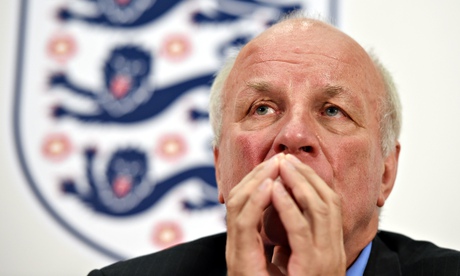
Greg Dyke’s instant dismissal of the allegations listed in Fifa’s summary of their investigator Michael Garcia’s report into the 2018 and 2022 World Cup bidding process was easy, predictable and depressing. In essence, the Football Association chairman said, other countries did worse than us, and, anyway, it is ridiculous that an organisation as corrupt as Fifa should accuse us of wrongdoing.
But that, as in much of what is turning out to be Dyke’s strangely casual, sofa-government approach to football leadership, was far from good enough. People who exonerate themselves in haste can sometimes find themselves revising that view at leisure.
In his uncomfortable interview on Newsnight – in which Dyke, to be fair, resisted being also drawn into a discussion about the convicted rapist footballer Ched Evans – Dyke was forced into one revealing correction. The FA had claimed, after the chair of Fifa’s ethics committee’s adjudicatory chamber, Hans-Joachim Eckert, issued the summary report, that everything in their bid for the 2018 World Cup was cleared with Fifa first.
On Newsnight, Dyke said this was not quite the case: it did not include the paid work placement the FA helped to obtain for an associate of the son of the then Fifa baron Jack Warner, whose vote they were seeking. Pressed about whether that was acceptable, Dyke eventually conceded that it was not.
So, although this may be a small favour in the oceanic scale of Fifa corruption, what does that amount to? Cronyism? Was it actual corruption to – borrowing Eckert’s phrase – curry favour with Warner in this way? Certainly, in the bid, which the FA said was all about England’s qualities as a football nation, and the worldwide sporting legacy a World Cup could bring, there was nothing about helping out with jobs for the boys.
Dyke dismissed the £35,000 cost of a gala dinner for the Caribbean Football Union, again at Warner’s request, as practically a pie-and-peas supper compared to the $1.8m, or possibly more, Qatar spent sponsoring the Confederation of African Football’s whole congress. But consider what £35,000 could have bought instead – let alone the £21m, including £3m public money, wasted on England’s futile bid.
Warner was given other favours, including substantial assistance for the Trinidad and Tobago Under-20s team to have a UK training camp in 2009. And while Dyke and others make a virtue of having cooperated with Garcia’s investigation – rightly, when set against Russia’s destroyed computers – the summary says the FA documentation showed “time and again” a willingness to accommodate Warner and meet his expectations of “personal benefits”.
Then there are the allegations made with Parliamentary privilege by Dyke’s predecessor, Lord Triesman, which were the subject of a previous Fifa whitewash, announced by Sepp Blatter and Fifa’s general secretary, Jerôme Valcke, in May 2011. Blatter and Valcke should now answer why they declared a report into those allegations, by James Dingemans QC, to have found Fifa’s executive committee members “completely clean” when Eckert now says: “The report presented ample evidence … to warrant the initiation of Fifa ethics committee proceedings.”
Dingemans highlighted that Warner asked the FA to build an “education facility” in Trinidad; England agreed to play a friendly against Thailand, whose FA president, Worawi Makudi, was a Fifa exco member with a vote, and the FA were negotiating to give the worldwide TV rights to the Thais. Dingemans also found staff working for the Paraguay exco member Nicolás Leoz made extraordinary requests, including, astoundingly, having the FA Cup named after him.
Eckert’s summary of Garcia’s investigation said: “Three or four Fifa exco members made improper requests … With regard to at least two of these committee members, England 2018 accommodated, or at least attempted to satisfy, the improper requests.” As with it all, Eckert reached the brazen conclusion that this did not greatly jeopardise the integrity of the bidding process. Garcia’s incendiary rejection of the summary, saying it contained “numerous materially incomplete and erroneous representations of the facts and conclusions” of his report, torpedoed Eckert, and Dyke has been right to point this out.
The FA is also right to feel the Eckert summary was a stitch-up, itemising these alleged English misdemeanours while giving scant space to Mohamed bin Hammam’s prodigious bribery and a free pass to Russia’s story that they had destroyed their computers.
Nevertheless, this is ugly for the FA. Dyke misjudged tolerance for very expensive schmoozing, giving somebody a work placement and considering honours for seriously undeserving people in return for votes. Eckert warned there was “potentially problematic conduct of specific individuals” in the England bid team and that Garcia’s investigatory chamber could bring proceedings. So Dyke might find himself having to defend actions, which were all before his time, rather more forensically than he thought necessary immediately after Eckert’s statement.
Above the specific tawdry details of favours asked and curried is the bigger issue: the FA spent £21m courting an organisation it must have discovered very quickly was endemic with corrupt senior people. When improper requests began to come in, rather than seek to accommodate them, the FA might more properly have pulled out. The public deserves a reckoning with what took place.
Dyke has stated an FA position of more integrity now: England will no longer bid for a Fifa tournament while Blatter is in charge. That makes his satisfaction with the 2018 bid, and his instant rejection of criticism, even more perplexing.