Railing against commercialisation in modern football is rather like siding with the evangelist who stands with a megaphone at Oxford Circus decrying rampant consumerism. He may have a point but it’s so futile as to be a complete waste of time.
The news that the world’s oldest knockout competition is likely to be called the Emirates FA Cup from next season has been held up by some as the latest nail in the coffin of a once-great competition or the equivalent of the ravens leaving the Tower.
But many more will shrug their shoulders. The truth is that the FA Cup has been sponsored for years. None of the various tongue twisters of “The FA Cup sponsored by Littlewoods”, “The Axa-sponsored FA Cup” or “The FA Cup in association with Budweiser” have delivered much value for those shelling out for the privilege.
And the strong likelihood is that going one step further and calling it the “Emirates FA Cup” is unlikely to change that. The FA will tussle with broadcasters and newspapers over what they call it in print and on air but for most it will remain simply the FA Cup.
If we had been in Milk Cup or Capital One Cup territory the tone of the debate might have been different. But most will simply ignore the new prefix.
When the FA Cup had a spell without a sponsor no one really noticed. Then when E.ON (one of a rash of nonsensical millennial brands whose name could have been applied to anything from an insurance firm to an energy company or telecoms group) returned to put its name to the competition that barely registered either.
Offering the new concession to the Dubai-based airline – just the latest increment in the ongoing tilt of the sporting world towards the Middle East – has ensured the FA’s commercial department will avoid another season without a sponsor and will top the £9m a year that Budweiser paid.
In an age when clubs jealously eyeing the financial success of Manchester United scour the globe looking for sponsors in an ever more bewildering array of categories it would be odd if the FA was not doing the same.
Under its new structure, with six secondary sponsors underneath the title one, the FA hopes to be making £20m-a-year from the competition by 2018.
Far more important to many will be just what the FA does with that money. For an organisation that by its very nature ploughs all of its money back into the game, it has made some odd choices down the years. And that’s being charitable.
With the FA chairman, Greg Dyke, promising to cut overheads in order to invest more in facilities and coaching, and a new chief executive in Martin Glenn about to stride into Wembley with a mandate to get things done, the organisation must demonstrate that it is spending the money it is making in the right way.
For too long crucial parts of its mission – such as grassroots coaching and schemes to increase participation – have effectively been subcontracted out to commercial sponsors such as Mars, Tesco and McDonalds. Meanwhile the England set-up became bloated and Wembley remained a drag on the FA’s finances.
With that phase coming to a close it is time to start using more of the money pouring in from selling sponsorship rights to the family silver to invest in the organisation’s core mission. If that was demonstrably the case the suspicion is that football fans would feel less conflicted about how the money was raised.
And there are bigger issues facing the FA Cup than the corporate appendage it bears. The new BBC and BT Sport broadcast deal has gone some way to re-elevating its status, particularly in the early rounds, and overall it is in better shape than when it was on life support a few seasons ago.
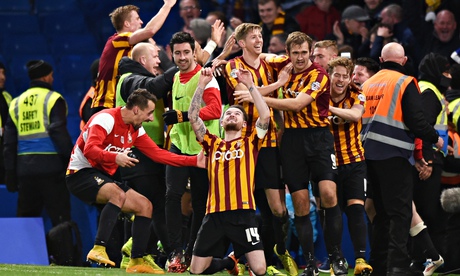
One of the defining memories of the season will remain Bradford City’s comeback victory over Chelsea at Stamford Bridge and there have been plenty of other highlights.
But grumbles about the semi-finals sharing the limelight with key Premier League fixtures, the wisdom of holding both semi-finals at Wembley and the paltry ticket allocation for fans of both sides that reach the final arguably do more harm to the competition than the latest tweak to its name.
While the logic for TV companies in spreading the early rounds from Thursday to Tuesday this season was clear, it risked undermining everything that makes third-round day – which should be one of the jewels in the football calendar – so special. Meanwhile, assuming the contract is eventually signed, the marketing men from Dubai can start pondering what they now call their pre-season Emirates Cup at the, er, Emirates.
The rest of us can look forward to the point at which modern football eats itself as being the moment at which it persuades a team to not only grant it stadium-naming rights but change the name of a club a la Red Bull Salzburg and RB Leipzig. Emirates United away to Arsenal at the Emirates in the Emirates FA Cup anyone?