The FA Cup final is an emotional day, Arsène Wenger confided in the Wembley programme. “The best way to keep calm is to focus on your game, keep your priorities right. You want to turn up and be at your best, which is why you prepare well. On the day you just want the players to focus on their performance.”
Wise words doubtless, yet even Wenger has no control over Arsenal’s former players. Paul Merson popped up on the big screen before kick-off with the news he felt sorry for Aston Villa should they concede an early goal, whereas the longer the game continued scoreless the more he would be worried about Arsenal’s chances. “Let’s hope there is an early goal,” he concluded, reasonably enough from where he was standing. “And let’s hope it’s not one of those games where the other team stick 10 men behind the ball.”
It was probably as well the players were not party to those points of view since Merson’s words might have put undue pressure on Arsenal and provided some extra motivation for Villa, who in all fairness have moved on a bit from the old ultra-caution under Paul Lambert. Tim Sherwood’s team play football and are capable of scoring goals – even Martin Keown accepted as much when it was his turn. “There could be an upset here, Villa will pack a punch,” Keown said, presumably in the spirit of fairness and neutrality. “Arsène Wenger will be calm in the dressing-room, that’s his strength, but once out on the pitch the team will need to be into the action much quicker than they have been doing. If they do that they can take the game away from Villa.”
Wenger did not turn up on the screen to emphasise the need for a quick start and an early goal, but selecting Theo Walcott up front instead of Olivier Giroud might have amounted to the same thing. When the game started Arsenal almost made a breakthrough in the opening minute, Walcott nearly seizing on a mistake by Jores Okore near halfway, but that, like the inevitable foul by Alan Hutton on Alexis Sánchez that followed it, was merely Villa’s way of feeling their way into the game.
Once the game settled down you could tell Arsenal were trying to force the pace because they won three corners in the first 10 minutes. From the third, which ended up back near the flag, Santi Cazorla tricked Christian Benteke with such insolent ease that the striker felt compelled to bring him down, avoiding giving away an early penalty by a matter of inches. Mesut Özil wasted the free-kick with a cross that was too easily cleared, and though Laurent Koscielny did test Shay Given’s reflexes with a header from the six-yard line 15 minutes came up on the clock without the early goal Arsenal were looking for. One would imagine the 20th minute still counts as early in Merson’s book but when a chance fell to Aaron Ramsey at that stage of the game he put it over. Cazorla helped create another opening in the 24th minute, still early-ish, only for Walcott to find Kieran Richardson in the way of his shot. Then the half-hour came up, and according to the Merson theory Arsenal were in Plan B territory.
Arsenal still had Cazorla, the cleverest player on the pitch and the one most likely to make an effective link with Sánchez or Özil. Villa were performing a rearguard action most of the time but they did have Benteke up front, and though the striker was only sporadically in the game he won a conspicuous proportion of his aerial challenges.
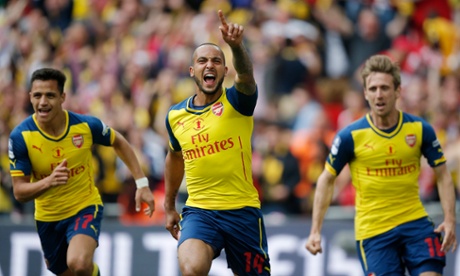
Walcott, on the other hand, was not making his presence felt through the middle and had begun to drift out to the left wing by the end of the first half, which is exactly when he produced the emphatic finish that gave his side a deserved lead.
There may be some debate over whether a goal in the 40th minute can be regarded as an early goal – some would say any time in the first hour would do – but the five minutes before half-time remains an ideal time to score. Especially to break the deadlock in a Cup final. It changes the opposing manager’s interval team talk, lifts the confidence of the side in front and above all reduces the chances of the sort of smash-and-grab raid Swansea perpetrated on Arsenal at the end of the league season.
Perhaps it is being too kind to Sherwood to assume Villa had something similar in mind. They certainly spent the first half defending doggedly enough, though looking at the Villa bench it seemed unlikely they would be able to find any matchwinners to throw on for the last 10 minutes. In terms of providing the sort of lively opposition that genuinely exciting Cup finals need, Villa were a disappointment, though the fact they spent so much time in their own half was partly due to the speed and organisation Arsenal showed whenever their opponents gained possession. It was an excellent Arsenal performance all round.
If Villa had a plan to repair, or even limit, the initial damage it never materialised. Arsenal began the second half as they had wanted to start the first, with an early goal. And what a goal it was, arguably among the finest in FA Cup final history. Walcott was involved, but only to the extent of losing possession 30 yards out. Villa let the loose ball run to Sánchez, and immediately regretted it. The Chilean’s shot was unanswerable as well as unstoppable. Villa were never going to come back from that, even before the winning margin began to widen. The rest of the final proceeded more or less as Merson had predicted, with Arsenal enjoying themselves and Villa wishing they were somewhere else.
By the final whistle most neutrals felt sorry for Villa, who looked as though they were feeling sorry for themselves. A 12th win puts Arsenal into the history books, out on their own as the most successful of FA Cup teams.
While this was perhaps not the most memorable of their finals, at least it produced a goal that will not be quickly forgotten.