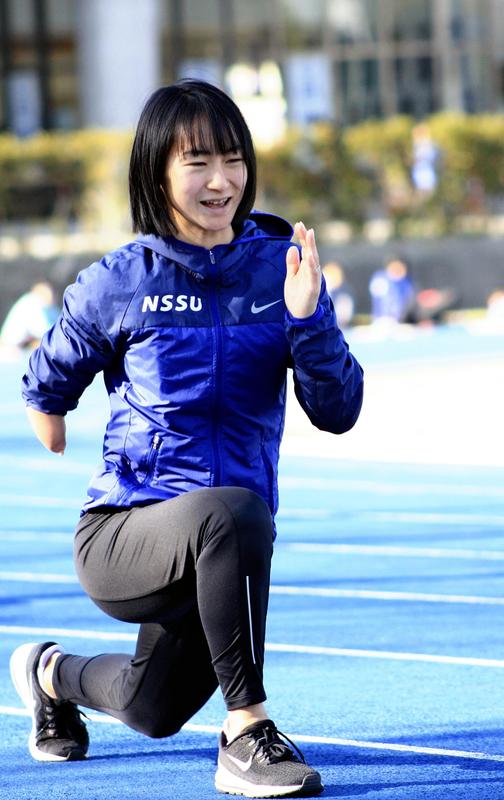
The Tokyo Paralympics will open on Aug. 25, 2020, less than 500 days from now. The Yomiuri Shimbun recently spoke with two female athletes -- Kae Kurahashi, 28, the lone woman representing Japan in the mixed-team sport of wheelchair rugby, and Sae Shigemoto (formerly Sae Tsuji), 24, who won the bronze medal in the women's 400 meters in athletics at the Rio de Janeiro Paralympics in 2016 -- to hear their feelings about the approaching competition.
World No. 2 aims higher
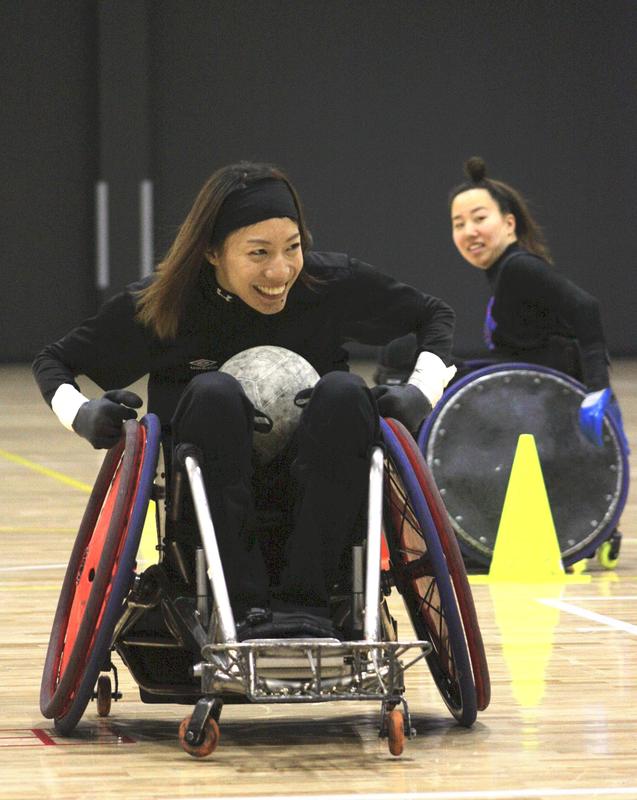
Following its victory at the world championships last year, the Japan national team also won an international wheelchair rugby event held in England this March, boosting its ranking to No. 2 in the world.
"Achieving these results before the Paralympics will give us confidence. We'll have to get stronger to make up for the fact that we'll be marked by other countries. From here on out is important," Kae Kurahashi said, girding herself for battle. Kurahashi is also a member of the Blitz wheelchair rugby team.
Wheelchair rugby involves athletes with a wide range of disability levels. The main role played on the team by Kurahashi, who is in the most seriously disabled group with damage to her cervical spine, is to prevent opponents' attacks through defense.
"To do things like block other athletes' path or force them to take even a slightly more roundabout way, I have to heighten my ability to position my wheelchair and adjust which way I'm facing. I'm not that fast, so I'm always thinking as I'm moving."
It's been two years since Kurahashi was selected for the team by head coach Kevin Orr of the United States, who took over the team after the Rio de Janeiro Games, but "I don't think I've firmly established my place [on the national team]. I always have a feeling of danger," she said.
Kurahashi is often knocked over by powerful male players from North America and Europe, but she isn't afraid. "Knocking into each other is part of the appeal of this sport. It's powerful and fun to watch," Kurahashi said with a smile.
Events promoting wheelchair rugby have increased lately, and in October, during the period of the 15-player rugby World Cup, an international competition featuring world powerhouses in wheelchair rugby will be held in Tokyo.
"This is a rare opportunity for games featuring Japan's national team to be watched in Japan. I want to enliven wheelchair rugby together with the World Cup," Kurahashi said.
Wheelchair rugby is one of the few Paralympic sports in which men and women compete together, but there are only a few registered female athletes in Japan, including Kurahashi. "I chose this sport because I wanted to move my body as much as possible," she said. "I hope more women will watch the Paralympics and think, 'I can do that too.'"
The Paralympic wheelchair rugby competition will begin on Aug. 26, 2020, the day after the opening ceremony, and the final will take place on Aug. 30, the first Sunday of the Games.
"I want to do my job and be a meaningful presence on the team," Kurahashi said. "I want to share the joy of the moment we win the gold medal on the court with my teammates."
'I mustn't limit myself'
Just over a year after she switched from able-bodied handball to Paralympic athletics, Sae Shigemoto medaled at the Rio de Janeiro Games. Yet, as she prepares for the Tokyo Paralympics, she says there were times when she wanted to quit the sport.
"I just went to Rio with the momentum of not knowing anything," said Shigemoto, who attends graduate school at Nippon Sport Science University. "As I've been building myself up over the following four years [until the Tokyo Games], feelings of 'I don't like this anymore' have bubbled up. The quality of my training would fall off, and there were times when I couldn't concentrate."
However, her desire to show herself competing on a big stage to her family and all the other people who supported and encouraged her didn't change. After Shigemoto set a new Japan record in the 400 meters in a domestic competition last July, she gained confidence, thinking, "I can do more."
"Numbers are everything [in track and field] and when things didn't go well, I felt anxiety and pressure," Shigemoto said. "But because I compete alone, I was able to squarely face my weaknesses and the things I need to improve." Now she even thinks positively about those times when she had negative feelings.
"I want to win the center of the podium at the Tokyo Paralympics," she said. "To do that, I can't train the same way as in the past, and I musn't set limits on myself."
In mid-February this year, Shigemoto traveled to the United States, where she trained together with able-bodied young athletes for about a month. She did more training that built up her basic endurance so she won't drop her pace in the latter half of races, and also worked on correcting her form.
"I believe that the accumulation of each day's training will lead to the final result," Shigemoto said. "This season my goal is to set a new personal best at the world championships in autumn, and reach the 57-second range."
As the Tokyo Paralympics approach, Shigemoto feels that Japanese society is changing little by little, actively seeking to embrace people with disabilities.
"Kids see me on the train and say, 'That person doesn't have an arm.' I prefer a society where parents don't say to that straightforward reaction: 'You musn't say things like that. You musn't look,' but instead say, 'There's a variety of people in the world' and [positively] explain our differences," Shigemoto said.
Shigemoto believes that the Paralympics are an opportunity for people to gain a more up-close understanding of the existence of people with disabilities.
Read more from The Japan News at https://japannews.yomiuri.co.jp/