A stunning photo of a bubble of gas that resembles a butterfly has been taken by the European Southern Observatory’s (ESO) Very Large Telescope.
The bubble – known as NGC 2899 – has never before been captured in such detail.
The gas spans as much as two light years from its centre, which is approximately 11.76 trillion miles, and can reach temperatures of up to ten thousand degrees. This is what gives the bubble its glow.
These high temperatures are caused by radiation from the nebula’s parent star, the ESO says. That causes the hydrogen gas to glow red around the oxygen gas, which glows blue.
The space butterfly is located between 3000 and 6500 light-years away, in the Southern constellation of Vela – otherwise known as The Sails. It has two central stars, which is what gives it its striking, near-symmetrical shape.
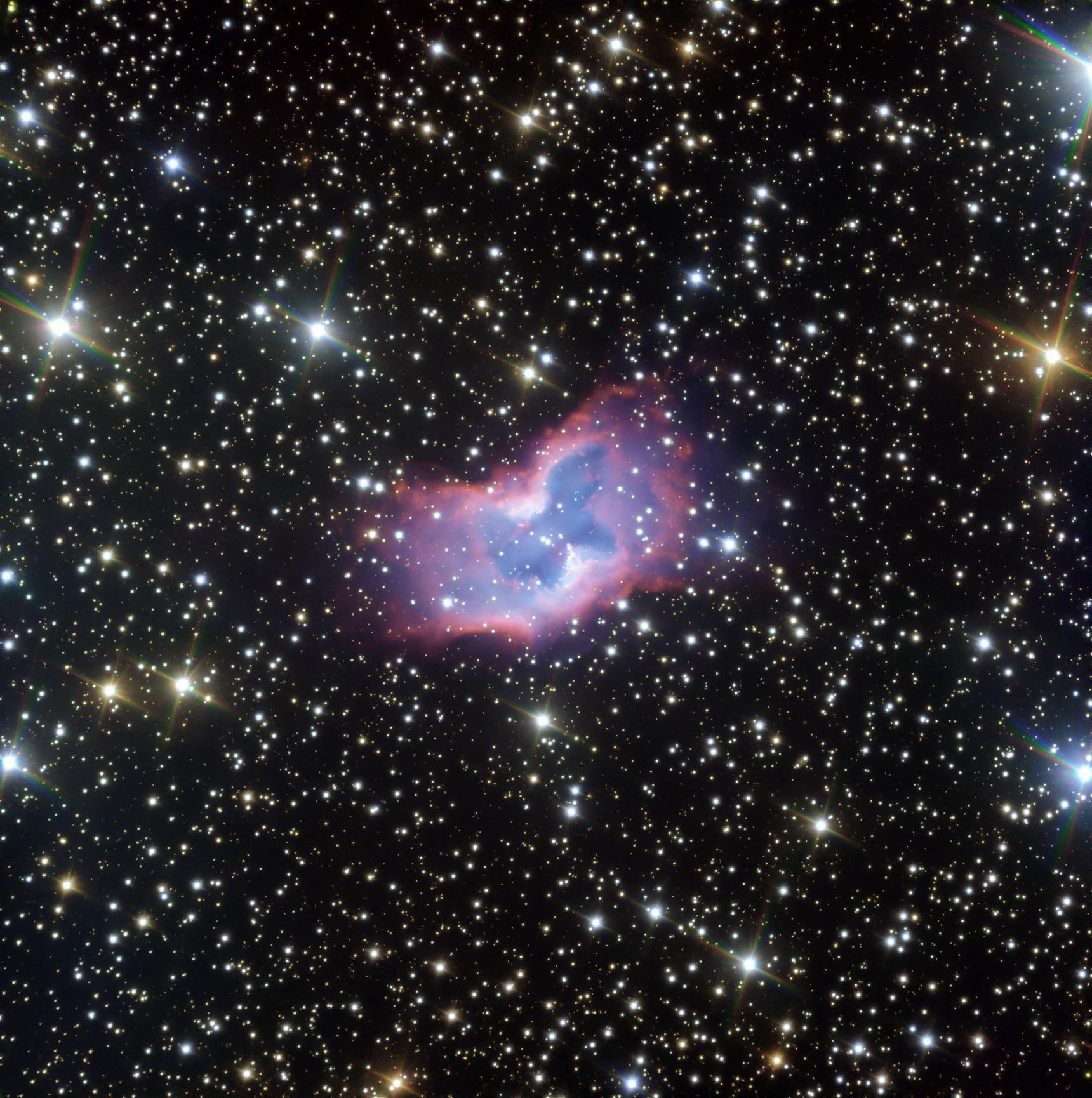
Only around 10 to 20 percent of all nebulae have this kind of bipolar shape.
Planetary nebulae are formed when ancient stars, which can have mass six times greater than The Sun, collapse and expel vast quantities of gas.
Ultraviolet radiation causes this gas to shine brightly until they are dispersed through space. On the cosmic timescale, these events happen very quickly.
This phenomenon was captured by the Very Large Telescope (VLT) in Chile, specifically the FOcal Reducer and low dispersion Spectrograph (FORS) telescope attached to it.
The FORS is one of four telescopes that makes up the VLT and is 8.2-metres long.
Recently, astronomers also spotted another beautiful, unique event: a blast of ultraviolet light following the explosion of a white dwarf.
Astronomers have only been able to see an event like that once before, but hope that it will be able to reveal the secrets of the universe, including how our own planet formed around its iron core, as well as the effects of dark energy.
Dark energy is a mysterious force that seems to have made the expansion rate of our universe increase, rather than slow down.
This energy comprises 70 percent of all the energy in the universe but is still relatively unknown to scientists.