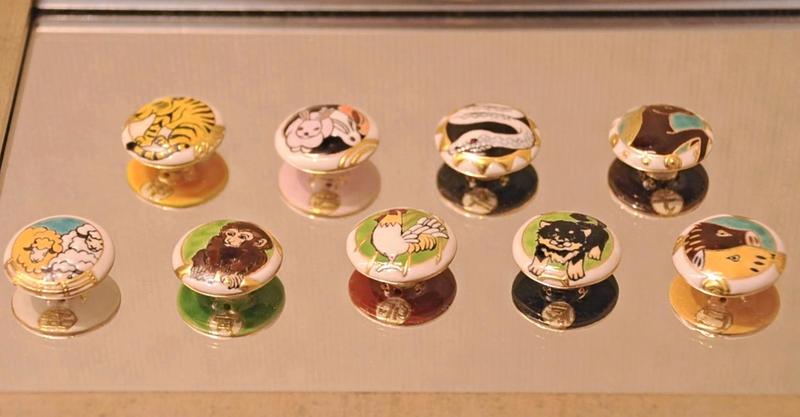
TARUMIZU, Kagoshima -- They were known as "phantom" items: small buttons just a few centimeters wide with magnificent, colorful paintings of flowers, birds and other motifs from nature. Known as Satsuma buttons, they became popular overseas beginning in the Meiji era (1868-1912), but were rarely for sale in the domestic market.
That's changed since Shiho Murota of Tarumizu, Kagoshima Prefecture, revived the buttons more than 10 years ago. Her meticulous craftwork has become so popular, she now receives orders from overseas.
Satsuma refers to the historical domain that roughly corresponds to today's Kagoshima Prefecture. The buttons are said to have been created from local Satsuma ware ceramics, as an export mainly to Europe to help the region earn foreign currency. Known simply as Satsuma, the buttons became popular overseas amid the Japonism craze for Japanese art at that time.
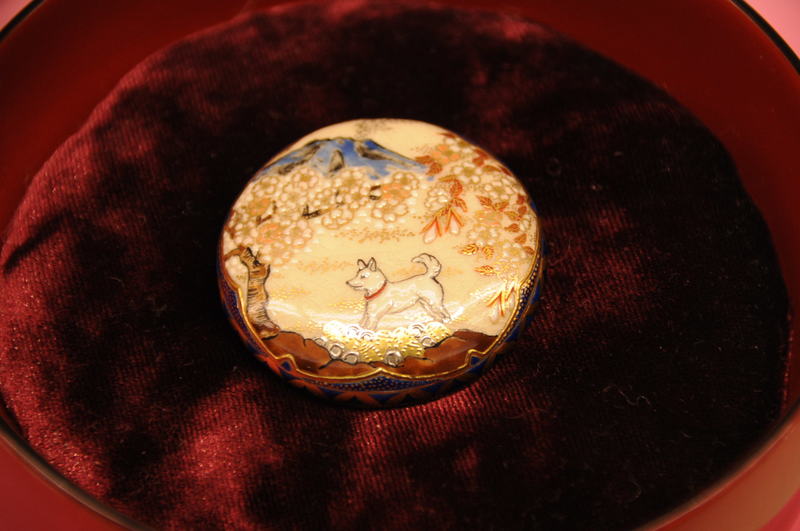
They were little-known in Japan, however, and eventually all the producers disappeared.
Murota, now 42, learned about Satsuma buttons around 2003. She was working as a ceramics painter at a local pottery for so-called white Satsuma ware, which was originally produced for the local lord and upper-class society, and a picture in a magazine happened to catch her eye.
She looked into the subject, which eventually led her to visit a museum in Tokyo that owns numerous Satsuma buttons.
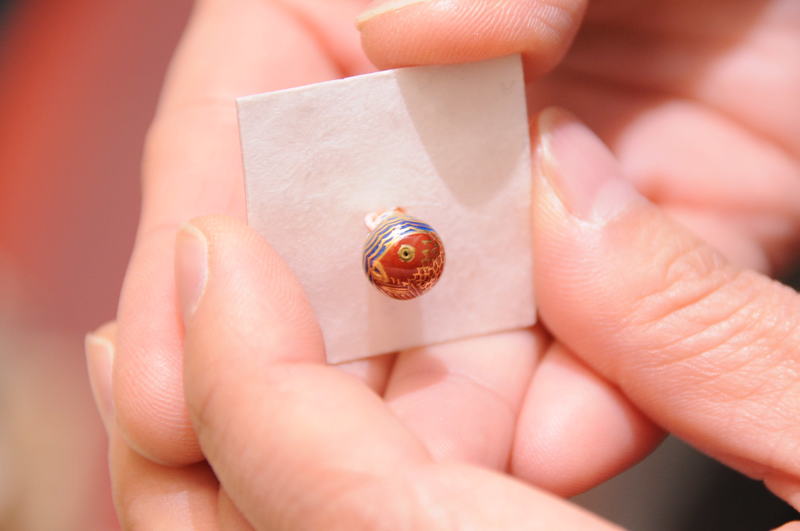
At the museum, Murota found small buttons with pictures illustrating people's lives in those days, such as seasonal landscapes and how children dressed. She was fascinated by their unique designs, which reminded her of ukiyo-e paintings. "I felt the universe in those small buttons," she recalled.
This made Murota want to bring the buttons back, and she eventually quit pottery in 2005. She set up her own atelier in a vacant house in Tarumizu to start her efforts to create Satsuma buttons.
Even though she had worked as a painter for white Satsuma ware, Murota found it difficult to draw a picture on a small "canvas" measuring just 2 to 5 centimeters in diameter, a task that required her to focus all her attention on the 1-millimeter-wide tip of a brush. "The more challenging a task is, the more passionate I get," Murota said.
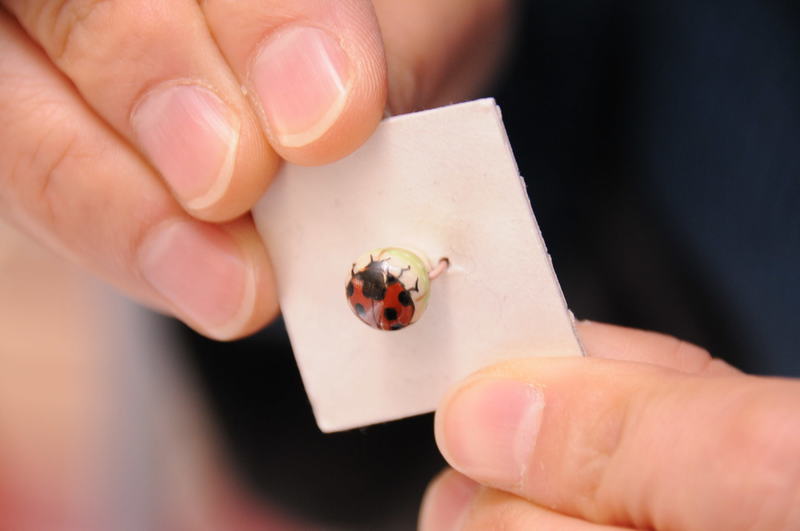
She devoted herself to practicing over and over, suffering chronically stiff shoulders and eyestrain. It ultimately took three years for her to become confident in her work.
In 2007, Murota held her first solo exhibition in Kagoshima city, where she received a much bigger response than she expected, as it was the first opportunity for most visitors to see Satsuma buttons.
The artist later took part in a U.S. exhibition on unique buttons around the world, which brought in a surge of overseas orders.
When making Satsuma buttons, Murota first draws sketches and applies color. She then fires the items in an electric kiln and applies additional color before putting them back in the kiln. It takes two to three weeks to make the buttons, making mass production impossible. Murota now makes 30 to 50 Satsuma buttons on order per month, spending plenty of time on each item.
Satsuma buttons again won the hearts of Europeans when Murota took part in an event in Paris in October last year.
While respecting tradition, the artist is also interested in taking up new challenges. At an exhibition held in December in Kirishima in the prefecture, she presented 2-centimeter-wide buttons with cute designs inspired by the animals from the 12-year Chinese zodiac calendar.
Murota said she tries to include aspects of "today" in her buttons. "[Items featuring] current trends will become antiques 100 or 150 years in the future," she said. "That's why I want to depict contemporary themes."
Read more from The Japan News at https://japannews.yomiuri.co.jp/