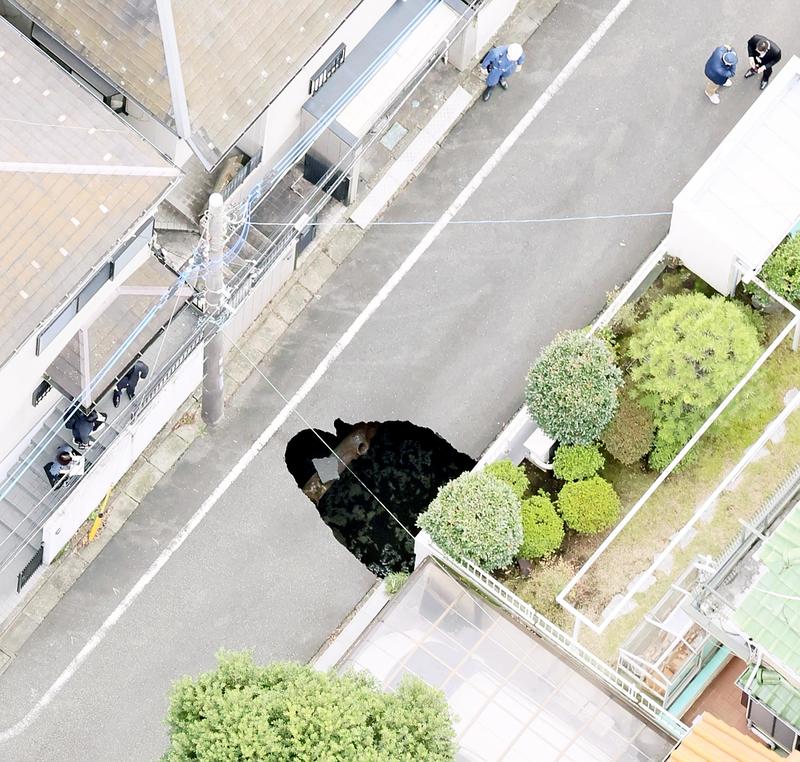
The construction of a deep tunnel "can be viewed as a cause" relating to an Oct. 18 cave-in that occurred at a municipal road in a residential area in Chofu, Tokyo, according to an interim report released by an expert panel from East Nippon Expressway Co. (NEXCO East).
Saying that "there is no option but to admit the causal relationship," NEXCO East announced it would move forward with procedures on how to issue compensation to residents based on the extent of house damage incurred.
The hole resulting from the Oct. 18 cave-in was over 5 meters long and about 3 meters wide. In the investigations that followed, an additional two cavities of about 30 meters in length were also discovered near the cave-in site.
Tunnel drilling work for the Tokyo Gaikando Expressway was conducted at a depth of 47 meters near the cave-in site about a month before the collapse occurred. NEXCO East., which had undertaken the project with other firms, set up the panel to investigate the cause of the cave-in.
According to the report, seeing that a boring survey had been conducted near the locations of both the cave-in and the cavities, it was determined that work relating to the tunnel's construction was a highly probable cause behind the cave-in.
The soil horizon around the scene of the cave-in consists of a soft clay layer above continuous firm layer containing gravel and coarse sand. As the drilling was conducted in the firm layer, the project's excavation machinery required frequent pausing of operations. The report indicated that the force generated by the machinery each time operations were resumed repeatedly sent vibrations through the layer of clay, thus potentially resulting in a softening of the ground.
The expert panel will continue the study in order to find the cause of the cave-in and compile a final report incorporating measures to prevent a repetition of a cave-in before the current fiscal year ends next March. NEXCO East said all work on the Tokyo Gaikando will be fully suspended until then.
The Gaikando is an outer-ring expressway running through areas located about 15 km from central Tokyo. The about 16 km-section linking the Kanetsu Expressway and the Tomei Expressway will comprise of two tunnels (one inbound and one outbound) and will be built at a depth of about 40 meters below ground. The application of the law on deep underground utilization was approved for the tunnel's construction in 2014. The construction of the section where the cave-in occurred was undertaken by a joint venture, including Kajima Corp.
According to the Land, Infrastructure, Transport and Tourism Ministry, other projects to which the law's application has been approved are the construction of water pipes in Kobe City (already completed), a section of the Linear Chuo Shinkansen undertaken by Central Japan Railway Co. (JR Tokai) and facilities to discharge water underground in the Neyagawa river basin in Osaka Prefecture. Drilling for the latter two projects has yet to start.
The law was enforced in April 2001 to utilize deep underground areas in urban settings, where lifeline infrastructure such as gas pipes and railways converge. The three major urban areas of Tokyo, Osaka and Nagoya are subject to the law's application. Deep ground is defined as ground at a depth of 40 meters and more below ground. In carrying out projects with high public interest, the law stipulated it is unnecessary to obtain permission from landowners and pay compensation to them.
Read more from The Japan News at https://japannews.yomiuri.co.jp/