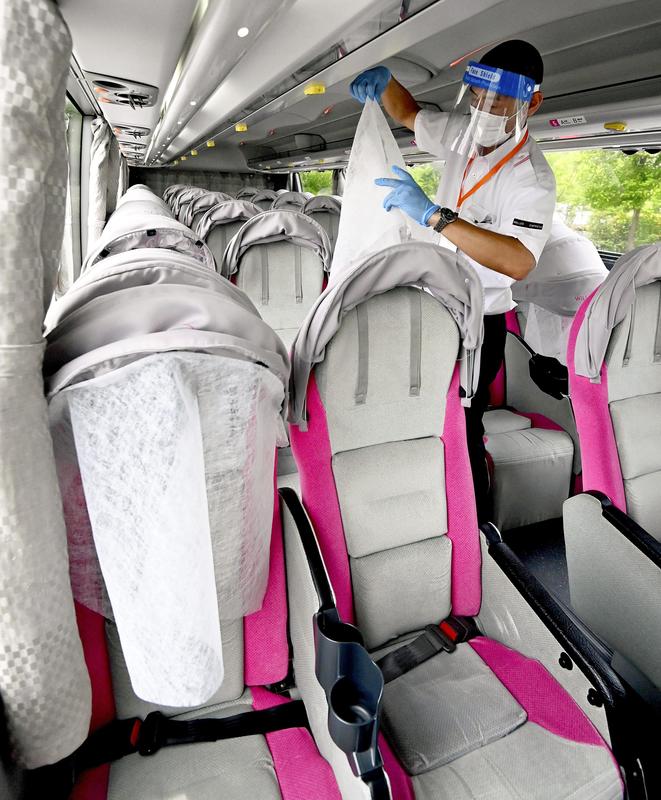
From installing curtains to putting hoods on seats to cover the upper body of passengers, expressway bus companies, which have been hit hard by the coronavirus pandemic, are stepping up ways they can help curb the spread of the virus.
Since the government request to refrain from inter-prefectural travel was lifted on June 19, people began traveling long distances again. This, in turn, has led to high expectations there will be a resurgence of express buses being used as it is a great means of travel for people on a budget.
--Aisle seats kept vacant
Willer Express, a Tokyo-based expressway bus company connecting Tokyo with Tohoku and Kyushu regions, started using the hoods to block droplets in the air on June 1.
The company originally introduced the hoods for female passengers who did not want their sleeping faces to be seen by others. To block droplets, each hood has had a nonwoven fabric attached, which is 50 centimeters long and one meter wide and hangs from the hood like a curtain. This makes the hood able to cover not only the face, but also the upper body of each passenger. The company frequently changes the fabrics for sanitation.
From April 4, even before the government declared a state of emergency, Willer Express suspended about 300 services on 20 routes. In response to the lifting of the declaration, the company resumed operations on some routes on June 1, keeping the seats on the aisle sides vacant for the time being.
The number of passengers using their services remain at about 30% of what it used to be before the outbreak.
"I believe if we take proper measures, customers will come back," said bus driver-conductor Shinichi Uchimura, 31.
--Fixed windows
About 103.5 million people used express buses nationwide in fiscal 2017, but the pandemic caused a sharp drop. From the end of April to the end of May, daily departures and arrivals at Shinjuku Expressway Bus Terminal, Japan's largest bus terminal, plunged by more than 80% from the previous year to about 200.
On June 19, when the government request not to travel between prefectures was lifted, the number of services on the route recovered to about 700, or about 45% of what it was.
However, problems remain with expressway buses; windows cannot be opened on most buses for safety reasons, and the journey time tends to be long. In January, a tour guide and others were infected with the virus on a sightseeing bus carrying Chinese tourists. The news tainted the image of bus operators.
Therefore, the companies are putting forth extra efforts, such as taking temperature readings before people can board and reducing seats that are available.
Companies that cannot afford to reduce available seats are trying to improve their facilities, instead.
Its low cost is a selling point of O.T.B., an expressway bus company in Tokyo that operates services on various routes from the Tohoku region in the north to the Chugoku and Shikoku regions. The company offers a journey between Tokyo and Aomori for about 3,500 yen.
The company decided to not take any measures to reduce available seating, instead installing curtains between all the seats and offering an alcohol disinfectant at the entrance. The company also uses air conditioners to constantly ventilate the bus.
"We can't reduce our seats and still maintain our fare," an official at the company said. "We have no choice but to do what we can."
--Measures for drivers
Unlike trains and airplanes, bus drivers share the same space with passengers, so it is also important to prevent infection among them as well.
In its guidelines on how to deal with the virus, the Japan Bus Association, an industry group of bus drivers, includes measures to maintain distance between the drivers and passengers as much as possible and to check the drivers' temperature in the morning and evening. Each member company has the driver's seat aboard each bus surrounded by a vinyl sheet and leaves the seat directly behind the driver vacant.
Yoshinobu Henmi, 20 and a second-year university student in Sendai, often used to return to his parents' home in Nagano Prefecture by highway bus before the infection spread.
He said he was thinking about using a bus after the government call for restraint on travel was lifted.
"I was worried because you have to spend a long time on a bus where all seats are occupied," he said. "But the bus companies are taking various measures, so I feel safer. There's no need to be overly afraid. I want to use the bus again."
--3-minute ventilation
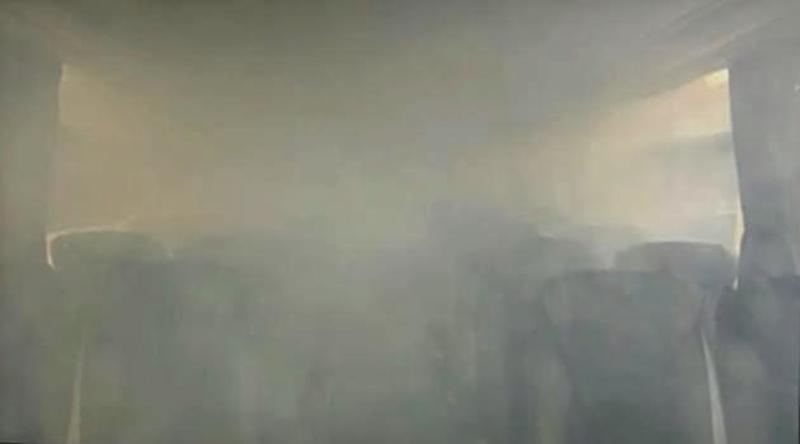
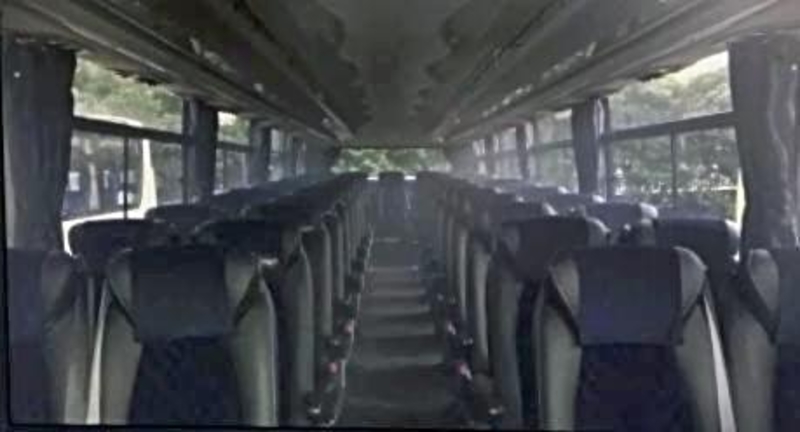
The Land, Infrastructure, Transport and Tourism Ministry appealed the safety of buses by demonstrating how quickly a bus can be ventilated, with a bus artificially filled with white smoke.
On June 19, two tourist bus companies and a vehicle manufacturer conducted the ventilation test at the ministry.
When an air conditioner was turned on, the smoke almost completely disappeared from the bus in about three minutes.
Visitors to Japan has drastically fallen, and tourist attractions have been closed due to the pandemic. As a result, the sightseeing bus industry is facing a serious financial crisis, leading to bankruptcies and layoffs at many bus companies.
"The industry is in a difficult situation because of the widespread notion that buses are a risk because people on board stay close to each other in a closed space," said Katsuhiko Miyamoto, the president of Toto Kanko Bus. "We want to dispel that notion."
Read more from The Japan News at https://japannews.yomiuri.co.jp/