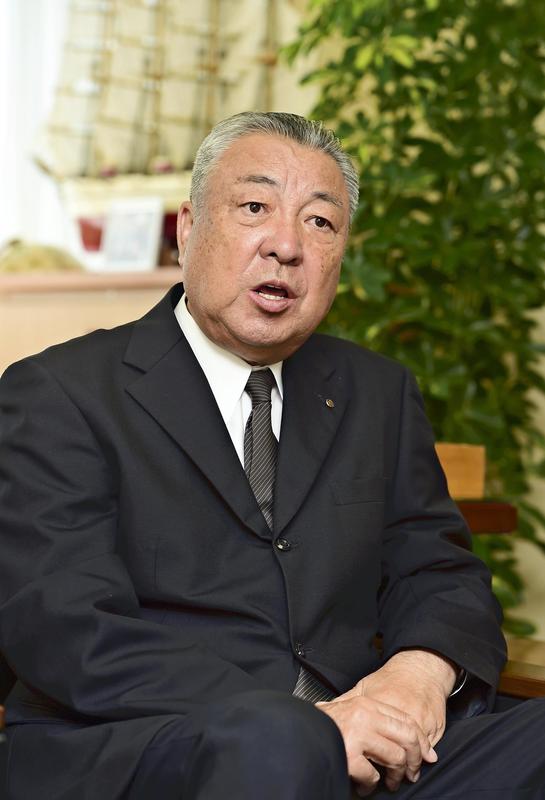
The nationwide outbreak of the new coronavirus has put tremendous downward pressure on the prices of fishery products, leading to a rethink of the business side of the seafood industry. Yomiuri Shimbun Staff Writer Yoshinori Yasui interviewed Kazuyoshi Kawasaki, president of the Hokkaido Federation of Fisheries Cooperative Associations. During the interview, Kawasaki said with emphasis that it is necessary for those engaged in fisheries businesses to adapt themselves to a changing situation, by creating a system for selling their products directly to consumers.
Kawasaki: From the latter half of February, the distribution of fishery products became stagnated, thereby starting to affect their selling prices. In particular, highly prized fishery products were affected first. Our fisheries cooperatives then refrained from production of these products in line with the declines in their distribution. Even so, prices continued falling to levels one-half or one-third of what they fetched before, essentially forcing the suspension of some catches. The fisheries business, which has a low risk of infections, was not subject to the self-restraint requests. But because the distribution network was affected, we became unable to sell our products, driving the fisheries industry of Hokkaido into a situation more difficult than we had expected.
By type of product, scallops were affected first. Their exports to China, made by way of Hong Kong, had been dwindling because of such factors as street protests in Hong Kong even before the new coronavirus outbreak began. Then came the spread of infections, pushing the scale of exports even lower. As a matter of fact, the catch of scallops, whose catch had been poor until the year before last, began to recover last year, which delighted us. But we didn't get to enjoy it long.
In the culturing of scallops, we will become unable to create fishing grounds in the years to follow unless we catch a certain amount of them every year. So even when their prices have fallen, we must continue catching them. As we have been unable to export them to China even now, the stock of scallops is rising. Sea urchins will also become old sea urchins with the passage of time, so we have to continue catching them so as not to upset their growth cycle. One measure we take is to keep them in refrigerators as processed products. But there is only so much refrigerator space at cooperative associations across the country.
(subhead) Looking 1 or 2 years ahead
At present, the coronavirus crisis has impacted the whole range of seafood, including flounders. Will these trends eventually subside one year or two years ahead? I believe we should assess the situation considering such a span of time. I believe that rather than hastily making conclusions, we should look at how things would develop, while at the same time looking at the course of actions to be taken by the central government, the prefectural government of Hokkaido, and those of cities, towns and villages. Nevertheless, it's inevitable that fishermen's incomes will decline and they can't stay afloat over the next one or two years if they continue employing conventional methods.
If they are handling the types of products for which we can adjust the output, we will do so. But for seasonal fish or shellfish, which we have to catch now or never, and which would go bad unless they are caught now, we have to catch them. The important thing is to figure out we should do both when the situation is not yet under control and when the situation is in the process of being resolved. Rather than merely holding back our production, we also have to make efforts to put our products in storage, while continuing production, and to explore new marketing channels and different methods.
(subhead) Direct sales, online channels
Until this crisis, delicious foods in season would be filling restaurants and supermarkets, having entrusted wholesalers and other middlemen with the sales, some of whom would even advertise our products for us. But as long as sales at restaurants are recovering less than we expected, we have to work out ways of retailing and distributing our products so they can be consumed at home. I believe that from now on, it will become ever more necessary to sell our products in such a way that those engaged in the fisheries business can immediately meet the needs of general consumers.
As a matter of fact, such efforts have already been started in each district. For example, those engaged in fisheries themselves can prepare a refrigerator van and sell directly to consumers, while having the delivery expenses shouldered by local fisheries cooperative associations and local governments. They can also find ways to tap the internet to build sales channels. We, the Hokkaido federation and our local fisheries cooperative associations, would put a process in motion to support such efforts.
Among our fisheries cooperative associations in Hokkaido, there has been such a case in which an association closed its direct-sales store during the stay-at-home period and instead operated only an online store. Its sales skyrocketed. Thanks to orders mainly from mainland Honshu, I heard that there were incessant calls for orders over one week at their online store. Because the department stores and restaurants were closed, people who were refraining from going out apparently thought "why not eat delicious things at home?"
(subhead) Dividing tasks at local associations
Those engaged in the fisheries business have to consider all the methods of catching seafood, how to sell these products and how to keep them in cold storage and so forth, in ways that can be understood by as many people as possible. For the primary industry, the days to come are at a crucial juncture.
Even at the Hokkaido federation, our modus operandi has undergone changes. Previously, we would hold a meeting for whatever we did, spending a lot of labor and time. But we have decided that what we can do via teleconferencing, we will do so from now on. But when it comes to those cases in which a full-fledged discussion is needed, then we will ask them to come together.
It is also necessary to work out measures that will not spur depopulation of a fishing community. A fisheries cooperative association is, in a sense, a trading house for a local community, and is engaged in various kinds of businesses. Also, in order to protect local stores and the like, it's necessary for the association to outsource a certain amount of business to private companies in the future. All of us have to have the feeling that we will build our towns together, without impoverishing them. Even if it is a town with a population of a few thousand, I think there will be only a small decline in population after crossing a certain threshold, as long as there are worthwhile jobs there. As the primary industry is firmly rooted, town-building that centers around this industry will prove effective.
Profile: Kazuyoshi Kawasaki is from Akkeshi, eastern Hokkaido. Since 1996, he has been president of the Akkeshi Fisheries Cooperative Association, president of the Hokkaido Federation of Fisheries Cooperative Associations since 2013 and vice president of JF Zengyoren, a nationwide federation of Japan fisheries cooperatives since 2016.
Read more from The Japan News at https://japannews.yomiuri.co.jp/