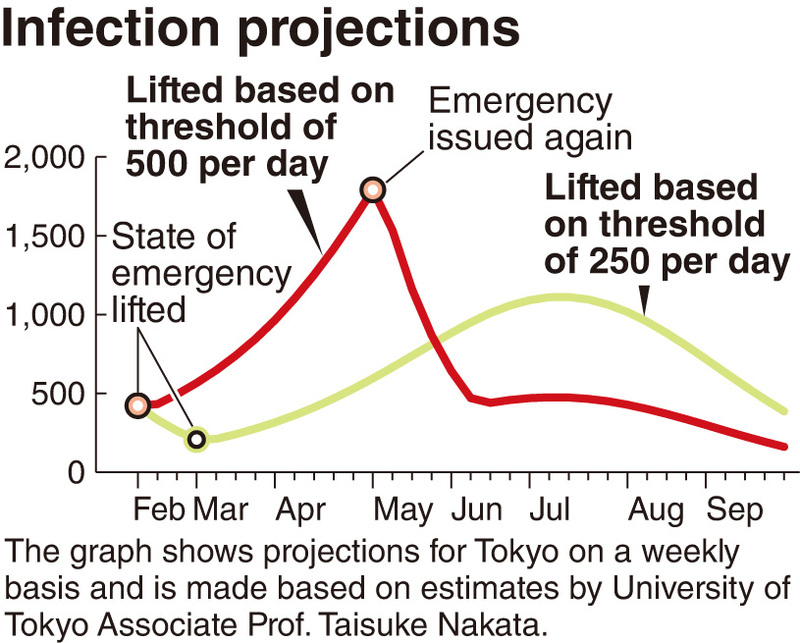
One of the government's criteria for lifting the state of emergency in Tokyo is a threshold of no more than 500 new daily coronavirus cases, but experts have argued that unless the figure is lower, the number of infections would rebound soon after the state of emergency was lifted, resulting in huge economic losses.
The target has already been met in Tokyo, with less than 500 new daily cases recorded for five consecutive days through Thursday.
The government's criteria for lifting the state of emergency are based on improvements in six indicators, including a change in alert level for new infections and hospital bed occupancy from the most severe Stage 4 to Stage 3.
However, according to projections by Taisuke Nakata, a University of Tokyo associate professor, and Daisuke Fujii, a project lecturer at the university, who provide materials to a government subcommittee and other entities, if the state of emergency was lifted in mid-February based on the threshold of 500 daily cases, the rate of infections would immediately rebound and exceed 1,000 in early April.
On the other hand, if the threshold was set at 250, the state of emergency would probably not be lifted until early March.
The rate of increase in new cases is projected to be slow following the lifting of the emergency, partly due to the effect of the vaccination program, which is expected to begin in mid-February for medical workers.
Based on their estimations, daily cases would reach 1,000 again in mid-June if the threshold was set at 250. The economic impact would also be expected to be less severe than under the threshold of 500.
If the criteria for lifting the state of emergency is stricter, the rate of increase is projected to be slower.
If the threshold was set at an average of 100 new cases per day, the emergency would be lifted in early April, and the number of new cases would not exceed 500 for another four months, according to their projections.
"The longer the state of emergency is, the greater the economic losses would be. But if the number of new infections does not fall sufficiently, there is a higher possibility that a state of emergency would be reissued," Nakata said.
The Tokyo metropolitan government has set its own goal of reducing the average weekly number of new infections in the capital to 140 or lower in early March when the central government is scheduled to end the state of emergency.
The metropolitan government said this goal can be achieved if the average daily number of new infections remains below 70% of the previous week's level.
"We aim to keep the weekly average below 70% and reduce the number of people coming to work by 70%. We will continue to carry out measures against infection based on these targets," Tokyo Gov. Yuriko Koike said at a metropolitan government meeting on Wednesday.
However, some medical professionals are also calling for even stricter targets.
"The [daily] number of new infections should be reduced to less than 100 in early March," said Masataka Inokuchi, a vice president of the Tokyo Medical Association. "If we can lower and then keep new infection cases in double digits, there will be more leeway in the health care system, allowing us to prepare the vaccination program."
Read more from The Japan News at https://japannews.yomiuri.co.jp/