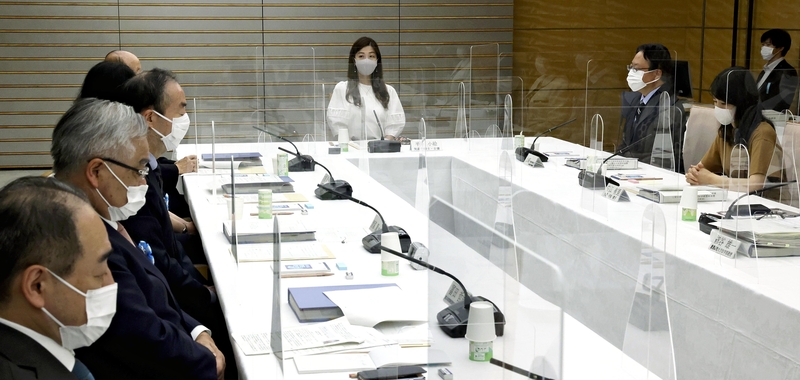
The government will report to the Diet as early as July a summary of discussions by an advisory panel that was convened to explore measures to ensure stable Imperial succession.
The panel, which held its fifth and final session on Monday, has been listening to the opinions of a wide range of experts on issues including female-line emperors.
In the report to the Diet, the government intends to summarize the major points expressed in the sessions, rather than providing clear directions for further discussions, in order to prevent the issue from becoming a point of contention in the next House of Representatives election.
On Monday, the panel heard opinions from four experts, including writer Risa Wataya, who said the issue of female-line emperors "needs to be cautiously dealt with from the perspective of attaching importance to tradition."
The panel held its first meeting in March this year. From April 8, it started listening to the opinions of 21 experts in such fields as history and legislation. According to a senior government official, emphasis was placed on ensuring that the opinions reflected the views of the general public, and the line-up was characterized by the relatively high proportion of young and female experts -- eight women were involved.
The experts were split on the issue of female-line emperors. Under the Imperial House Law, only male descendants in the male line of Imperial lineage can succeed to the Imperial throne. In the sessions, many experts voiced opinions in favor of female emperors, who have reigned in the past. However, opinions were split over female-line emperors, which suggests opinions are also likely to be divided among the general public.
The experts in favor of female-line emperors also said that public understanding is a prerequisite to realize female-line emperors.
An expert against female-line emperors proposed making it possible to restore men in the male line of the Imperial family who lost their Imperial status after World War II, in order to maintain male-line succession.
Opinions were also split on the matter of female Imperial branches to allow female members of the Imperial family to keep their status after marriage, with those against arguing that it "could lead to future female and female-line emperors."
A supplementary resolution to the special measures law enforced in 2017 to realize the abdication of the Emperor in the Heisei era (1989-2019) called on the government to consider as soon as possible such issues as measures to ensure stable succession to the Imperial throne and report them to the Diet. However, discussions have been delayed due to the novel coronavirus pandemic, among other reasons.
The panel will start compiling its findings from June 16. The government plans to submit a report to the Diet before the lower house election, which will be held by autumn.
According to a source, the government wants to avoid the report being submitted under circumstances in which ruling and opposition parties are battling to win an election. The government is likely to submit only a summary of discussions, aiming to hold full-fledged discussions after the lower house election.
Read more from The Japan News at https://japannews.yomiuri.co.jp/