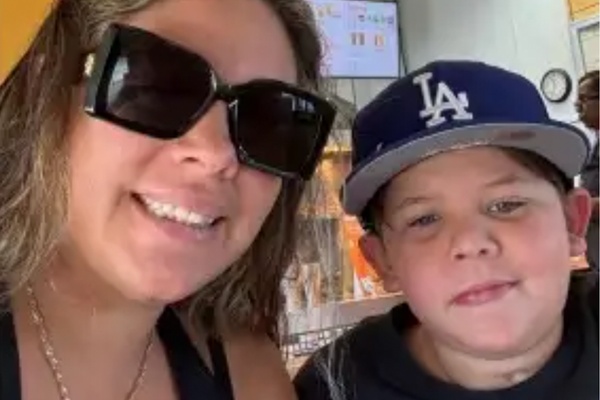
ST. LOUIS_JaKeem Jones, 6, asks his grandmother if he can go see his mother whenever they pass the Washington University School of Medicine in the Central West End.
For the youngster, it's easier to comprehend that she is there, or at any hospital they pass, working as a nurse than it is for him to understand that she has died.
JaKeem's mother, Whitney Brown, 24, and a friend, Devon Fletcher, 28, were fatally shot in front of him in the city on the city's north side in August 2015. Police said at the time that someone in a pickup fired shots at a group of people, and Fletcher and Brown were hit.
Ever since, Erica Jones has been raising her grandson and hoping that sharing her story will somehow help stop the violence.
On Tuesday, Jones of Florissant in the St. Louis area, spoke with reporters during Washington University's annual conference, "Gun Violence: A Public Health Crisis."
The issue of gun deaths became personal for Washington University Chancellor Mark Wrighton when Chelsea Harris, 16, a St. Louis high school student his wife mentored for 10 years, was shot to death in 2014.
This year's event focused on keeping children safe from firearms and the societal and economic impact on children of firearm deaths and injuries.
Dr. Martin Keller, a trauma surgeon at St. Louis Children's Hospital, was among the speakers during the four-hour event.
During his 20-year medical career _ eight years of which were spent at Cardinal Glennon Children's Medical Center and 10 at St. Louis Children's Hospital _ Keller has operated on countless victims of gun violence.
"Some would like to think that it's just bad kids involved in bad circumstances, but a third of all of these victims are just kids being kids, finding a gun and playing with it," Keller said. "This goes beyond just sewing up holes, there are a lot of diseases we take care of on the prevention side, and we need to do a better job at preventing gun violence."
Keller admits it can be frustrating for him at times to discuss a child's injuries with the parents or guardians whose gun caused the injuries he has to treat, so he has turned that frustration into research on prevention.
Keller said one way he believes doctors can help would be to ask, "Is there a gun in your home?" during annual checkups. Then, doctors can connect gun owners with resources on gun safety just like they connect families to resources to prevent diseases or other injuries based on the answers they give during checkups.
"If I ask that question now, I could lose my license," Keller said.
He also believes safety training and technology could help curtail the amount of firearm deaths and injuries coming into his operating room.
From 2002-2015, St. Louis Children's Hospital cared for 916 children injured or killed with firearms; 35 percent were younger than 15.
"There ought to be a way to make guns safer without infringing on anyone's rights," he said.
Prevention of gun-related injuries also has an economic impact, which Ted Miller of the Pacific Institute for Research and Evaluation, covered in his presentation.
He said firearm incidents cost society 1.75 times what deaths and injuries from alcohol-impaired driving cost. He added that drunken-driving incidents have decreased through education, enforcement, laws and other factors.
Children's Hospital spent $76 million treating gunshot wounds during 2014 and 2015.
Jones remains haunted by her daughter's death. At the time, Brown had just moved into a new apartment in Ferguson and bought a new car. She was going to nursing school while working at Walmart and Federal Express.
"I still have her stethoscope," Jones said.
The night of Brown's murder, Jones said her daughter had gone just after midnight to a friend's home in the Walnut Park West neighborhood _ a place she rarely ventured _ to get money he offered her to buy school supplies for her son.
JaKeem was inside a car when the shots rang out.
"He saw everything," Jones said, adding that she and her grandson receive therapy.
Jones said she hopes to one day go out into the streets and ask the typically young men who carry guns what she and other mothers grieving for their children can do to persuade them to disarm.
Right now, she said she's focused on making sure her grandson never becomes one of them. He's already showing signs of loving math and science, like his mother did. That's why Jones hopes someday he might visit a hospital. And wear his mother's stethoscope.
His mother's murder remains unsolved.
Lisa Eisenhauer
Assistant metro editor/nights
St. Louis Post-Dispatch
HYPERLINK "mailto:leisenhauer@post-dispatch.com"leisenhauer@post-dispatch.com
314-340-8220
Twitter: @stled