DULUTH, Minn. — Every time the phone rang, it seemed to Kristine Smoley like more bad news about her husband, who contracted COVID-19 and was in a hospital intensive care unit on a ventilator because he couldn't breathe on his own.
Smoley was prepared for the worst when a nurse from Duluth's Essentia Health called with hope — albeit with risks and no solid evidence it would save her husband.
"They asked if I wanted to consider signing off on an experimental treatment for him," Smoley said. "A treatment that had never been done before."
Essentia's Dr. Tim Rich and the University of Minnesota Medical School's Dr. David Ingbar had studied for years whether a common thyroid hormone could be repurposed for the treatment of acute respiratory distress syndrome (ARDS), an often fatal type of lung failure. The doctors received federal approval late last year to test the therapy, so when COVID-19 caused a sudden surge in ARDS, they were ready for their first patient — Smoley's husband, Bob Schlicht.
"It was scary," Smoley said. "But I don't know that I really had an option. Because the other option wasn't good."
The turnaround that followed was so remarkable that Rich and Ingbar have advanced their research — unique for a regional medical provider in a world of urban and academic COVID-19 studies — to a phase 2 U.S. Food and Drug Administration study. The doctors have optimism about the impact their treatment could have amid the pandemic.
"There has been a lot of highly technical science to understand this biology, but the elegance now is in its simplicity," said Rich, a pulmonologist. "This is not a designer drug. This is something we know the lung needs and uses."
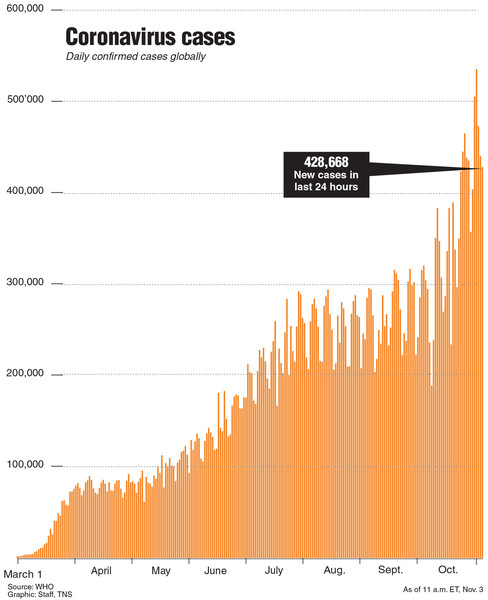
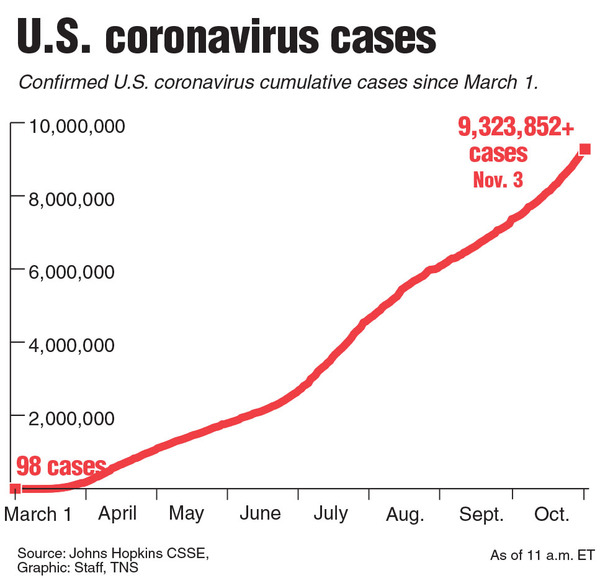
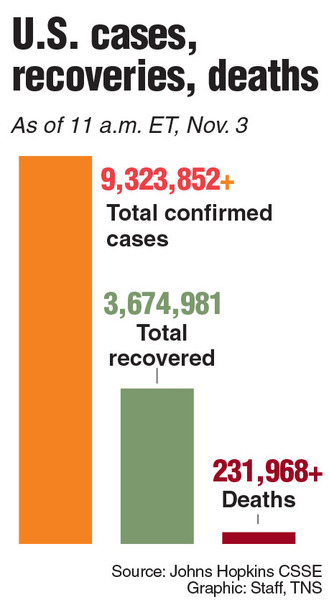
New therapies are needed against a pandemic that has caused 150,672 known infections, 10,334 hospitalizations and 2,475 deaths among Minnesotans. Only the antiviral remdesivir has received full FDA approval as a COVID-19 therapy for hospitalized patients, while treatments such as plasma infusions remain experimental and available only under emergency authorization.
Rich and Ingbar made a key discovery during the H1N1 pandemic of 2009, when families of those who died from influenza-related ARDS permitted autopsies. Rich found the victims' lungs lacked T3, a thyroid hormone that would normally be detectable.
Ingbar said T3 reduces inflammation and coaxes epithelial cells in the lungs to absorb fluids — which is vital for patients with ARDS.
"A part of this acute lung injury with ARDS is the lungs get leaky, and they tend to fill with fluid," Ingbar said. "That makes it really hard to get oxygen in or carbon dioxide out."
Schlicht was coughing and congested when Smoley dropped him at an emergency room in Grand Rapids on March 26, a few days after the retired couple cut cross-country travels short due to the spread of the novel coronavirus that causes COVID-19.
Schlicht, 68, was Itasca County's first known positive case of COVID-19. Smoley watched medical staff garbed in full protective gear take her husband to an isolated room. He was transferred to Duluth within two days.
A few weeks later, Mary Ellen Evangelista found herself in a similar situation. Her brother, Tim White, was a corrections officer at the Moose Lake prison, where inmates and workers tested positive for COVID-19 in early April.
Evangelista, who lives in Georgia, urged White to call an ambulance after he spent a week getting sicker at home. He was placed on a ventilator in Duluth late that night because the virus led to ARDS.
Doctors told Evengelista that her 51-year-old brother might not survive and asked to try the thyroid hormone.
"And every day, I just had a little more glimmer of hope," she said.
White spent more than a month in the Duluth hospital but has been back home since spring and is working to gain enough strength to return to work. Chest X-rays for months have shown healthy lungs.
"This is really a much faster recovery than we see with typical ARDS," said Ingbar, noting that many survivors have lung scarring that can cause breathing problems for years and the need for supplemental oxygen.
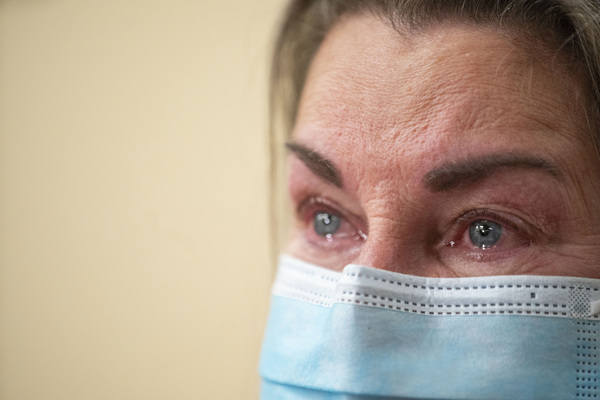
White plans to visit his family in Georgia for the holidays. Evangelista choked up discussing the trip.
"That he's going to be with us at Christmas was not a foregone conclusion back in April," she said.
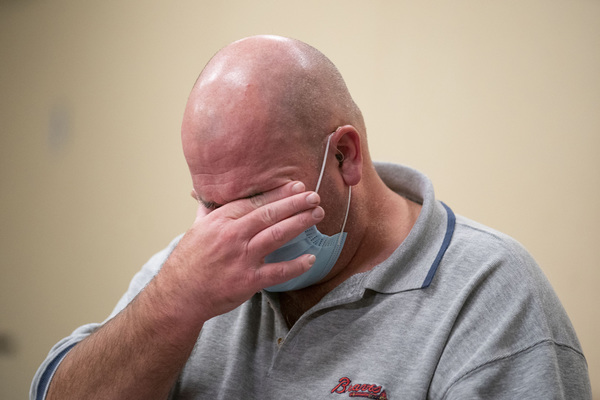
Schlicht said he feels "100% healthy" and has been helping build an event center near home for his son's upcoming wedding.
"Each visit really puts in perspective how close we were to death," he said.
While the timing of recovery and abrupt reversal of symptoms suggest that T3 worked, doctors can't rule out that the men recovered due to other medical care.
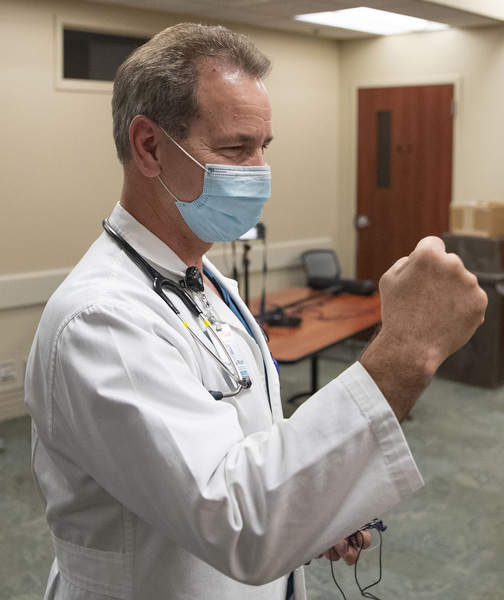
The trial was paused for months following the treatment of Schlicht and White for a safety review, but Rich and Ingbar recently received the go-ahead to give the therapy to more patients in Duluth and plan to expand to three Twin Cities-area hospitals.
The next step to prove cause and effect is to recruit 68 patients with ARDS from COVID-19 or other causes for the FDA-approved study, and to compare 50 who receive supplemental T3 with 18 who receive standard care.
ARDS stems from a variety of causes, including heat, physical trauma or inhaled substances. Research showed that any such lung injury produces more of an enzyme that breaks down T3.
"There's a real local destruction of the hormone that explains why its concentration is so low," Ingbar said.
Doctors administer the hormone directly to a patient's lungs through a breathing tube. That is a novel part of this study, as sick people have received thyroid hormones for years, but never straight into their lungs in this manner.
The U's Center for Translational Medicine is working to produce a patented powder T3 formulation. That inhaled or nebulized form would be cheaper and easier to administer, meaning more patients could receive it if it proves safe and effective.
"Our hope is actually that this therapy should work for some other illnesses in addition to ARDS," Ingbar said. He and Rich may explore administering the treatment earlier to see if it prevents patients' lungs from suffering distress.
Success of the ongoing study will be measured by whether supplemental T3 sops up enough lung fluid and allows for healthy blood oxygen levels. Rich said the overriding hope is not only survival but a return to life without chronic breathing problems and disabilities.
"Any survival of ARDS, especially this COVID ARDS, is exciting, but it's not enough to survive," Rich said. "It's to not have the morbidity of a compromised lung for the rest of your life."
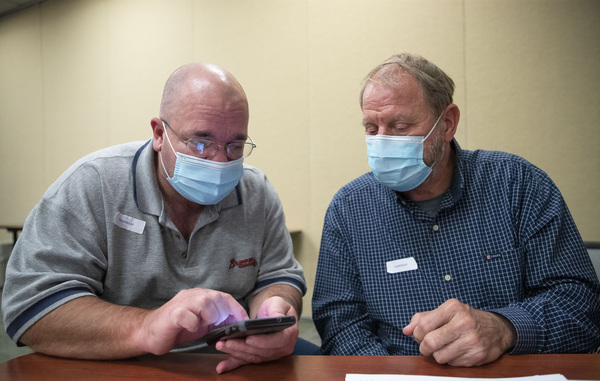
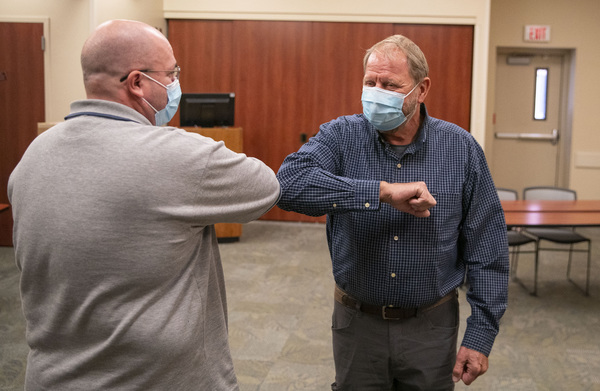
The recoveries of Schlicht and White will be featured in an upcoming medical journal. The two men, the first people in the world to receive this experimental treatment, met after White's October checkup at the hospital where they spent so many sick days. They exchanged an elbow bump.
"I'm a very lucky man," White said, "to be sitting here today."