BANGKOK -- Expatriate employees of Japanese-affiliated companies are scrambling to maintain their supply chains in Thailand, which continues to ask people to practice caution over the new coronavirus. Thailand serves as a food supply base for Japan and other Asian countries, so these workers are striving to support people's lives.
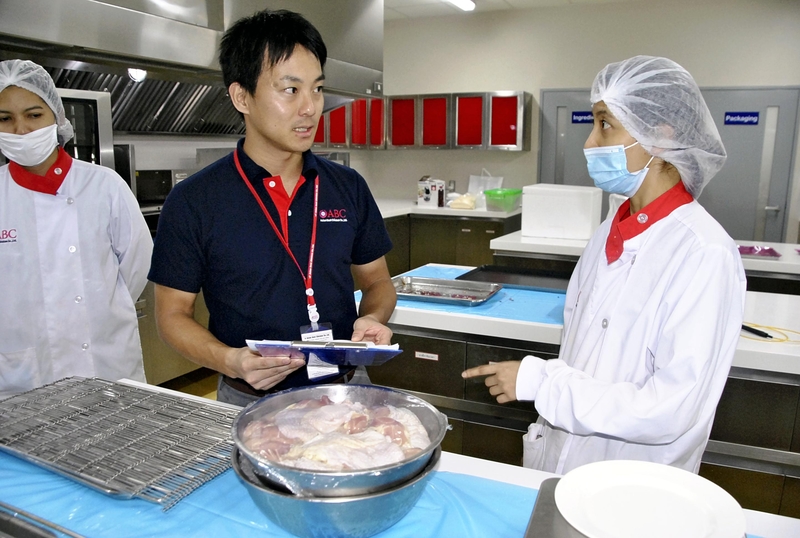
There is a brand-new building in an industrial park near Bangkok. It is a chicken processing factory of Asian Best Chicken Co. that was built last November. The plant was scheduled to start operations this spring, but its opening been delayed due to the pandemic.
The first case of infection outside China was confirmed in Thailand in January. The country declared a state of emergency in late March, and restrictions remain, including a night-time curfew.
"I've been involved since the site where the factory now stands was a vacant lot. So I feel a strong attachment [to the factory]," said Keigo Metsugi, a 31-year-old employee who has been temporarily posted by Mitsubishi Corp. to Asian Best Chicken, in which the trading house has invested.
Metsugi is making preparations to get the factory up and running as he expects the declaration to be lifted in late May.
However, many flights to and from countries with which Asian Best Chicken has business have been suspended, making it difficult for him to travel between Thailand and these countries. But Metsugi couldn't just sit around waiting, so he started communicating with people at these business partners by sending smartphone videos that showed quality control facilities and other things at the new plant.
He has given particular consideration to Japan-related businesses. According to trade statistics from the Finance Ministry, Thailand is Japan's largest importer of pre-prepared chicken items, including processed foods. Many popular steamed chicken breast products called "salad chicken" also come from Thailand.
"I want to do whatever I can to keep familiar items in stores in Japan," Metsugi said.
More than 6,000 Japan-affiliated companies have made inroads into Thailand. Hideyuki Murakami, 53, president of Kaset Phol Sugar Ltd., a sugar manufacturing company in which Mitsui & Co. has invested, has continued to search for an alternative warehouse to store sugar in, considering the risk that exports will stagnate if an infection is confirmed at the current warehouse.
Thailand is the world's second-largest sugar exporter after Brazil and meets demand from many Asian countries. If Thailand's export of sugar is suspended, the impact will be immeasurable.
"In the 30 years I have worked at a trading company, I've never felt this kind of pressure before," Murakami said.
The number of new cases has started to decline in Thailand, but the cumulative number of infections has exceeded 3,000 and more than 50 people have died.
"This situation, like walking a tightrope, will continue," Murakami said. "We have to try to prevent distribution from being halted."
Read more from The Japan News at https://japannews.yomiuri.co.jp/