Access to modern energy services still remains a luxury to many that are living at the base of the pyramid (BoP). It is estimated that some 1.4 billion people have no access to electricity, and around three billion people – 40% of the world’s population – rely on traditional fuels such as biomass and coal to meet their everyday needs.
Energy provides transformative income-generating and quality of life opportunities. These often have health benefits too, whether it is clean cooking, power for health clinics, or heating at home.
Innovative consumer products such as solar-powered systems and clean cookstoves are being offered by some of the breakthrough small and medium-sized enterprises in the Business Call to Action (BCtA) portfolio. As it was reported in ‘Breaking Through’, BCtA’s flagship report, there are successful inclusive business models that are expanding access to energy at the BoP.
Solutions in this sector often involve tackling multiple challenges that include product design and innovation, creating access to finance options, and marketing and last mile distribution.
The Small-Scale Sustainable Infrastructure Development Fund (S3IDF), a nonprofit organisation that supports small-scale enterprise development, has worked in India’s silk sector to improve its energy efficiency, and their experience further speaks to the multifaceted nature of providing energy solutions and related productive end-uses to the poor. The silk industry is characterised by its labour intensity, and employs thousands of people that live below the country’s national poverty line.
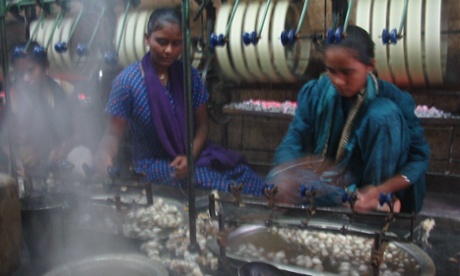
Silk production requires a heavy use of time and energy, once silk cocoons are graded and sold to the reeling units, they are boiled and thrown into a spinning reel to produce the mile-long yarn. Local producers rely on traditional ovens during this process, which are fueled by firewood, and are environmentally hazardous.
To tackle these challenges, S3IDF provided a holistic solution that offers a lesson for others looking to innovate.
Upon recognising the sector’s needs for more efficient ovens and other relevant technologies to increase their profits, S3IDF worked with N.M. Pooja and N.M. Ganganna to develop three types of energy efficient production facilities - energy efficient ovens, a gas-based reeling system, and a heat recovery system.
The entrepreneurs came to S3IDF with knowledge about the industry and the challenges its workers faced with the stoves they used. The Technology Informatics Design Endeavor (TIDE), a nonprofit organisation based in Bangalore, manufactured the three products for silk reeling and helped install several hundreds of them through the two entrepreneurs.
Consumers at the BoP often do not have access to finance that enables them to make an upfront investment necessary to purchase a machine or other equipment. To address this specific case, S3IDF provided financing for Pooja and Ganganna totaling INR 500,000 (£5149).
They used this loan as the working capital to purchase the energy efficient production facilities from TIDE, together with their own equity. A percentage of payments from the entrepreneurs’ customers was used to pay off the loan from S3IDF in a typical payment schedule.
Both entrepreneurs were successful in their business and eventually received support from the Karnataka state government, which provided subsidies to cover up to 50% of the cost for purchasing the products from TIDE. The state subsidies have not only provided additional funds for Pooja and Ganganna, but also acted as an endorsement for them, which allowed them to receive funding from local commercial financial institutions.
Pooja and Ganganna installed over 400 energy-efficient ovens to serve the needs of the silk industry in India, benefiting thousands of workers. Installation of these new TIDE ovens, costing between INR2,000 (£20) and INR3,000 (£31) each, resulted in fuel savings of around 30% for each oven, which helped the industry to reduce costs.
This cost reduction ultimately resulted in an increase in workers’ income. The energy efficient facilities were also proven to create better health outcomes for workers in the reeling units.
Both entrepreneurs are also now able to access commercial financing from local financial institutions and increase their distribution networks.
BCtA’s report ‘Breaking Through’ also includes further lessons from businesses that expand access to energy. Common challenges seen in this area include low consumer awareness, finding the right price point for the product, reaching consumers in remote areas, and a lack of consumer finance. As this case from India’s silk sector has shown, companies and other organisations adopt strategies to address these multiple challenges. Some of the strategies that we have seen include, focusing on product quality to boost demand, providing consumer finance either directly or through partners such as microfinance institutions, diversifying the product range to grow sales, finding the right partner to scale, and seeking external finance to expand operations.
About S3IDF
S3IDF is a nongovernmental organisation based in Cambridge, (Massachusetts), Bangalore and India, fostering small-scale enterprise development to alleviate poverty through its Social Merchant Bank Approach.
Through the approach, S3IDF provides co-financing, technology access and knowledge and business development support. Follow S3IDF on Twitter here
Tomohiro Nagasaki is the impact measurement consultant at Business Call to Action. Nakul Kadaba is a project associate at S3IDF.
More from the Business Call to Action partner zone:
- Launching a roadmap to guide the base of the pyramid domain
- Four ways to build an ecosystem to support business in low-income markets
- Empowering farmers through mobile communication in west Africa
Launched at the United Nations, the Business Call to Action (BCtA) is a global alliance hosted by the United Nations Development Programme headquarters in New York. Follow: @BCtAInitiative
Content on this page is paid for and provided by Business Call to Action, sponsor of the role of business in development hub