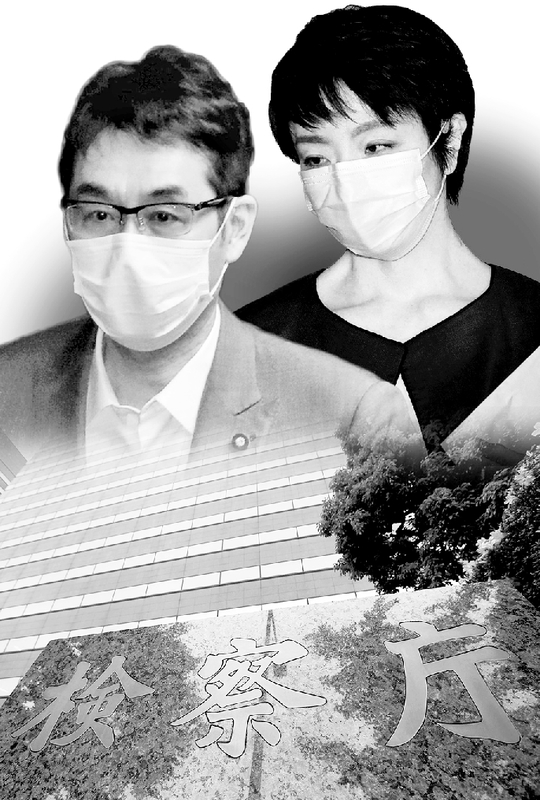
The recent arrests of former Justice Minister Katsuyuki Kawai and his wife, Anri, reflect an expansion of the scope of what qualifies as bribery, which could affect future elections in Japan, according to an expert.
Police generally step up work on cases involving suspicion of violating the Public Offices Election Law immediately after elections, but there have also been quite a few cases that prosecutors uncovered through their independent investigations.
In the 1998 arrest of Yojiro Nakajima, then a House of Representatives member, the special investigation squad of the Tokyo District Public Prosecutors Office detected that Nakajima had given about 20 million yen in bribes, mainly to members of his support group, just before the 1996 lower house election, while the investigators were probing a separate case in connection with improper use of political subsidies.
Nakajima was eventually indicted on five charges, including violating the Public Offices Election Law and receiving bribes.
In the 2012 lower house election scandal involving the Tokushukai hospital group, 10 people, including sisters of Takeshi Tokuda, a lower house member at the time of the race, were indicted for allegedly bribing about 600 employees of the group by giving them rewards worth about 155.6 million yen for participating in Tokuda's campaign activities.
In many of the past cases, those involved were indicted for illegal acts they conducted shortly before the elections. In the case of the Kawais, however, the cash in question was allegedly provided under the pretense of "encouragement money," "congratulatory gifts" or other reasons over an about four-month period leading up to the election.
"Prosecutors moved to establish a case [against the Kawais] by expanding the scope of what counts as bribery more widely than was precedented," said Kazunori Kawamura, an associate professor of political science at Tohoku University. "If their acts are found to be bribery, the public will take an even dimmer view of politicians and their practices, such as giving encouragement money. Thus the latest case may affect future elections."
Read more from The Japan News at https://japannews.yomiuri.co.jp/