The Theatre of the Absurd, which delighted some audiences and baffled many more, in the 1950s and 1960s explored the world’s real dilemmas through surreal plots and settings and crazed, sometimes nonsensical dialogue.
One of its chief architects, the French-Romanian playwright Eugene Ionesco, is somewhat astonishingly only now receiving his first outing at the National Theatre, with this manic meditation on the nature of death.
King Berenger is over 400 years old and dying. Wife number one, sensible (though a little ruthless) Queen Marguerite accepts this. Wife number two, vampish (though a little scheming) Queen Marie is in denial. The doctor in red waistcoat and pointed hat has come to attend his patient just after operating on himself.
Well, it wasn’t called the Theatre of the Absurd for nothing.
The kingdom is disintegrating. As Marguerite says to Marie in one of their many, beautifully acerbic exchanges, “He has explored all of your holes, and now his kingdom is full of holes.”
But behind this surreal exploration of how we accept death was a serious inspiration. Ionesco had fallen ill in the early 1960s and told himself: “I could learn how to die… It seemed to me the most essential thing we can do.”
And so we are taken on a roller-coaster ride through a dying king’s last hours (“You will die before the end of the play” his wife warns him with one of several slightly laboured nods to the alienation technique that was a slightly laboured part of the years of Absurdity).
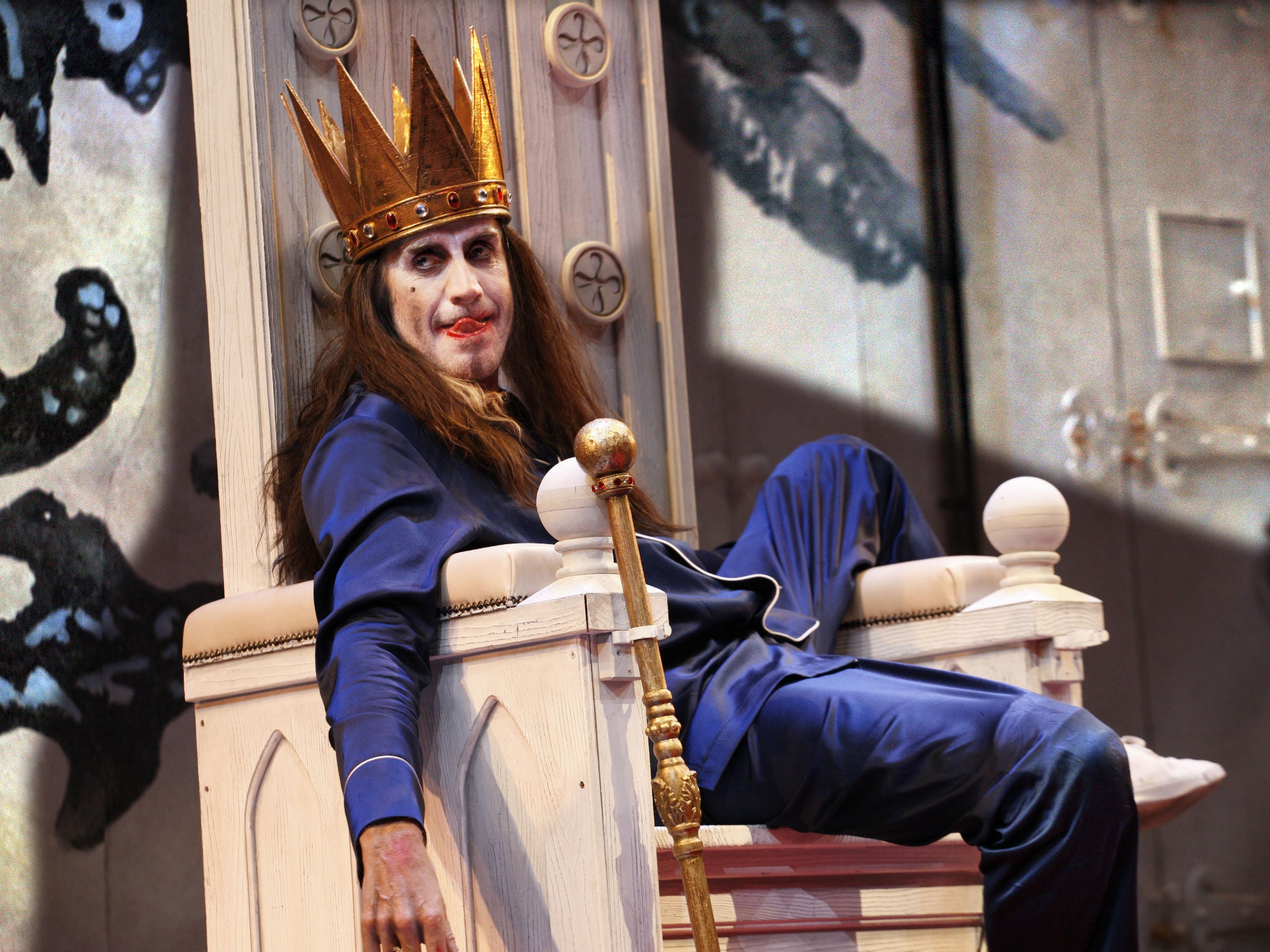
And a roller-coaster it sure is thanks to a central performance that is little short of a tour de force. Rhys Ifans owns the stage, by turns Lear-like, sonorous and haunted, then demonic and daft, then ever so slightly camp. It’s a mesmerising performance, with the pain of his difficulty in accepting finality only ever slightly below the surface.
There is much to enjoy here besides the fantastical humour and exquisite one-liners. The contrast between Indira Varma’s magisterial wife number one and Amy Morgan’s would be sex-bomb of a wife number two is joyously given full rein. As the doctor, Adrian Scarborough has few equals for swivel-eyed lunacy with a hint of evil underneath.
The play is Ionesco’s but adaptation and direction is by Patrick Marber who has worked wonders through dialogue so snappy that the audience is often having to catch up. Designer Anthony Ward ably supports him with a throne-room set that feels appropriately faded, and slightly divorced from reality.
And with a startling change of pace in the final scene, both open up the cavernous space of the Olivier stage as Varma’s Marguerite coaxes Ifans’ Berenger into taking his long, slow, final walk to acceptance. It’s a memorable and suitably haunting moment.
It is perhaps heretical to wonder whether this play might have been even more affecting without the Absurdist framework. But such thoughts are quickly banished by the excellent performances and the constant profundities that rise from the surreal and zany humour, and have one uneasily searching one’s own self for how ready we are to accept the inevitable.
“He thinks he’s the first person ever to die,” says Queen Marguerite wearily at one point about her husband. Queen Marie responds: “Everyone is the first person ever to die.”
Until 6 October (nationaltheatre.org.uk)