What is it like to spend your days gliding through the air, weaving through clouds and piloting an aircraft? It’s exhilarating – I love the feeling of being in the air. And taking off is a surreal feeling – watching the tarmac suddenly fall away beneath your feet. I still feel the same excitement as during my first ever training flights.
One memory that has stuck with me is flying alone for the first time. I had been training for eight months and suddenly I was in a double jet with just me in charge of the craft. I nervously steered through the air – it was a feeling of adrenaline and freedom.
Flying over breathtaking landscapes is also a perk of the job. Mediterranean coastlines are always impressive, but my favourite view is the UK at night. On a clear night it’s possible to see almost all of England in one screen – each town and city stands out with a unique sodium-lit shape. And there’s nothing like flying over home, friends and family below.
Being a pilot is livelier than your typical office job, but there are also challenging aspects to the work. It’s hard to fit in seeing friends at home. You don’t work nine-to-five and can often be doing night shifts, or staying abroad in different countries. Trying to get a regular sleep pattern is also a nightmare.
On the flipside, this irregularity helps to keep the job interesting. I really enjoy the variety of the work – no two days are the same. Even if we’re flying the same aircraft on the same route, changes in the weather, the time of day or simply having different customers on board can bring unexpected challenges. I’ve always loved travelling and this job also offers the perfect opportunity to do that.
Naturally, there’s a lot of responsibility to being in charge of an aircraft. Bad weather can cause flights to be cut short and decisions on whether to fly rest with the pilot. The weather is always at the forefront of our minds and we are trained for such conditions – from our initial brief where we review forecasts to help us make decisions about how much fuel to take, to the wind reports given over the radio as we’re given our clearance to land. We don’t cancel flights unless the weather is extremely bad – though I often take extra fuel if the forecast is stormy.
There’s also a timekeeping aspect to the job. Another difficult decision is take-off time. If a passenger is running late you have to decide whether or not to go without them. You want to fly as many people as possible, but you also need to stay on time, so it can be a tough call.
For all its perks, aviation is a competitive field to get into. It takes perseverance to become a pilot. While it’s a competitive field, you’ll do fine if you’ve got the right skills. There are essentially two sides to the job – the ability to fly the plane and then the social side of the work, dealing with people.
Anybody with the necessary academic qualifications can become a pilot. You need three A-levels or a 2:1 degree to apply to training schemes. Though it’s open to all degree subjects – so you don’t need to have studied aviation to apply.
If you’re young, I recommend you get involved in youth squadrons – such as the air cadets. Then go to university and look out for graduate schemes, such as the programme I was part of with BA. It’s important to get as much flying experience as possible for your applications. And of course, make sure flying is something you truly enjoy.
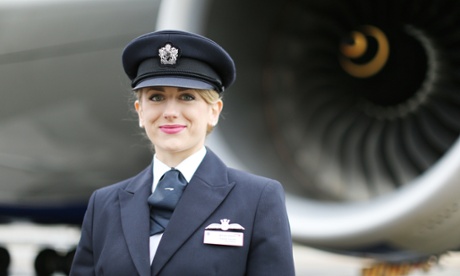
British Airways first officer Emily Lester is an Airbus 320 pilot who recently graduated from the British Airways Future Pilot programme.
Looking for a job? Browse Guardian Jobs or sign up to Guardian Careers for the latest job vacancies and career advice