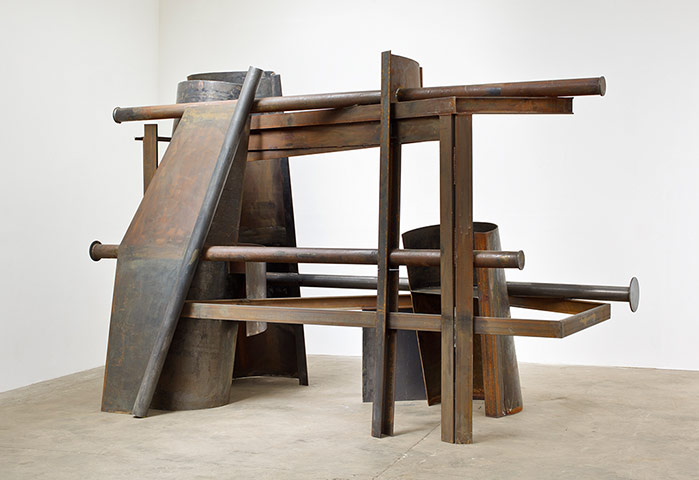
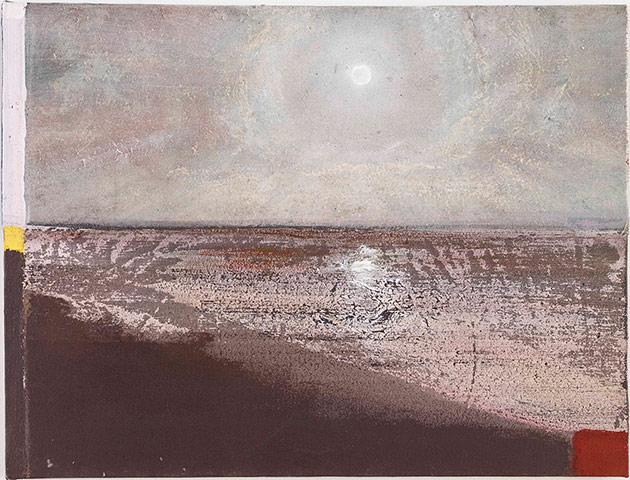
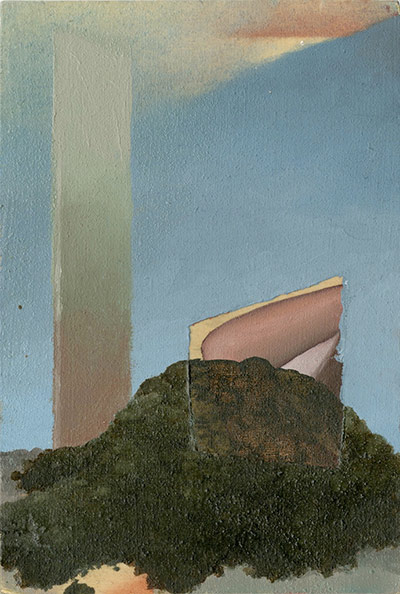
Anthony Caro, London When it comes to peaks and troughs, even Britain’s greatest living sculptor™ doesn’t always have it easy. Caro’s grand plan for a three-block-long public sculpture on New York’s Park Avenue fell by the wayside. Not one to let good work go to waste, he’s turned sections from the project into sculptures in their own right. These hulking rusted metal girders, pipes and pieces of agricultural technology have evolved from designs meant to be seen while travelling along the street, and things evolve as you move along and around. Thrusting slabs of slanted steel suggest a cityscape of skyscrapers and construction sites. Meanwhile, a huge pronged form looks ready to dig, like the lost tool of an ancient race of gardener giants, now warped and eroded having spent aeons in the ground. Gagosian Britannia Street, WC1, Fri to 27 JulPhotograph: John Hammond/PRMerlin James, London In Merlin James’s paintings, traditional subject matter such as wispy sea scenes, nudes or railway bridges, get an unconventional treatment. He mines art history, drawing on work by famous names such as Courbet, Titian or Poussin alongside under-sung talents like French-Russian painter Serge Charchoune. There’s no straightforward quotation or homage; he puts his medium through its paces, from stripping it back to bare-bones materials or applying pigment so thick it threatens to overwhelm its filmy support. Summing up this Glasgow-based artist’s output can feel like a fool’s errand; what unites it all, though, is his interest in the stuff of painting. Parasol Unit, N1, Thu to 10 AugPhotograph: PRModa WK, Newcastle upon Tyne The WK of the title refers to the little-known early 20th-century British painter Winifred Knights. Here, Holly Antrum, Nadia Hebson and Titania Seidl try to rescue Knights’s reputation by using their own work as a collective mixed-media biography. So three artists pay tribute to one who lived and worked through a period in which becoming a successful woman artist was far from easy. Knights’s most known painting, now in the Tate collection, is The Deluge (1919), a take on the biblical scene set against a backdrop of Clapham Common. It’s a haunting image, all overcast greys with hints of impending menace. In their own individual ways, Antrum, Hebson and Seidl cast back over almost a century to share Knights’s apocalyptic dread in a spirit of female fellow feeling. Vane Gallery, to 29 JunRCPhotograph: PR
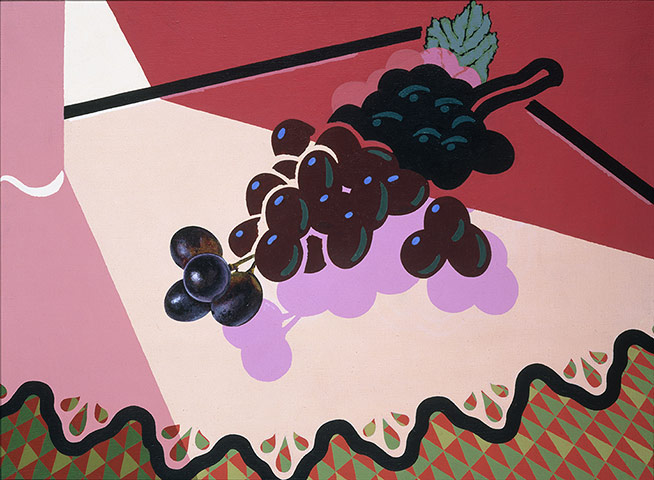
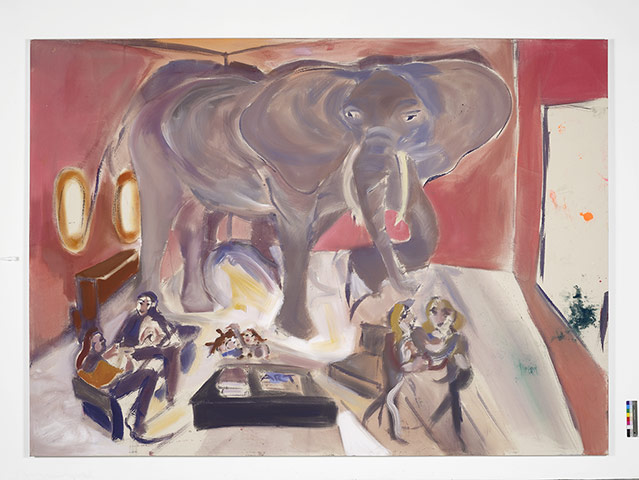
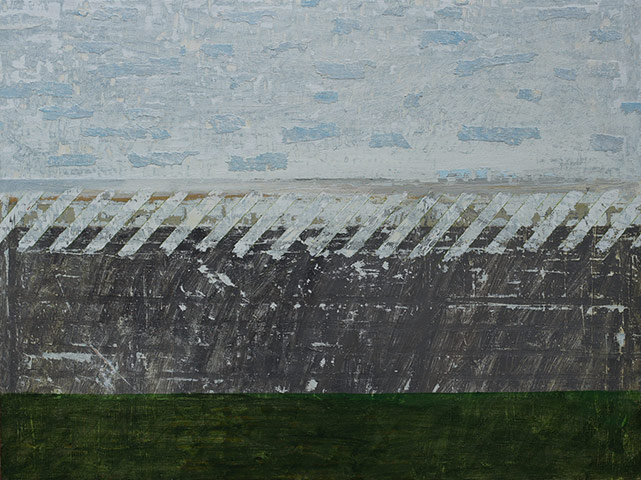
Gary Hume, Patrick Caulfield, London Twenty-five of Gary Hume’s gloss-on-aluminium paintings, as brilliant as a freshly waxed car bonnet and as flat as a billboard, chart the artist’s career to date. For all the apparently impersonal surface gleam, Hume’s approach is quirky and idiosyncratic. A painting inspired by Angela Merkel abstracts the German chancellor to something resembling a lemon against an oval expanse of mint green. Hume’s painting is paired here with that of 1960s upstart Patrick Caulfield (work pictured), who shares his love of line and bold, flat colour. Particularly inspired by the Spanish cubist Juan Gris’s treatment of still lifes and interiors, Caulfield turned his surroundings into stylised images with strong black outlines. Tate Britain, SW1, Wed to 1 SepSSPhotograph: PRPauline Boty, Wolverhampton Boty has become a legendary figure. She’s known for her charismatic beauty and tragic death in 1966 at the age of 28. Diagnosed with leukaemia during pregnancy, she refused chemotherapy and died soon after giving birth to her daughter. Mixing with such male luminaries as Bob Dylan, Peter Blake and David Hockney, she had been a darling of the swinging 60s scene. So it’s about time that her work as an artist is now, at long last, being reassessed in a show that reveals art not seen for 40 years. How Boty would have developed creatively had she lived into artistic maturity is hard to imagine, yet there is an open-ended experimental spirit in her surviving paintings and collages that indicates a sensuous touch rare amid the more clinical pop art clan. Wolverhampton Art Gallery, Sat to 16 NovRCPhotograph: richard valencia/PRSophie von Hellermann: Elephant In The Room Sophie von Hellermann’s paintings are loose, dreamy creations where a haze of pastel watery pigment might depict celebs from magazine pages, literary heroes or subjects from theoretical science alike. At first blush they can seem as light-headed as pink fizz. Make no mistake, though, the girlishness hits hard: a sort of lipstick in the eye to a male-dominated tradition where sanctified subjects get a laborious treatment. This show takes figures of speech as its starting point, including the eponymous overlooked elephant. Things get more cryptic with Cold As A Witch’s Tit, a 7.5 metre, 3D pyre of paintings depicting hundreds of women killed by Essex’s notorious Witchfinder General. First Site, to 26 AugSSPhotograph: PRTom Pitt: Between Object And Place, Derby Tom Pitt stood out in last year’s prestigious Liverpool John Moores Painting Prize exhibition for his modest-sized yet engagingly mysterious image of a flight of steps seemingly suspended in an abstract void. This, his first solo show, should further establish his reputation as a painter of illusionistic intrigues. Working on board, he builds up subtly coloured surfaces in layers that are often sanded and scraped back to evoke the wear and tear of time passing. Pitt sets up perspectives that trick our eyes into believing these are three-dimensional views, although the places he pictures remain virtually abstract in their lack of familiar props. There are unmistakable paths, passages and gate-like structures but the overall atmosphere is of a disorienting dream. Tarpey Gallery, Castle Donington, Sat to 13 JulRCPhotograph: PRWalk On: 40 Years Of Walking Art It is a century and a half since the symbolist poet Charles Baudelaire celebrated aimlessly wandering about the streets of Paris as a form of creative exploration. His flâneur (stroller) was a precursor of the surrealist spirit of much radical 20th-century art and the work in this delightful show picks up the story of artistic walking from the 60s onwards, a period increasingly inflected by cross-cultural migrations and ecological concerns. For Richard Long, the countryside trek became a way of paying homage to the disappearing wilderness, but the most intriguing work here extends the tradition of Baudelaire’s proto-surrealist wanderings into an age of high-tech recording gadgetry. Northern Gallery For Contemporary Art, Sat to 31 Aug; touring to 12 DecRCPhotograph: PR
Sign up to read this article
Read news from 100's of titles, curated specifically for you.