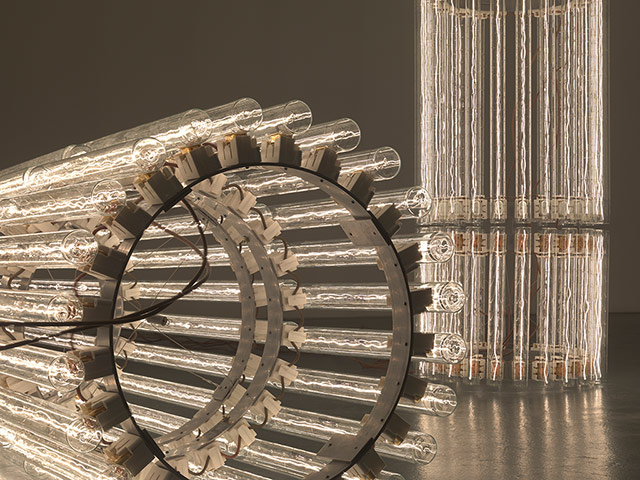
In horror movies, flickering lights generally mean something supernatural. There's a similar fusion of language, electricity and yearning in Cerith Wyn Evans's art, not least in his chandeliers, flashing messages in Morse code. This haunting quality permeates all his work. Here he creates a love letter to the De La Warr Pavilion, removing gallery walls and revealing windows to flood the space with bright light. At De La Warr Pavilion until 10 June 2012 Photograph: Todd-White Art Photography
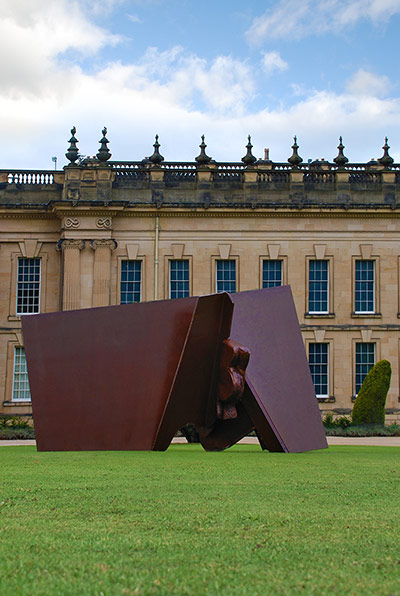
This is the first show in the magnificent Capability Brown gardens to be dedicated to the work of a single artist, and features 15 sculptures created by Anthony Caro over the past 40 years, resplendent in varnished or rusted steel, or industrially spray-painted in blue, orange and green. At Chatsworth House, 28 March until 1 July 2012 Photograph: PR
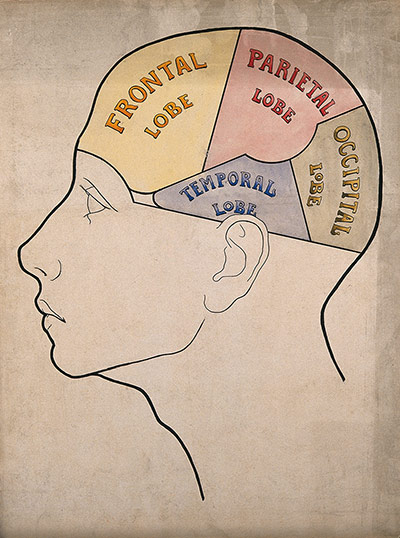
Don't expect an enquiry into the elusive business of invisible thought and emotion from this show. It's all about brains as grey, squidgy, tangible matter, and what we've done over the centuries to probe them. This includes plenty of dodgy but fascinating apparatus, from phrenology models to exquisite 17th-century brain maps locating essential landmarks like the seat of the soul. At Wellcome Collection, NW1, 29 March until 17 June 2012 Photograph: Wellcome Library, London/Wellcome Images
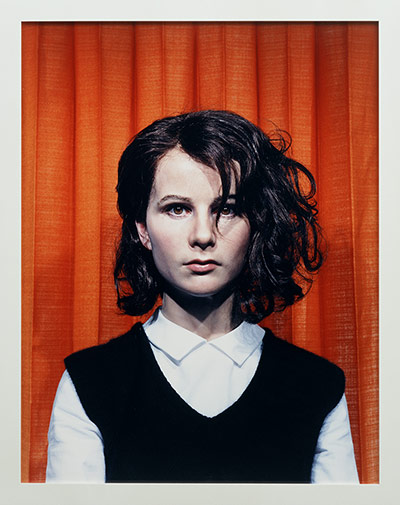
This survey of her confessional projects features a revealing cross-section of society's under-sung: the anxieties of teenagers are lip-synced by adult actors, people in the street write their true feelings on signs. Meanwhile, in an early work, Wearing herself dances in a Peckham shopping centre and later photographs see her dressing up as members of her family or creative inspirations such as Diane Arbus. It adds up to a poignant study of selfhood in a reality TV age where the camera is our very public confessional box. At Whitechapel Gallery, E1, 28 March until 17 June 2012 Photograph: the artist Courtesy Maureen Paley, London
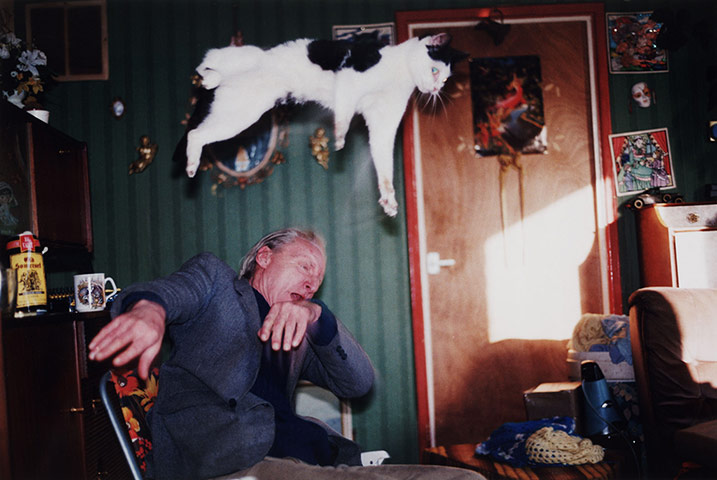
This is the kind of thing the National Media Museum does best: setting up media studies exhibitions that are as captivating as they are informative. Here you'll find Eadweard Muybridge's late-19th-century stop-frame photo sequences. But then you come across Richard Billingham's Untitled, 1995 (pictured), a stark photograph of a cat being flung over the photographer's drunk dad's head, and your attention suddenly stops still on the perceptual surprise of a simple piece of great art. At National Media Museum, until 2 September 2012 Photograph: Courtesy the Anthony Reynolds Gallery
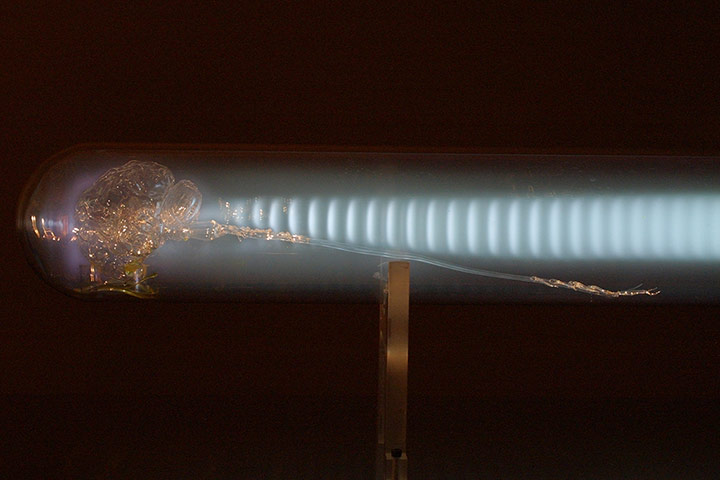
Just when you would suspect the National Glass Centre might run out of good art made from glass, it comes up with another exhibition that demonstrates the medium's enduring metaphorical potential. A central installation is Catherine Richards's I Was Scared to Death/I Could Have Died of Joy (pictured), a glass replica of the brain and spinal column that responds to your approach by pulsing with electromagnetic light signals of distress or elation. At National Glass Centre until 20 May 2012 Photograph: PR
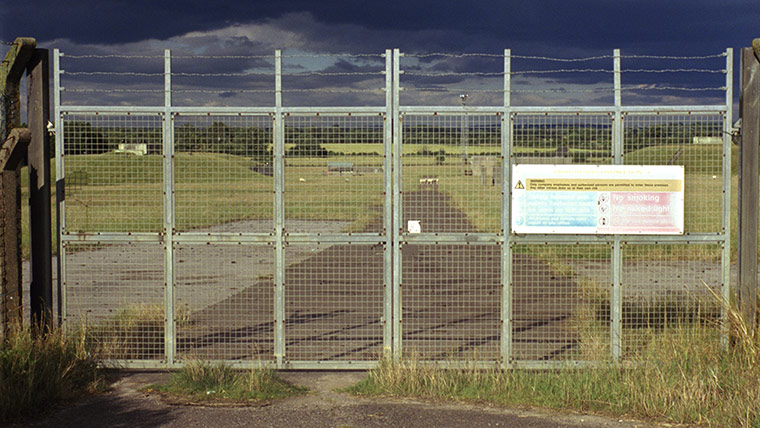
When it comes to humour, poetry and interrogation of our political landscape, no film-maker in Britain beats Patrick Keiller. Since the last Tory government, his fictionalised essay-documentaries have mixed shots of inner-city decrepitude and drab hinterlands with wry narration on economic failures, forgotten history, literary heroes and the peculiar English mind trap of nostalgia. At Tate Britain, SW1, 27 March until 14 October 2012 Photograph: PR
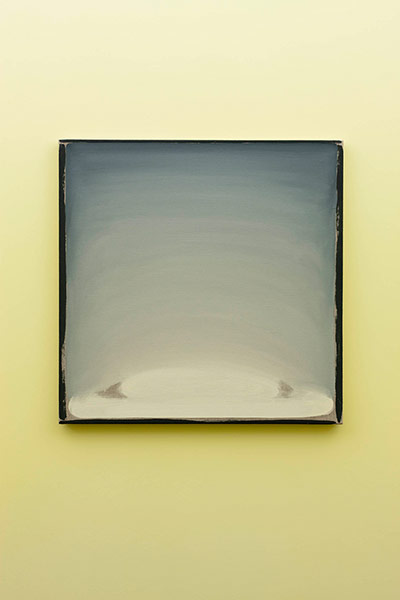
McKeown has been sorely missed since his untimely death late last year. Here was an artist who reminded many of us why we got into art in the first place: the pure thrill of opening one's first box of paints, the wide-eyed amazement at seeing an expanse of abstract colour taken so seriously in a gallery. His paintings, building up sensitivity from layers of resonant colour, are almost painfully uncomplicated. At Kerlin Gallery until 14 April 2012 Photograph: Denis Mortell