SAN FRANCISCO _ The California Supreme Court decided Thursday that a key provision in last year's ballot measure to speed executions failed to impose strict deadlines for resolving death penalty appeals.
Proposition 66, sponsored by prosecutors and passed by 51 percent of voters, was intended to remove various hurdles that have prevented the state from executing an inmate in more than 10 years.
Thursday's ruling left most of the initiative intact, leading one of the sponsors to predict that executions would resume in months.
But the decision, signed by five of the seven justices, construed the measure's requirement that death penalty appeals must be decided within five years as "directive," not mandatory.
That deadline is merely "an exhortation to the parties and the courts to handle cases as expeditiously as is consistent with the fair and principled administration of justice," Justice Carol A. Corrigan wrote for the majority.
Because of a huge backlog of appeals, the California Supreme Court would have to spend 90 percent of its time on death penalty cases for at least the next five years to meet the five-year deadlines, legal analysts said.
But without a strict timetable, appeals can take decades to resolve.
Six of the justices agreed that the measure's time limits on resolving appeals have no legal force and that judicial leaders need not devise new rules to implement them.
Michael Rushford, president of a pro-death penalty group that helped sponsore the measure, said 18 inmates on death row who have exhausted their appeals don't have "much time left."
"I think months is a reasonable estimate" of when the next execution will occur, he said.
Kent Scheidegger, legal counsel for Rushford's group, the Criminal Justice Legal Foundation, and an author of Proposition 66, said that if the court decides appeals more quickly, "we should see a very substantial speedup."
But Christina Von der Ahe Rayburn, who represented the challengers, said federal courts could delay the resumption of executions.
"Nobody is going to be executed tomorrow, thank goodness," she said. "But it does make executions more possible in the short term."
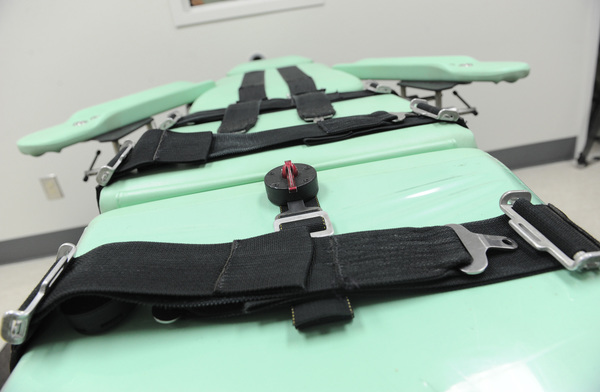
She noted that a federal judge's legal hold on executions remains in force until the state devises a new lethal injection protocol the court can review.
The proponents' prediction of executions occurring in months is "overly optimistic on their part," she said.
"I just can't imagine the federal case gets resolved that quickly, especially if it can go up on appeal," she said.
She said the decision surprised and disappointed her, though she was heartened by language in the ruling "that they won't make much effort to honor the deadlines."
Corrigan, writing for the majority, said "it remains to be seen" how effective Proposition 66 will be in expediting death penalty appeals. Much will depend on whether the Legislature provides more funds for the courts, she said.
"The time limits reflect the voters' will, which we respect," Corrigan wrote. "However, they were presented to the voters by the proponents of Proposition 66 without the benefit of hearings or research exploring their feasibility or their impact on the rest of the courts' work."
Opponents of Proposition 66 challenged the measure the day after the November election, contending the initiative usurped the authority of the courts.
The court put the new law on hold while considering the challenge.
California law gives each person convicted of the death penalty an automatic appeal and a separate habeas corpus challenge to the California Supreme Court.
The appeal is based on the written record of what happened at trial and could involve, for example, a challenge of a judge's ruling on whether to admit or exclude evidence.
It now can take a decade or longer for the California Supreme Court to rule on an automatic appeal.
Afterward, the court considers the inmate's habeas challenge. That is based on events that were not reflected in the trial transcript, such as newly discovered evidence or juror misconduct.
Chief Justice Tani Cantil-Sakauye and Justice Ming W. Chin did not participate in the case because they serve on the Judicial Council, the policymaking body of the courts and a defendant in the lawsuit.
They were replaced by two members of the Courts of Appeal: Santa Ana-based Justice Raymond J. Ikola, an appointee of Gov. Gray Davis, and Sacramento-based Justice Andrea L. Hoch, an appointee of Gov. Arnold Schwarzenegger.
Corrigan, a conservative, was joined in the majority ruling by Justice Kathryn Mickle Werdegar _ a Republican appointee who has voted frequently with the liberals _ Hoch and Justices Goodwin Liu and Leondra Kruger, both appointees of Gov. Jerry Brown.
Liu wrote separately to stress that the deadlines set in Proposition 66 need not be enforced. Hoch, Kruger and Werdegar joined him.
"The five-year limit, construed as directive or simply unconstitutional, has no binding effect and provides no guidance for responsible actors charged with the fair and efficient administration of justice," Liu wrote.
Corrigan and Kruger face voters next year in a routine retention election.
Justices have been ousted at the ballot only once. Voters rejected the late Chief Justice Rose Bird and her liberal colleagues after a campaign that accused them of refusing to enforce the death penalty.
Justice Mariano-Florentino Cuellar, in a dissent joined by Ikola, said the majority should simply have struck down the deadline for deciding appeals as unconstitutional rather than engage in a "novel reinterpretation" and "neutering" of the initiative.
The majority's decision to simply construe the deadlines as flexible was "at odds _ entirely _ with what the initiative says, how it was designed to work, and how it was sold," wrote Cuellar, a Brown appointee.
"Courts do not have the power to disregard a clear statement that a judicial deadline is mandatory, nor to construe a mandatory deadline to be something other than what it is," Cuellar said.
Cuellar and Ikola also would have a struck down a provision in the measure that shifts review of habeas corpus challenges to the lower courts. That has in the past been exclusively the domain of the California Supreme Court.
California has 748 inmates on death row _ the largest number in the country _ and legal challenges over lethal injection have prevented executions since 2006.