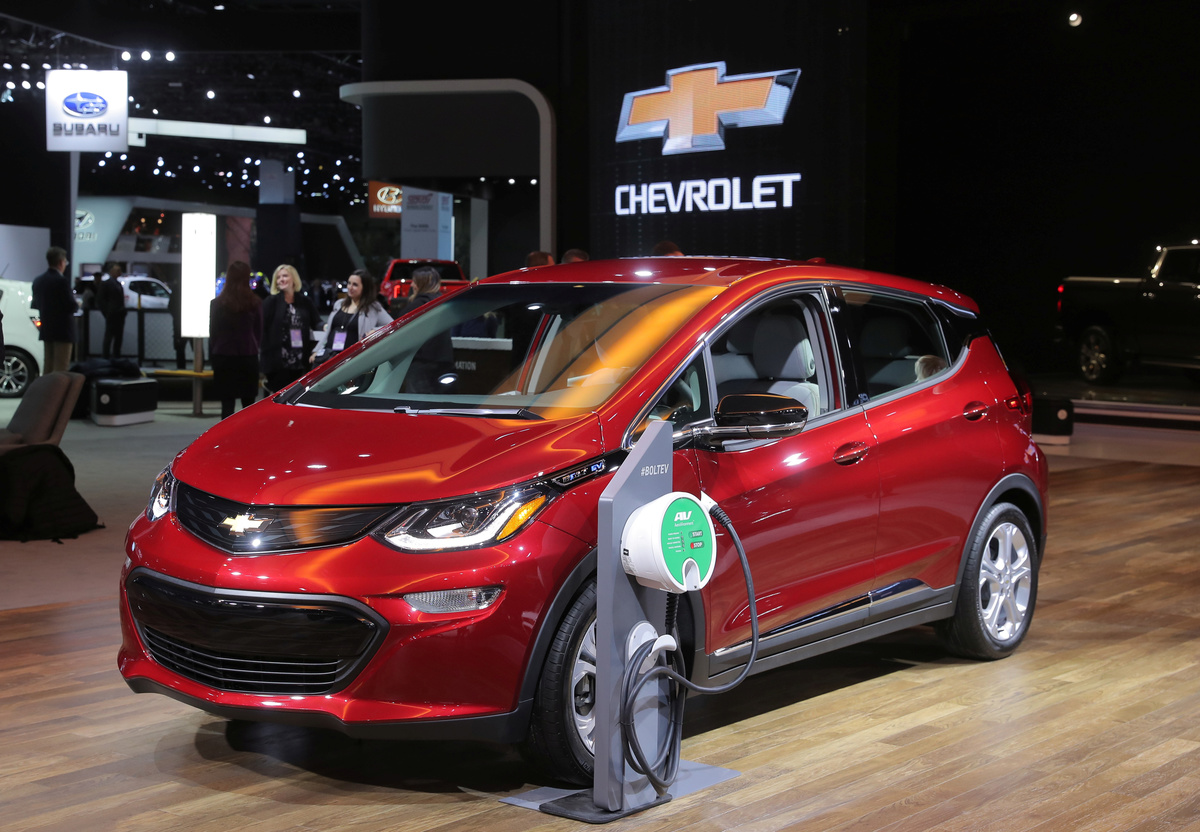
WASHINGTON (Reuters) - A bipartisan group of U.S. lawmakers introduced legislation on Wednesday to expand the electric vehicle tax credit by 400,000 vehicles per manufacturer, a provision that would give a boost to Tesla Inc and General Motors Co before the existing credit comes to an end for them.
The bill is sponsored by Democratic Senators Debbie Stabenow and Gary Peters, Republican Senators Lamar Alexander and Susan Collins and Democratic Representative Dan Kildee.
The bill could lift electric vehicle sales in a boost for automakers that have committed tens of billions of dollars toward meeting global emissions requirements.
GM and Tesla shares rose on Reuters report that the bill would be introduced. Tesla shares recently traded up nearly 1 percent, while GM was up 0.2 percent.
Supporters hope to attach the proposal to tax legislation that could be considered in the next few months.
The existing $7,500 EV tax credit, which allows taxpayers to deduct part of the cost of buying an electric car, phases out over 15 months once an automaker hits 200,000 cumulative EV sales. GM saw its tax credit cut to $3,750 on April 1. Tesla's tax credit fell to $3,750 on Jan. 1 and will end entirely at year's end.
The bill dubbed the "Driving America Forward Act" would grant each automaker a $7,000 tax credit for an additional 400,000 vehicles on top of the existing 200,000 vehicles eligible for $7,500 tax credits. It would shorten the phase-out schedule to nine months.
The bill would also extend the hydrogen fuel cell credit through 2028. The bill is estimated to cost $11.4 billion, with all but $91 million of that tally to extend the EV tax credit.
"We have a cap that's got to go up," Stabenow told a group of automakers at a dinner last week. "I want to get this done as soon as possible."
The proposal has strong backing from automakers, environmental groups and others, but will face opposition.
Last month, the White House proposed immediately eliminating the $7,500 tax credit, a move it said would save the U.S. government $2.5 billion over a decade.
Senator John Barrasso, a Republican who chairs the Environment and Public Works Committee, in February proposed legislation to end the credit and impose a highway user fee on EVs to pay for road repairs.
The bill is backed by major automakers including GM, Tesla, Toyota Motor Corp, Ford Motor Co, Fiat Chrysler Automobiles NV, Honda Motor Co, BMW AG, Nissan Motor Co, Volkswagen AG and utilities.
GM President Mark Reuss said in a statement "the EV tax credit provides customers with a proven incentive as we work to establish the U.S. as a leader in electrification."
Michael Brune, executive director of the Sierra Club, said "as we build and grow the clean energy economy, we must continue to invest in tackling the sector that generates the most pollution: transportation."
Both GM and Tesla have been lobbying Congress for more than a year to extend or expand the EV tax credit.
GM’s credit drops to $1,875 in October and will completely disappear by April 2020, while Tesla’s credit falls to $1,875 in July and expires at the end of the year.
(Reporting by David Shepardson in Washington; Editing by James Dalgleish and Bernadette Baum)