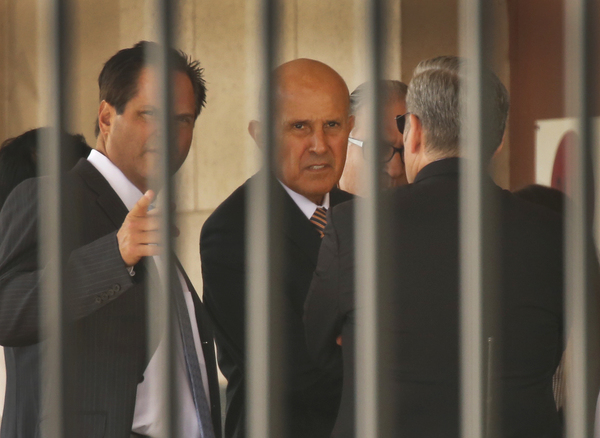
LOS ANGELES _ Attorneys for former Los Angeles County Sheriff Lee Baca were scrambling Monday to reach a last-minute deal with federal prosecutors that they hoped would satisfy a judge who threw out an earlier plea agreement limiting Baca's time in prison to six months.
Following the decision last month by U.S. District Judge Percy Anderson to reject the plea deal, Baca had been expected Monday morning either to withdraw his guilty plea and go to trial, or to allow Anderson to sentence him for making a false statement to federal investigators, a charge that carries a maximum sentence of five years. Anderson sentenced Baca's former No. 2, Paul Tanaka, to five years in prison earlier this year after Tanaka was convicted in a related obstruction-of-justice case.
Instead, the morning hearing became a series of private sidebar conferences between the judge and attorneys from both sides, ending in an instruction from Anderson to return Monday afternoon.
In rejecting the earlier plea agreement two weeks ago, Anderson said a six-month sentence for Baca "would not address the gross abuse of the public's trust ... including the need to restore the public's trust in law enforcement and the criminal justice system." Michael Zweiback, one of Baca's attorneys, had argued that Baca should serve no time because he is in the early stages of Alzheimer's disease.
After Monday morning's hearing, Baca's attorneys briefed reporters on the sidebar discussions. Anderson had suggested that the parties try to reach a settlement with the help of a different judge, but prosecutors said Department of Justice rules do not allow them to negotiate plea deals with a judge's involvement, according to Zweiback.
Anderson would not tell the attorneys what sentence he would hand down if Baca withdraws his plea. The judge did indicate that he believed the sentence should be increased based on Baca's role in the larger obstruction of justice case, using factors such as whether the former sheriff abused a position of trust, said Nathan Hochman, another Baca attorney.
Without a firmer indication of Anderson's intentions, there is a "good likelihood" that Baca, 74, will choose to go to trial, knowing that prosecutors may bring additional charges besides the single false statement charge, Zweiback said.
"If he's not going to be in a situation where he has some understanding of what he's walking into, he may feel he has no alternative but to fight for his life and go to trial," Zweiback said.
Baca's Alzheimer's could be a factor if the case heads to trial and his ability to understand the proceedings deteriorates. The trial could be put on hold if he is declared mentally incompetent.
Zweiback on Monday said his client's dementia had progressed, but that Baca remained aware of the legal wranglings going on.
Legal experts said Anderson's decision July 18 to reject the plea agreement was unusual but not unexpected, considering his law-and-order reputation and comments he has made during sentencing hearings in related cases. Besides Tanaka, Anderson has sentenced seven other lower-ranking sheriff's officials to terms ranging from a year and a half to more than three years in prison for their roles in obstructing the federal investigation.
Many sheriff's deputies have been closely watching the criminal prosecutions to see if the punishments for former bosses would approach those of lower-ranking employees following their orders.
Anderson, who was appointed to the federal bench by President George W. Bush in 2002, is a former federal prosecutor who served on the Christopher Commission, which investigated excessive force by LAPD officers after the 1991 Rodney King beating.
The obstruction-of-justice case grew out of a secret FBI investigation launched in 2010 into corruption and brutality by jail deputies. After sheriff's officials discovered that an inmate, Anthony Brown, was an FBI informant, they booked him under false names and shuttled him to different locations. They also went to the home of an FBI agent and threatened her with arrest.
Prosecutors alleged that Tanaka directed the efforts to hide Brown from the FBI and intimidate the FBI agent, with Baca playing a lesser role. Baca retired in 2014 before completing his fourth term as the head of the nation's largest Sheriff's Department.
In his plea agreement, Baca admitted to lying in an April 12, 2013, interview with investigators, when he stated that he was not aware of the plan to confront the FBI agent at her home. In fact, according to the agreement, Baca was at a meeting where officials came up with the plan, telling his subordinates that they "should do everything but put handcuffs" on her.
Baca was also involved in a conversation with subordinates about keeping Brown away from the FBI, though he denied knowledge in his interview with federal investigators, the agreement said. He was also aware that his subordinates had stopped FBI agents from questioning Brown, contrary to what he had said in the interview, according to the agreement.
In entering his guilty plea, Baca admitted only to lying about the visit to the FBI agent's home while agreeing not to contest the prosecutors' other allegations.