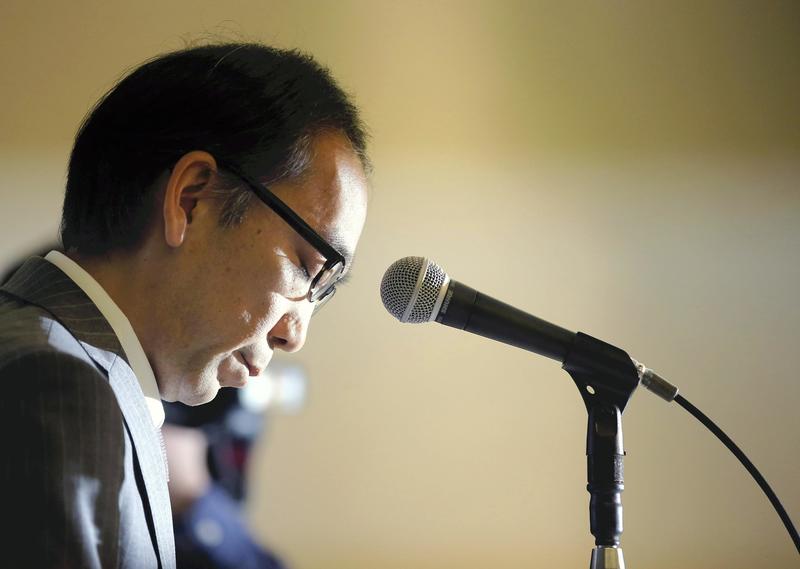
On Feb. 6, 2014, a composer who had never been in the spotlight before was bombarded with camera flashes.
Takashi Niigaki held a press conference that day and revealed that he was the ghostwriter for Mamoru Samuragochi, who had been acclaimed as a deaf composer. Niigaki thought at the time that he would never work in the music industry again. However, his life turned in an unexpected direction as society became aware of his skills: a versatile composer who can write music in various genres.
Six years have passed since then, and Niigaki, 50, is now charging ahead in the world of music under his own name.
"This is wrong," Niigaki thought in 2001, five years after meeting Samuragochi through an acquaintance who had gone to the same university.
Niigaki had already provided Samuragochi with film scores and computer game music. When writing for Samuragochi, Niigaki usually received sound sources he could use in the composition, such as synthesizer samples. This time, however, he only received written instructions: texts and diagrams indicating the image of a piece of music. He was told to write a symphony based on the instructions.
Niigaki had no financial worries at the time, because he was working at his alma mater, Toho Gakuen College in Tokyo, as a part-time lecturer. Yet he had one problem.
"I was terrible at saying no to people when they asked me to do something," Niigaki admitted.
What if he refused and that person became angry? He thought hard about how he could avoid saying no and still stay out of trouble.
"If I write a very long piece, it probably won't sell. If it doesn't sell, no one will realize it's ghostwritten," Niigaki thought. In the end, he spent about a year composing Symphony No. 1, which takes 80 minutes to perform.
"While the main reason [for writing the work] was that I couldn't say no, it's also true that somewhere deep in my mind I wanted to write a contemporary symphony that's different from classical music," Niigaki said.
Samuragochi's request was troubling, but there was also undoubtedly an element that nudged Niigaki's creative impulses as a composer.
Symphony No. 1 received little attention at first. However, Samuragochi published an autobiography in 2007, in which he wrote, "I lost my hearing, but I wrote a symphony as a second-generation hibakusha." Before Niigaki knew it, the symphony had suddenly acquired the subtitle "Hiroshima" and was being performed all over the country, even though he was not thinking about Hiroshima at all when he composed it.
Things were getting out of his control.
-- Extraordinary talent
Niigaki was born to a father who worked at a securities company and a music-loving mother. When he was in the second grade of elementary school, he began regularly attending a local Yamaha Music School class in Chiba Prefecture, and learned about the profound art of composition.
"I found it interesting that the musical notes I wrote became sounds," he said.
Composer Satoshi Minami, who was teaching at the Yamaha school, was surprised at a piece Niigaki composed when he was a sixth-grader.
"It was a full score with all the orchestral instruments. Normally, the best that kids his age can do is write a piano duet. I'd never seen a child like him before," said Minami, now a professor at the Hokkaido University of Education.
Minami gave Niigaki private composition lessons until around the time he was in the third year of junior high school.
"Unusually for a child, he wrote slow-moving music, as if he had abandoned himself to time," Minami said, recalling the boy's extraordinary talent.
Composer Toshio Nakagawa, 62, succeeded Minami as Niigaki's private composition teacher.
"He was clear about which tonal colors he liked to use. It wasn't that he just played the piano, but he was choosing the tonal colors he wanted to express," Nakagawa said of Niigaki.
According to Nakagawa, however, Niigaki was introverted and tended to retreat into himself. When he heard the rumor in the music community that Niigaki might be ghostwriting music for Samuragochi, Nakagawa intuitively thought it was possible.
In the spring of 2013, Nakagawa called Niigaki to a cafe in Tokyo. Handing him a DVD recording of a TV documentary about Samuragochi, Nakagawa told him to squarely face what was happening and what he was involved in.
About six months later, a weekly magazine reporter visited Niigaki, and he confessed to everything.
At the press conference in 2014, one reporter asked Niigaki, "After your work received good reviews, didn't you feel any urge to say 'I wrote it'?"
After listening to the question intently, Niigaki nodded slightly and said: "I was very happy that many people listened to the work. But I didn't know how to accept and digest [the praise]."
The joy of his own work being accepted by the public was huge. But he was also aware that the appreciation his work received was based on the story that it was written by Samuragochi, who had supposedly lost his hearing. How can one express this complicated feeling?
"That's why I just handed [Samuragochi] the music, pretended not to look at the fake story and tried to believe I had nothing to do with it," Niigaki said, describing his thinking at the time.
-- Redemption comes
After the debacle, Niigaki became unable to board trains due to the fear of being criticized by the public. He also quit his part-time lecturer's job. He could not think of anything in the future.
To his surprise, however, he started receiving job offers one after another. Some had nothing to do with music. He appeared on a TV variety show and had his nose pinched by a stag beetle. He even promoted a film wearing a sailor blouse. He did all those jobs with full commitment.
"People might have wondered what I was doing, but after I caused such a furor, I found it very difficult to say I'll accept this job but not that one," Niigaki said.
As he continued exposing himself in this never-say-no or cannot-say-no style, he became widely recognized for his ability to improvise on the piano. By the time a year had passed since the scandal, he was receiving many offers for his main job of music, such as composing ballet and film scores and participating in a pop band.
He even received a commission from Hiroshima Prefecture, which he had betrayed badly with Symphony No. 1.
"I find this symphony very rewarding to play. Each movement is fitted with a meaning, such as destiny and hope," said Shigeru Kudo, 38, the leader of the Higashihiroshima Symphony Orchestra, one of the orchestras that performed Symphony No. 1.
After the uproar, the orchestra commissioned a new piece from Niigaki, saying this time it wanted him to compose music for the orchestra under his own name. The new symphony "Litany" was finished in 2016.
Niigaki's colleagues in music did not abandon him. According to composer Kenichi Nishizawa, 42, Niigaki was already a respected figure in the music scene from the 1990s, long before the Samuragochi fiasco. He was known for being ready to help with any request, from piano accompaniment on a difficult piece, to arranging music at the last minute.
Following the 2014 press conference, music professionals launched an online petition asking Toho Gakuen College to show leniency. The petitioners collected 8,000 signatures in one week and eventually managed to gather about 20,000 overall. Niigaki returned to the college as a part-time lecturer in 2018.
He also joined Osaka College of Music as a guest professor from this year.
It's only in the past year or so that Niigaki has become able to board trains and use taxis again.
"I've just kept on running and managed to accumulate experiences within myself, to look at things in a positive light," he said.
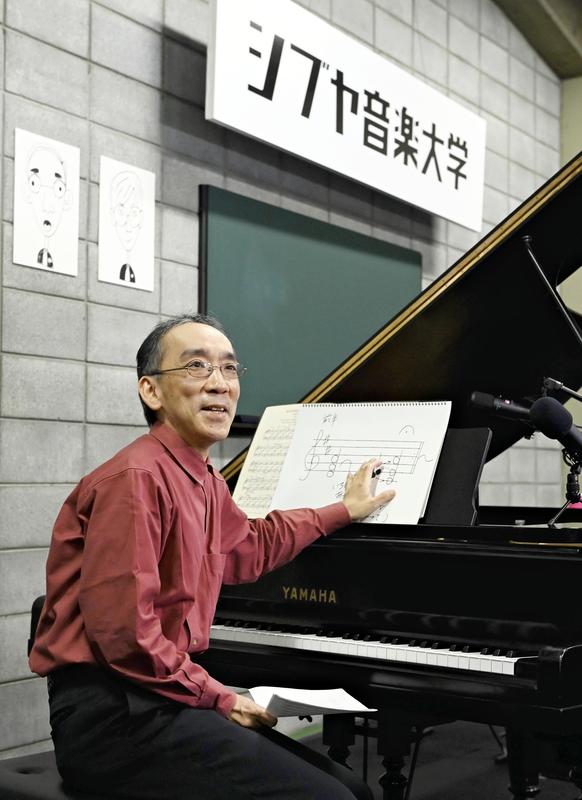
Due to the COVID-19 pandemic, many of Niigaki's concerts this year have been canceled. In August, he launched Shibuya Music College, an online platform for ordinary people to become familiar with music. Niigaki is the president, and other specialists in fields including composition and voice music offer support.
"I want to meet and work with many people, regardless of the genre," he said. "Mr. Samuragochi gave me the opportunity [to think in this way], so I'm grateful to him in that respect."
Some time after the debacle, Niigaki lost contact with Samuragochi. At the time, the two held separate press conferences. "I wish we could apologize to society together," Niigaki said.
He also thinks about figure skating star Daisuke Takahashi, who did not change his plan to use Sonatina for Violin for his short program at the Sochi Winter Olympic Games. The Games took place immediately after Niigaki revealed that he wrote the piece for a girl with a prosthetic hand under Samuragochi's name.
Niigaki has a DVD recording of Takahashi's performance at the Games, although he still cannot bring himself to watch it.
"I understand the seriousness of what I did," Niigaki said. "Now I'd like to feel grateful for the joy of being able to get involved in music and do my jobs, one by one. Of course, under my own name."
He thinks the only way to overcome his past is to continue producing real things in all the jobs he is offered.
-- More than 20 pieces
According to Niigaki, he composed more than 20 pieces for Samuragochi over 18 years from 1996 to 2014 and received about 6.5 million yen in remuneration. Among the works are Symphony No. 1 and Sonatina for Violin as well as a piano piece written as a requiem for a girl who lost her mother in the tsunami after the Great East Japan Earthquake. These works were widely reported on by the media, including The Yomiuri Shimbun.
Niigaki transferred the copyrights of all those works to Samuragochi. The copyrights are not managed by the Japanese Society to Rights to Authors, Composers and Publishers (JASRAC) either. Currently, Niigaki is not allowed to perform the pieces he composed as Samuragochi's ghostwriter.
Read more from The Japan News at https://japannews.yomiuri.co.jp/