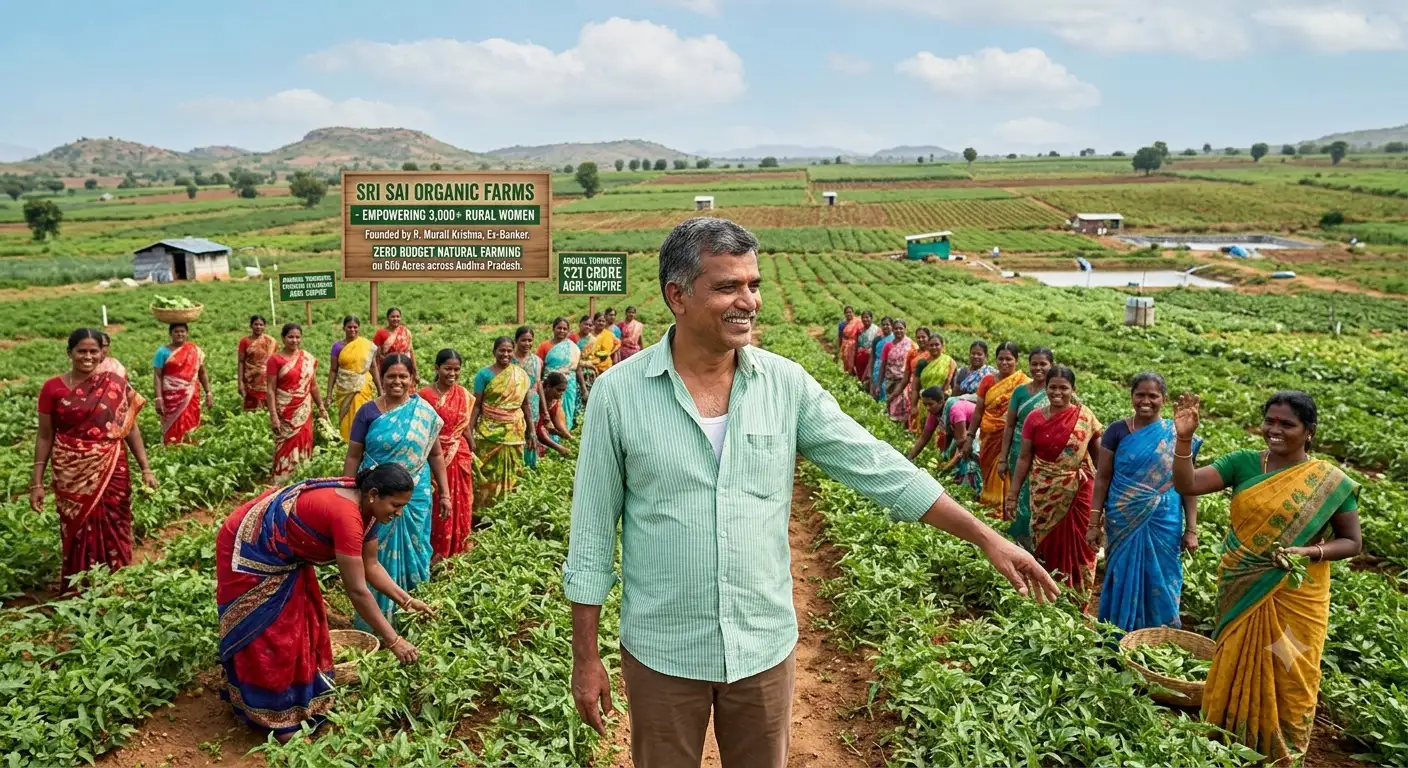
At Hebbevu Farms in Andhra Pradesh, agriculture looks nothing like modern industrial farming. What began as a personal shift back to traditional farming by former banker Amith Kishan has now developed into a 650-acre natural farming enterprise.
Over the years, Hebbevu Farms has grown into a structured ecosystem focused on chemical-free cultivation, rural employment, and sustainable food production, while also influencing consumer awareness around food quality and farming practices.
ALSO READ: Weather Tomorrow June 24
A Banker Who Chose Soil Over Salary
Before stepping into farming, Amith Kishan spent nearly eight years in the corporate banking world in Bengaluru, working with major banking institutions like ICICI, Bajaj, Axis, HDFC, and Punjab National Bank, reports The Better India. Fed up by the increasing availability of chemical-laden food, the 33-year-old quit his corporate job in the banking sector in Bengaluru to turn to traditional methods of farming
But something always pulled him back to the land. “My grandfather was a renowned farmer in the area. As a child, we used to go to the farm and play with soil while he worked on the field,” he recalled.
The turning point came after a deeply personal professional experience.
“There was a person who was insured with me. In a span of 1.5 years, he died of cancer. I did all the claiming formalities for the family. Looking at this, I understood that we need to correct ways of how we are living, and what we are eating as our food is not up to the mark. I wanted to correct that. Everything was pushing me to do something better,” he told Better India.
Starting from Zero: Learning the Language of Farming
In 2016, he resigned and chose farming full-time. “We did not know what to grow and when. When farmers in the neighbouring fields grew chillies, we would grow groundnuts. We did not understand the kharif and rabi seasons,” he said.
For the first three years, it was pure learning — meeting organic farmers, studying soil patterns, and rebuilding everything from scratch. By 2019, Hebbevu Farms was officially co-founded with his brother Ashrith.
Zero Chemical, Zero Tractors: The Natural Farming Model
At the core of Hebbevu Farms is one strict principle — no chemical intervention. “We use desi cow dung and cow urine, we use bulls to plough the soil and produce wood-pressed oil. We sow native seeds and grow only what Mother Earth has given us. Indigenous farming is the uniqueness of our farm,” he explained.
“We have been following zero budget farming and have been successful in it. We grow everything in a natural way and we do not use chemical fertilisers to ensure soil is safe in the long run,” he says.
The results, according to him, became visible over time — healthier soil, returning earthworms, and stronger crop resilience.
700 Indigenous Cows Powering a Circular Ecosystem
One of the most striking features of the farm is its livestock ecosystem. Today, Hebbevu Farms is home to around 700 indigenous cows and buffaloes, including Gir, Sahiwal, and Jafarabadi breeds.
“The cows, buffaloes, and bulls help us practise natural farming, sell dairy products, make biogas, and boost farm tourism,” he added. The animals are not just part of agriculture — they are central to a closed-loop system that supports farming, energy, and dairy production.
The farm has also adopted solar power, reducing monthly electricity costs significantly from ₹3 lakh to around ₹40,000.
From 40 Crops to 3 Lakh Customers
Today, Hebbevu Farms grows nearly 40 varieties of indigenous crops — from brinjals, groundnuts, white chickpeas, toor, moong, urad, and rare coconut varieties like gangabhavani.
The scale has grown rapidly:
- Around 6 tonnes of vegetables sold daily
- 1,500 litres of milk produced every day
- Over 3 lakh customers served so far
- Around 1,800 daily customers through Bengaluru outlets and online platforms
What began as a 15-acre experiment has now expanded into a 650-acre operational farm with annual revenue of around ₹21 crore.
3,000 Rural Women and a Quiet Economic Revolution
Beyond farming, Hebbevu Farms has become a major rural employment engine.
The initiative has empowered over 3,000 women from 18 villages, including Chinnamanthur, Mavutur, Peddamanthuru, Roddam, and Madakasira.
“We give 25 litres of milk every day to each woman to make ghee, paneer, and other dairy products. For every kilogram produced of our A2 desi cow Bilona ghee, one woman from the village receives a direct employment opportunity,” he said.
From Urban Burnout to Rural Balance
For Amith, the transformation is not just professional — it is deeply personal.
“In Bengaluru, I used to leave for work at 8 in the morning, hustle in the pollution, and come back only by 8 in the evening. We were dependent on burgers as a meal. Here, I live a peaceful slow life and spend sufficient quality time with my family and pluck fruits directly from the tree whenever we want,” he says.
“There, I used to work and exhaust myself for others, here I work for myself and my village,” he added.
Hebbevu Farms is no longer just a farm. It is a working model of indigenous agriculture, rural employment, and sustainable food production rolled into one ecosystem.