
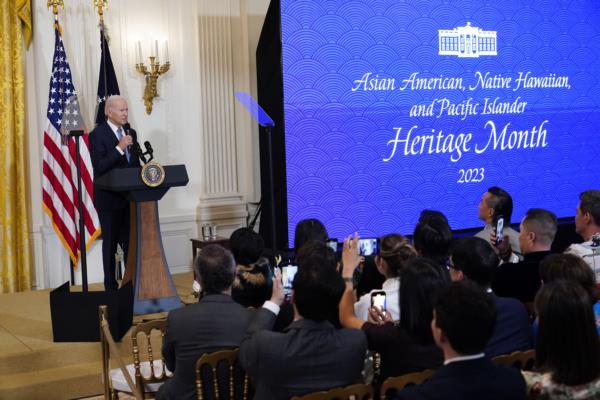
It has been almost 50 years since the U.S. government established Asian American, Native Hawaiian, and Pacific Islander Heritage Month to recognize the accomplishments of these communities. What began as a weeklong celebration in May has evolved into a monthlong tribute with events held in cities across the nation. The focus of the celebrations has also expanded to include not only festive elements like food and fashion but also discussions on grief and social justice, particularly in response to the rise in anti-Asian hate during the pandemic.
The origins of Asian American and Pacific Islander Heritage Month can be traced back to 1977 when Jeanie Jew, a co-founder of the congressional Asian-Pacific staff caucus, shared the story of her grandfather's contributions to the transcontinental railroad with Rep. Frank Horton. This led to the establishment of the first Asian/Pacific American Heritage Week in May. The month of May was chosen due to significant events in Asian American history, including the arrival of the first Japanese immigrants in 1843 and the completion of the transcontinental railroad in 1869 with the help of Chinese laborers.
Over the years, the observance has grown in significance, with President George H.W. Bush expanding it to the entire month in 1990 and President Barack Obama renaming it Asian American and Pacific Islander Heritage Month in 2009. President Joe Biden's administration now refers to it as Asian American, Native Hawaiian, and Pacific Islander Heritage Month.
Advocacy groups have used the month as a platform to bring resources to underserved communities and educate the public. The impact of COVID-19 and the increase in assaults on Asian Americans in the U.S. have underscored the importance of the heritage month's mission. Events planned for this year include a Lantern Festival for Justice and Remembrance, a panel on the Asian American Church, and an Asian Comedy Fest, showcasing the diversity of Asian American and Pacific Islander cultures.
These celebrations aim to dispel the notion of a monolithic Asian American and Pacific Islander population, highlighting the over 70 different ethnic and national groups and more than 100 languages spoken within these communities. The month serves as a platform for collective grief, cultural celebration, and advocacy for social justice within these diverse communities.









.png?w=600)




