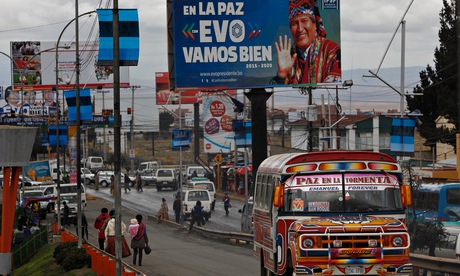
Above La Paz, gleaming red, green and yellow cable cars glide across the sky. Outside the southern city of Potosí, a formerly long-dormant smelting plant is turning out lead ingots. In the eastern state of Santa Cruz, a new project is bringing natural gas for cooking into more homes.
Bolivia is riding an economic high partly based on greater state control of natural resources and an unusually long period of political stability – not what critics expected when Evo Morales, coca farmer, unionist and the country’s first indigenous president, was elected in 2005.
Now Morales seems poised to win a resounding election victory – his third – that will take his presidency through 2020 and make him the longest-serving leader in Bolivian history.
Polls show him at 59 points, 41 points ahead of his closest competitor, thanks to the endorsement by labour and campesino organisations, and the support of many middle-class urban citizens. “Most people are voting for Evo because there is change,” said law student Marinalda Jemio.

Historically, Bolivia’s vast reserves of natural resources created great wealth for a small number. Under Morales, that has started to change. Investment in the transport system, cash grants for schoolchildren, women and the elderly, and a scheme to bring natural gas for cooking into more homes have led many voters to feel that Bolivia’s mineral wealth is finally benefiting its impoverished people.
In 2002, when Morales made his first bid for president, the US ambassador warned Bolivians against electing a man who rose to national prominence as the leader of the country’s largest coca farmers’ union. Coca has a long history of traditional uses in Bolivia but is also the raw material needed to make cocaine.
“Morales certainly disappointed conservative critics abroad and at home who claimed his tenure would lead to economic collapse, social chaos, unbridled cocaine production, violence and abandonment by the international community,” said Kathryn Ledebur, director of policy analyst group the Andean Information Network.
“He took almost everyone by surprise with sound, homespun macroeconomic policies, and an ability to confront US political pressure without immediate dramatic adverse consequences.” But as well as confounding his critics, Morales has also disappointed some of his supporters.
“The indigenous movement has been betrayed by this government,” said Cancio Rojas, one of the leaders of the National Council of Ayllus and Markas of Qullasuyu (Conamaq), a group of traditional governing bodies. Rojas, who was jailed and released for his role in a 2012 mining protest, said the government had failed in its promises to empower indigenous peoples and protect the environment – and sought to divide indigenous organisations that question its policies.
Morales has repeatedly pledged to give priority to the protection of Pachamama (Mother Earth) but, according to environmental activist Fabrizio Uscamayta, this has not led to concrete protections in Bolivia. “I think for us it’s painful because that [environmental management] was one of the principal points in government proposals, but sadly it’s the point that has been least accomplished,” he said.
The Bolivian constitution allows a president just two terms, but Morales’s party argued that because his first term was under the country’s former constitution, which was replaced in 2009, he can legitimately stand again. The constitutional court agreed, and public opinion seems to support the move. Morales has a great deal of company in Latin America when it comes to legally justifying extending a presidency, including Alberto Fujimori in Peru, Rafael Correa in Ecuador, and, perhaps most famously, Hugo Chávez in Venezuela.
Javier Pari, who works in a La Paz bank, says Morales will win the election not because of unreserved endorsement of his government, but because the opposition has failed to generate excitement. “There is no new political figure who has come out to say: ‘We’re different, we’re going to form a new kind of government’,” he said. “So even if people are against it [a third term], it’s going to happen.”