
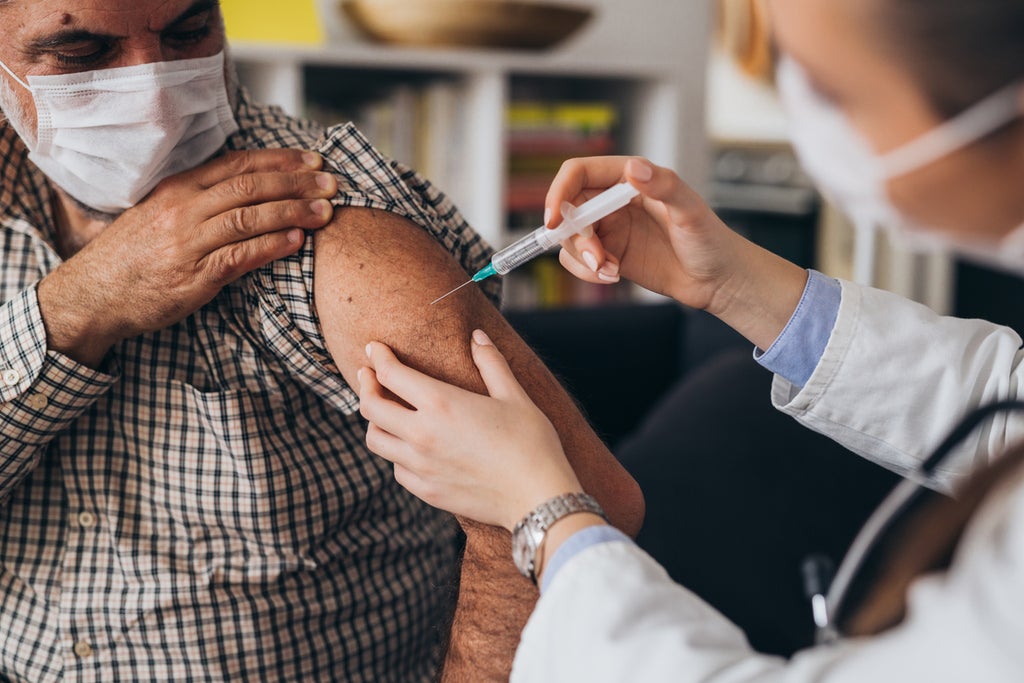
With plans underway to potentially offer the UK public Covid booster jabs in the coming months, the health secretary Sajid Javid has indicated they could be rolled out along with the annual flu jab drive.
The Joint Committee on Vaccination and Immunisation (JCVI) is meeting on Thursday morning to discuss the campaign for people who might “really need” a third dose of the vaccine.
It comes after the Centres for Disease Control and Prevention (CDC) in the US said it plans to start administering booster jabs to all Americans from 20 September.
But what exactly is a booster jab and why might we need them?
What is a booster jab?
A booster jab is an additional dose of a vaccine that was administered before, and gives the immune system a top up to ensure a good level of antibodies are present.
Dr Ashish Srivastava, GP and Medical Director at Gogodoc told the PA news agency: “Vaccines contain a weakened form of the disease-causing virus or bacteria, and work by triggering your immune system to attack the foreign organism, like it would if you actually had the disease.
“As a result, your immune system is able to ‘remember’ the disease-causing bacteria or virus, and if you’re exposed to it again, your body’s defence cells (antibodies) can recognise and kill the germ before it causes harm.
“Boosters are the same vaccine which can be given, weeks, months or even years after the first vaccine in order to boost your immune system with a further weakened form of the virus.”
Who will need a booster?
During the early planning stages of the booster programme, the NHS aimed to administer the jabs to more than 30 million of the most vulnerable people in the UK, including all adults aged 50 and above, and anyone over 16 who qualifies for a flu jab.
But according to Professor Adam Finn, a member of the JCVI, it is not yet clear if booster jabs should be reserved only for certain groups of people.
He told BBC Breakfast: “I think at this point we need to focus on individuals who are more likely, if you like, to get sick again if they’ve not got a booster.
“And in fact we’ll be having a JCVI meeting this morning to discuss exactly that. So, trying to identify the people who are really at risk and really need that third dose.
“I think it’s less clear really whether a third dose in a more general way, for sort of all people above a certain age, is really going to make very much difference.
“But at this point I think the main message is that the direct protective effects of these vaccines is excellent i.e. if you get the vaccination you’re in a much better place in terms of getting sick.”
When will Covid boosters be available?
The government has not yet announced when the booster programme will be rolled out, and much depends on the JCVI’s decision on who should get the third jab.
Prof Finn said a decision was “imminent”, but that more evidence was needed.
If the booster programme is rolled out in tandem with the annual flu jab drive, then they will be offered from September and throughout the upcoming winter season.
Are booster jabs needed for holidays?
Maybe. It has been reported that booster jabs might be needed for quarantine-free travel abroad.
A government source told the Mail on Sunday: “The assumption is that you will be required to have the most up-to-date health passport.
“So if the advice is to have a booster six months after your second jab, then that is what you’ll need.”
Currently, Britons who have received both doses of a Covid vaccine are exempt from quarantine when they return from countries on the UK government’s “amber” travel list. Those who have not yet been vaccinated must isolate for 10 days when they return.
But Austria and Croatia have set an “expiry date” on vaccination statuses, meaning tourists are only considered immune to Covid-19 for 270 days after a second jab. Without confirmed plans for booster jabs, UK travellers who were double-vaccinated in March 2021 could lose their right to visit these countries as early as November 2021.
No other EU countries have yet announced such deadlines for vaccination statuses.













