Felix Habarugira was a child soldier in the rebel army that brought Burundi’s president, Pierre Nkurunziza, to power in 2005. Now, he and thousands of others in the capital Bujumbura are demanding that Nkurunziza step down.
“Those we fought alongside in the rebellion got hold of power and then forgot us. Everything we fought for was a lie,” he says.
Habarugira grew up in Gitaramuka, in Karusi province in central Burundi. In 1993, aged 14, he says he left home with his two older brothers to fight for the rights and freedom of ethnic Hutus. That year, Burundi’s first multi-party elections had brought the first Hutu president to power. Three months later, the president was assassinated and the rounds of retaliatory violence began.
Habarugira fought in the civil war for 11 years, losing almost all of his close friends. He met Nkurunzia in jungle out-posts and remembers him as a respected commander. “But even those of us who liked him [then] now don’t. We’ve been disappointed,” Habarugira says.
He says the president’s promises of better education and economic development have failed to materialise during his 10-year presidency.
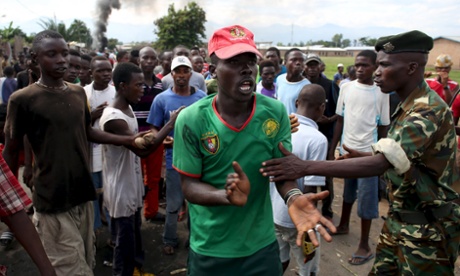
The former soldier has joined thousands of protesters taking to the streets of Burundi to demonstrate against Nkurunziza’s attempts to extend his rule for a third term. At least 20 people have died during the weeks of unrest.
Opponents say Nkurunziza’s bid for a third term violates both the constitution and the peace accords that ended the 13-year civil war in 2006. East African leaders are meeting in Dar es Salaam today to discuss the crisis, amid claims that the military has withdrawn its support for the president – who is out of the country.
“The country has been attacked by the very people supposed to defend it,” said Chauvineau Mugwengezo, president of the opposition UPD party. Opposition parties vowed to boycott the vote, saying they have no trust in the electoral commission and cannot campaign in a process they believe to be fundamentally flawed. Communal and legislative elections are scheduled for 26 May and the presidential elections 26 June.
During the unrest the government closed one of the country’s most popular independent radio stations, Radio Publique Africa, accusing its journalists of insurrection, and suspended the regional broadcasts of a number of others. In the countryside, a paucity of information fuelled fear and rumours. Since early April more than 50,000 people, mostly women and children, have fled the country with at least half of them going to Rwanda, according to the UN’s refugee agency.
International pressure on Nkurunziza to reconsider his decision has mounted. Belgium, the biggest bilateral donor for the elections, has suspended nearly $6m (£3.8m) in aid. The EU and US warned that credible elections could not be organised by June, but Nkurunziza rejected their request to delay, saying the vote will be “very peaceful, transparent and also fair”.
While previous conflicts in Burundi have torn the country apart along ethnic lines, today’s protestors are drawn from all ethnicities and age groups. They march, and sleep, in shifts; across the capital, people fear moonlit reprisals from violent and heavy-handed police. At the weekends, they call a truce to recuperate.
Twenty-one-year-old Alain Muhetoweintorere was one of those rising early on Monday mornings, rested and well-fed, ready to resume the fight.
“Nkurunziza has to obey the constitution,” he said, joining a swelling crowd that taunted police standing in a tight line behind riot shields. “Prices have shot up. There’s no justice; no killer ever sees a court room. If you report someone to the law, they come for retribution.”
Muhetoweintorere’s voice was drowned out by the crowd. “Shame on you, Nkurunziza,” they sang to a riff that has become the soundtrack to their demands.
As Burundians consider the implications of the army’s latest statement, many believe the uprising has been necessary. One political analyst in his 60s, who asked not to be named, declared that it was “good for democracy”, and showed that the people were willing to hold the president to account.