Careers advisers tell students who want to become sports journalists to study English. After another week of doping allegations and rebuttals – along with forensic discussions of off-scores, reticulocytes and the legality of publishing blood values – a working knowledge of chemistry, biology and the law appears just as valuable. Since the BBC Panorama documentary on drugs in sport in early June I have written around 110 articles for the Guardian; almost half have been on doping. It shows no sign of stopping.
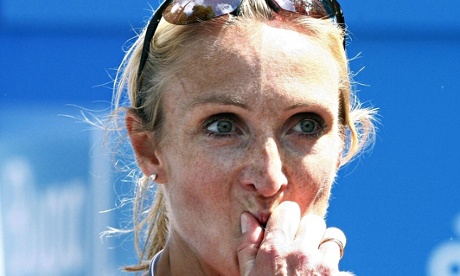
The last few days have been particularly sprawling and messy, what with the French anti-doping agency revealing suspicions that the European Rugby Champions Cup winners, Toulon, were supplied with anabolic steroids, and the authoritative boxing writer Thomas Hauser raising questions about whether Floyd Mayweather violated doping rules. Closer to home, Paula Radcliffe – so often a beacon of openness and light in this dank, scabby struggle – has appeared to lose her torch by appearing so defensive when questioned about her blood values.
Allegations that anti-doping authorities have been too cosy with athletes and administrators on the other side of the fence are even more serious. According to Hauser, Mayweather had an illegal intravenous drip procedure just before he fought Manny Pacquiao – only to be granted a therapeutic use exemption certificate 18 days later by the United States Anti-Doping Agency. The headline of Hauser’s article asked whether boxing could trust Usada. Some will now be wondering the same about UK Anti-Doping. The Sunday Times revealed that Nicole Sapstead, its chief executive, sent emails to the head of the British Olympic Association after they began exposing the problems of blood doping in athletics. In them she said: “We’ll do everything we can to ensure the focus is on the positive news. The last thing we want is a story like this detracting from the [one year to] Rio countdown.”
Agencies such as Ukad are the Maginot Line in the fight against drugs in sport – well-intentioned and solid-looking on the surface but all too easy to get around in practice. And it is certainly far from reassuring when its generals begin waving pom-poms. As Michael Ashenden, a world-leading blood expert, put it: “It would seem the [UK] anti-doping authority has morphed into a cheerleader for sport, anxious to quickly remove uncomfortable revelations of doping from the headlines.”
But sports can no longer shy away from the uncomfortable. The landscape altered forever when the depths of Lance Armstrong’s deviousness came to light. The public are more cynical, less trusting. It is not enough for an athlete to say they are clean. It is not enough for friends to back them up. It is not even enough for a governing body to vouch for them. Instead, at every step, twist and turn they have to ask themselves: what can I do to be more open and transparent?
Greg Rutherford gets it. As the world champion admitted, such is the perception of athletics that when his dad helped builders install a long jump pit in his home, one said: “Well, everybody’s on drugs, Greg included, surely.” Rutherford was horrified that anyone would believe that, and confirmed he would happily release his blood values. More athletes need not only to speak, but back up their words.
Of course we don’t know how many athletes cheat. Officially around 1% of tests are positive each year, but many experts I speak to suspect around 10% of athletes violate the rules. A Wada report in 2011 went higher still, estimating that a staggering 29% of athletes at the world championships in Daegu had taken a banned substance in the previous 12 months. Even if that figure is accurate, 71% of competitors were still clean. Most athletes are doing it the right way.
And I have sympathy for athletes and cyclists who feel that their sport gets too much of the negative focus on doping. Why would they cheat in higher numbers than, say, football or rugby players? It feels odd, at least, for us not to be at least a tiny bit suspicious when footballers are able to perform far more high intensity sprints than ever before, and rugby players are around two stone heavier than 20 years ago.
Most experts say that choosing to dope isn’t as simple as measuring risk versus reward; the incentives of cheating against the likelihood of being caught. Instead people “cheat to the level that allows us to cheat up to the level that allows us to retain our image as reasonably honest individuals”. Even so, it is worth pointing out that the rewards for most athletes are small. One recent survey form the US Track and Field Foundation found that more than 50% of athletes ranked in the top 10 in America in their event earned less than $15,000 a year from their sport. That’s around £10,000.
The rewards would theoretically be far higher, and the risks much lower, for a footballer in a minor global league. If that person could take EPO, get a reputation for having a big engine, and earn a transfer to a bigger league their contract would be much bigger than £10,000 a year. Reassuringly, Uefa announced on Friday it would introduce what it called the “strongest anti-doping programme ever seen in European football” by employing Wada’s biological passport scheme and stricter whereabouts rules. The caveat is that it is only for players in the Champions League and Euro 2016.
Still, it is a start. But Uefa, along with every other sporting body, needs to do much more to tackle doping. And all sporting administrators should know this: if they are not willing – even eager – to catch even the biggest names, regardless of the short-term harm to their sport’s public image, then their anti-doping programme is a mere chimera.