Over recent months, the British farming industry has been shouting loudly about the price of milk. In the face of fierce competition from low-cost retailers such as Aldi and Lidl, the UK’s major supermarkets have been cutting prices ever lower on a range of household basics, including milk, which can now be bought on the high street for as little as 89p for four pints.
To pay for this cost-cutting, people further down the supply chain are being squeezed, with some supermarkets apparently paying dairy farmers less than it costs them to produce their milk. Last month, farmers in the UK’s north-east took to the streets to raise awareness of the issue with the public.
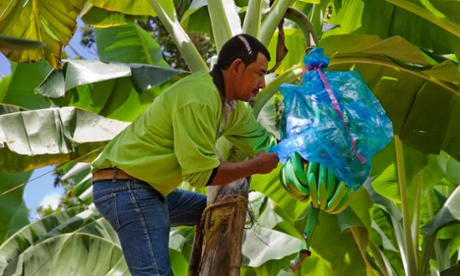
The difficult position that UK milk farmers are in, looks a lot like that of banana farmers in developing countries, who despite growing the UK’s favourite fruit often struggle to earn enough to make a living. As Fairtrade’s Make Bananas Fair campaign highlighted last year, the price that shoppers pay in UK supermarkets for loose bananas has halved over the last 10 years, while the costs of producing them have doubled.
Ultimately, it is banana farmers that are paying the price for our cheap fruit. Fairtrade’s campaign called for the UK government to take action on unfair pricing, and asked retailers to ensure that banana farmers are protected from the impact of their price wars. The UK government, perhaps with one eye on the upcoming general election, has been keen to show it is listening to concerns raised by farmers, at home and abroad. In Parliament earlier this year, the Prime Minister agreed that more needed to be done. “Specifically on the Groceries Code Adjudicator … it is time to make sure that [it] has the power… to levy fines so that it can get its will obeyed,” David Cameron said in January. As an independent regulator, the Groceries Code Adjudicator (GCA) has the important job of ensuring that supermarkets treat their suppliers fairly. Christine Tacon, the adjudicator, has been looking closely at relationships between retailers and their suppliers over the last 18 months and recently announced the GCA’s first formal investigation.

From April, it will have new powers to fine supermarkets up to 1% of their UK turnover if they breach the groceries supply code of practice.
These new powers sound useful, and they are. But there is an important loophole. Currently, the GCA’s remit only extends to supermarkets’ direct suppliers. But most farmers don’t sell directly to a supermarket. Instead, they sell to a trader, who then sells their produce on – so under current rules, they can’t ask the GCA to help them if they are treated unfairly.
Fairtrade’s banana campaign called for this loophole to be closed, and we continue to call for the GCA’s remit to be strengthened and extended, so that it can ensure that all suppliers to the big retailers, including those further down the supply chain, are treated lawfully and fairly.
Actually, even this doesn’t get to the core of the problem. Neither the GCA, nor any other government body, has the power to ensure that supermarkets pay farmers at least the cost of production. In fact, the law effectively pushes supermarkets in the other direction. In 2007, the Office of Fair Trading, now replaced by the Competition and Markets Authority (CMA), fined supermarkets that tried to agree a minimum price for milk to the tune of millions of pounds.
Nobody wants cartels, which keep prices artificially high. But while low prices may appear to be in shoppers’ short-term interests, do they really serve our long-term interests?
Paying farmers less than it costs to produce their goods is just not sustainable. Low prices have led to the number of dairy farmers halving over 10 years, with the UK increasingly needing to import milk. What does that mean for our wish to buy British in the long term? If most of our milk comes from overseas in future, what happens if there are shortages? Surveys show that the public will pay more for their groceries if it means that the farmers and workers who grew their food receive fair prices and are well treated. But regulators are either uninterested in acting, or are powerless to do so.
There are things that can be done. Buying Fairtrade is a good way to guarantee that farmers in developing countries, who grow commodities such as bananas, tea or coffee, earn at least the Fairtrade minimum price, which aims to cover their costs of sustainable production, plus the Fairtrade premium, an extra amount that they can invest in their businesses and their communities. Commitments from retailers to move towards payment of a living wage for the workers in their supply chains are also welcome. But beyond voluntary action by consumers and retailers, we need to do more to ensure that the market works in the long-term interests of both farmers and consumers.
We’re a long way from that at the moment. We need the penny to drop with regulators, that maximising public welfare means more than giving us a cut price banana.
Content on this page is paid for and provided by Fairtrade Foundation