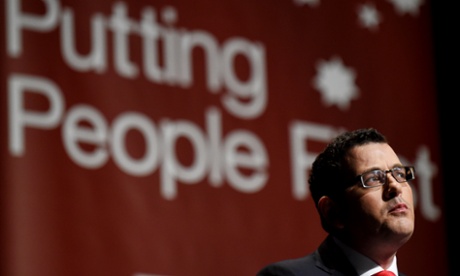
Daniel Andrews, Victorian Labor’s candidate for premier, last Friday rejected the Greens’ offer of clear preferencing in the lower house in return for the same in the upper house.
“No deal will be offered and no deal will be done, because the last thing I am ever going to sign up to is unstable, minority government,” Andrews said.
“We need to end the instability, the chaos, the dysfunction that has come to define Victorian politics over the last four years ... The best way to achieve that is a strong, stable, majority Labor government.”
You would think that a party like Labor with a centre-left legislative agenda – and if present polling is correct, a strong likelihood of winning government – would be keen to shore up a deal with the party most likely to vote with their legislation when it hits the upper house.
The Greens are the strongest of the parties to the left. Both Labor and the Liberal party won’t commit to preferencing, which favours the rightwing microparties: PUP, for example, or the conservative Christian outfits like Rise Up and Family First, the ancient Catholics of the DLP, the Shooters party and the libertarians-in-bikinis of the Sex party.
The structure of Victoria’s second chamber presents a greater likelihood of a candidate from one of these microparties getting elected; Dennis Napthine, the Victorian premier, has confirmed his party will preference Rise Up before the Greens. Pollsters like William Bowe tip the huntin’, fishin’, shootin’ Country Alliance as the party most likely to benefit from Labor’s electoral game playing.
The rightwing minor parties in the federal Senate have already been a niche interest nightmare for Tony Abbott’s government. By contrast, Julia Gillard’s negotiations with the Senate Greens allowed her to pass the greatest number of bills since the end of the second world war. If what Andrews wants is to end the “chaos and dysfunction” of Victorian government, preference deals that could elect a Jacquie Lambie type (or another Geoff Shaw) to the balance of power in Victoria will keep the circus in town.
ALP “pragmatists” have reasons to hedge their bets. Greens supporters vote centre-left on values anyway; in the absence of deals in the past, around 80% of Green preferences still flowed to Labor. Preferencing on a seat-by-seat basis also gives Labor the privilege of publicly distancing themselves from the Greens.
Thing is, the Labor tendency to defer to hierarchy rather than talent in the appointment of personnel to strategic decision making has compromised their own agenda in the past. Victorian Labor preferences in 2006 revived the electoral fortunes of the DLP after their 50 years in the wilderness, electing one to the upper house and very nearly with the balance of power.
And every single student in Australia has Labor to thank for the preference deal that elected notorious Family First senator Steve Fielding to office in 2004. He consistently voted with the Howard government, including on the bill to smash the student unions.
Such Labor deals were roundly criticised by Labor identities like former premiers Joan Kirner and John Cain. “We should put our preferences with the people who are like-minded in terms of social justice and social reform,” Kirner said at the time of the 2006 DLP deal.
What’s happened since, of course, is the seizure by the Greens of once-safe lower house inner city seats - Adam Bandt federally in Melbourne and Jamie Parker for Balmain in New South Wales. Parker and Bandt have frustrated the expectations of a generation of aspirational Labor careerists who have come to view the Greens as a threat to their personal ambition.
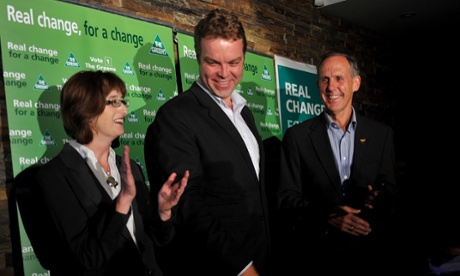
These Greens candidates are rising on a combination of disaffected Labor voters casting protest ballots on values; visible local community organising that a top-heavy Labor has largely forgotten how to do; and the emergence of a youth and digital-industries vote Labor has no idea how to speak to. The Labor hierarchy, both locally and nationally, would have to restructure its operations and beliefs to address the shifts in the inner city electorates where they are losing ground.
Their only strategy against the innercity Greens has been a resort to ugly personality politics. That’s an inept tactic. The Melbourne vote for Adam Bandt increased in the last federal election.
It appears the genius of the Liberals in the last federal electoral cycle was to identify this as Labor’s weak spot. Gillard’s ability to pass volumes of legislation relied on Greens support and the Coalition have made a tactical effort across the country to exploit tensions in the Labor-Green relationship to destroy it.
Former Liberal premier Ted Baillieu’s “put the Greens last” mantra in the 2010 Victorian election was never about the Greens. Really it was about Labor, who could have defused the Liberal offensive by laughing Baillieu off as a clumsy old conservative terrified by a tiny handful of inner city hippies whose votes were never going to change the government.
But Labor’s own existential fear of said hippies claiming inner city seats got the better of them - despite Baillieu’s preferencing effectively securing them for Labor. Tempted into taking Baillieu’s bait, Labor has spent four years since disavowing their relationship with the Greens.
It’s Labor orthodoxy to believe that perceptions of a close relationship with the Greens cost them government in Victoria four years ago; analysts at the time identified the 11-year Labor incumbency in Victoria, ongoing problems with public transport and a white elephant desalination plant as the actual issues at play in the key swinging seats.
The Liberals are playing the same game this election. “If Daniel Andrews and Labor fail this simple test of putting the Greens last on their how-to-vote cards,” Napthine said, “then all Victorians will know that if they vote for Labor they’re voting for a Labor-Greens alliance.”
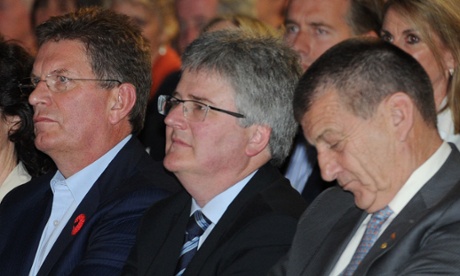
Labor is trapped by its own mythology on the Greens: if they win the balance of power in the lower house by taking Melbourne and Richmond, Daniel “no deals with the Greens” Andrews must either allow the Liberals to govern, or prepare to be called a liar.
The reality is that with the days of bicameral majorities growing ever unlikely – the electorate is shifting to the left, and the Green vote amongst those aged 18-24 is now almost equal to Labor’s at 31% – a governing Labor party will struggle to pass centre-left legislation without Green help in any case.
The ultimate outcome is the nobbling of centre-left politics. Labor preferences against their own ultimate legislative interests, while engaging in electorally unpalatable behaviour. Labor attacking the Greens smacks of professional politicians warring with each other instead of collaborating to achieve community outcomes. That harms Labor, but benefits the Greens.
And when a major party like Labor scraps with a minor one like the Greens, its the major party’s credibility that gets damaged. When a wolf attacks a chihuahua, it makes the chihuahua look plucky - and the bear in the corner look unbeatable. In Australia, we like underdogs and winners; we have no time for the dude in the middle who’s pissing around.
The Liberals learned the lesson that the way to deal with a minor party is to absorb its base through coalition, but draw as little attention to its existence as possible. Anyone who’s ever had to engage the National Party knows they are an antediluvian unit of kooks with worldviews that would pop the eyes out of any Labor/Liberal swing voter with a basic grip of biology, 21st century history or the hard, tough surfaces of material reality. Yet the Liberals are more than happy to hoover up their support and in the last Victorian dealt the Nats into 10 seats.
It’s not the only lesson learned by the Liberals that Labor would be sensible to emulate. The triumph of Abbott at the last election was not a triumph of policy, as the mass opposition to the reviled federal budget has revealed. It was a victory of appearances: that is, of a strong, united Abbott Coalition’s willingness to govern compared to that of an ALP Gillard-Rudd mushroom-marinated bush-doof publicly indulging petty rivalries.
If Labor makes gains in Victoria, that won’t be because Andrews refuses to deal with the Greens, but because the long blind giant of Trades Hall finally has leadership dancing with its eyes open. 1500 volunteer ambos, nurses, firefighters and other community members, feeling the reality of Liberal cuts, have doorknocked on services issues across six marginal seats: polls in three of these now have the Liberals visibly behind.
Contrast this show of activist strength around existing community sentiment to the effect of Victorian upper house ALP candidate Phil Dalidakis, who spent a week on Twitter shopping around a meme blaming Labor’s 2013 federal election loss on the Greens refusal to pass Labor’s ETS bill of... 2009. The Liberals rely on Labor falling into these kinds of symbolic, discursive and behavioural traps, because while swing voters want cohesive leadership, study after study keeps showing the vast majority of Australians actually lean to the centre-left values on the Labor and Green side.
Australians didn’t vote against Whitlam in 1975 because they didn’t like what his government had achieved, they voted against him because they no longer believed he could govern, which was why Fraser kept the hallmarks of Whitlam’s structural achievements in place. Australians prefer services to tax cuts, they vehemently oppose privatisation, they support welfare, pensions, quality state education and universal healthcare. The best way for Labor to deal with the Greens is actually to accept what help the Greens offer, and stop damaging their brand by playing scrappy personal politics.
Labor should recognise that a seat that swings Green may be a personal loss but would still be a win for centre-left politics. Let the Greens falter before the electorate in their own way, if that’s what will happen; Labor’s energies would be better spent on Trades Hall-style campaigning to capture Liberal seats like, Mordialloc and Frankston. These seats, not the one or two the Greens may win in the city, are the ones that will allow them to govern.