Thailand is accelerating its transition towards cleaner transport, with commercial electric vehicles (EVs) emerging as a centrepiece of the country's sustainability drive.
From provincial bus routes to airport taxis and motorcycle taxis in Bangkok, pilot projects are multiplying, signalling a shift in how public and private transport may operate in the coming decade.
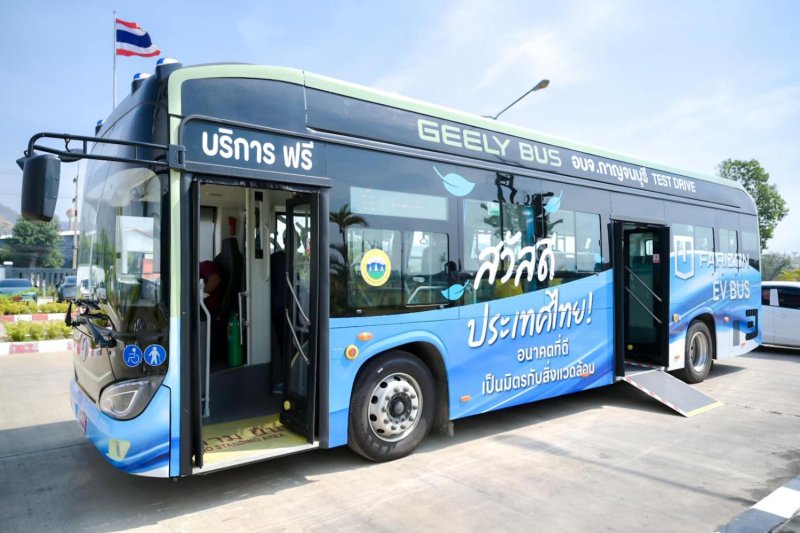
In Kanchanaburi, a province known for its historic landmarks and natural beauty, the state-run Electricity Generating Authority of Thailand launched an initiative through its subsidiary InnoPower.
The project replaces diesel-powered buses with battery-operated vehicles, offering tourists and residents alike a greener way to travel. The effort is part of a broader push to monetise green tourism while reducing emissions.
While the boom in commercial EV adoption is undeniable, challenges loom large. High upfront costs, infrastructure gaps and the need for domestic manufacturing capacity threaten to slow progress.
Thailand's EV journey is at a crossroads: the country is showcasing ambitious pilot projects, but scaling them to a nationwide structure requires overcoming financial, technical and regulatory hurdles.
GREEN TOURISM
InnoPower's pilot project in Kanchanaburi has become a symbol of how EVs can transform tourism.
The company, led by chief executive Athip Tantivorawong, partnered with the Kanchanaburi Provincial Administrative Organization to replace oil-run buses with battery-powered electric buses. The initial fleet consists of 12 Geely Farizon C10E buses, each designed with low floors, 30 seats and access for passengers with disabilities.
These buses operate along Route 6273 from Lad Ya to Tha Muang, passing iconic sites such as the Bridge over the River Kwai, Kanchanaburi Railway Station, schools and hospitals.
Mr Athip said the project is more than a transport upgrade -- it is a carbon credit opportunity.
"The project can help Thailand achieve its net-zero goal by 2050," he said.
Carbon credits generated from reduced emissions can be sold to other companies, creating financial incentives for green projects.
InnoPower plans to expand its fleet to 200 buses nationwide this year, targeting other state-regulated bus systems for conversion.
The company is also considering opportunities from Thailand's forthcoming climate change bill, expected to pass this year.
The legislation provides mechanisms for tourism businesses such as hotels, resorts and attractions to access funding for EV investment.
AGENCY PUSH
Other state agencies are preparing to follow suit, adopting EVs for transport in urban areas.
The Bangkok Mass Transit Authority (BMTA) is exploring EV adoption for its bus fleet.
Airports of Thailand (AoT) introduced electric taxis at Suvarnabhumi airport, and the Bangkok Metropolitan Administration (BMA) is piloting electric motorcycle taxis. These moves are expected to enhance Thailand's image as a leader in sustainable transport.
Transport Minister Phiphat Ratchakitprakarn confirmed procurement of 1,520 electric buses, with deliveries beginning next year and continuing through 2028.
The BMTA wants to reduce its fleet size from 2,800 to 2,300 buses, aiming to cut fuel costs by more than 60%, compared with diesel and compressed natural gas.
AoT's electric taxi service at Suvarnabhumi offers environmentally friendly "VIP taxis" with fares starting at 150 baht for the first two kilometres, supported by dedicated charging stations.
Meanwhile, the BMA's "EV for Motorcycle Taxi Drivers" campaign, backed by German development agency GIZ and King Mongkut's University of Technology Thonburi, provides rental models costing 75-140 baht per day.
More than 200 drivers and city staff have joined pilot programmes, with battery-swapping systems supporting daily operations.
STRUCTURE
Analysts caution that pilot projects alone will not guarantee success.
Nattaphorn Buayam, a research fellow at Thailand Development Research Institute, said the system must include purchase incentives, charging infrastructure, battery supply chains, regulations and recycling systems.
She highlighted the cost challenge, noting electric trucks cost nearly 2 million baht more than diesel trucks, or 1.5-2 times higher.
While there are energy savings, per-trip expenses remain higher -- 2,700 to 2,900 baht for EV trucks compared with 1,600-1,700 baht for diesel, said Ms Nattaphorn.
Infrastructure investment in charging stations and advanced batteries adds further costs. Without a supportive system, businesses may hesitate to invest, she noted.
To transition oil-fuelled trucks to EVs, Ms Nattaphorn suggested starting with sectors prepared for electrification, such as employee shuttle services in industrial estates and container transport at ports.
She also stressed the importance of building domestic manufacturing capacity.
"If Thailand remains solely an importer without local production, the transition to electric trucks will be in jeopardy," said Ms Nattaphorn.
Localisation of parts and battery production is critical to ensure competitiveness and avoid dependence on foreign supply chains, she noted.
PROMISE AND PRESSURE
Thailand's commercial EV boom reflects both ambition and urgency.
Pilot projects in Kanchanaburi, Bangkok and Suvarnabhumi airport demonstrate the potential for cleaner, more sustainable transport. Yet the challenges of high costs, infrastructure gaps and reliance on imports underscore the complexity of scaling up.
The government's climate bill and net-zero targets provide momentum, but the road ahead requires coordinated action across agencies, businesses and communities.
For Thailand, the EV transition is not only about technology, but also building a structure that balances economic feasibility with environmental responsibility.