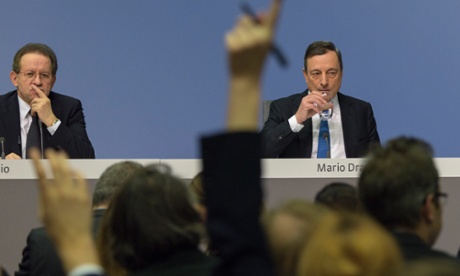
Buying €60bn worth of assets a month for 18 months sounds like an enormous commitment. It amounts to €1.1tn from the European Central Bank, enough to ensure a liberal serving of stock phrases about president Mario Draghi unleashing his “big bazooka” to achieve “shock and awe”.
Certainly, it was enough to excite markets. Share prices rose across Europe, government bond yields fell and the euro slumped. The latter will import a little inflation (the whole point of the exercise) and help eurozone exporters become more competitive.
But, if we’ve learned anything over the years about the eurozone’s attempts to help itself, it is never to trust the market’s first reaction. Initial wild enthusiasm is often replaced by a sinking realisation that the problems go very deep indeed. Exhibits A and B would be the two Greek bailouts. The second reaction was: when’s the next one?
One could also pose the same question to the European Central Bank about QE: what happens in September 2016 when the initial €1.1tn programme is exhausted?
The hope, of course, is that the job will be done by then – that the deflationary threat will be tamed and that the ECB, instead of downgrading growth forecasts every time it speaks, will be announcing upgrades. But isn’t it more likely that the outlook will be blurry and the ECB will face calls to launch QE2?
That’s how the script played out in the US and the UK, which took the plunge (the US even had QE3). Economists at Societe Generale are already predicting that €2tn-€3tn of QE will be needed to restore inflation in the eurozone to close to 2%.
Would sceptical Germans cheer another dose of monetary medicine that, come September 2016, may have produced only minor improvements? Not without a fight, one suspects. Thursday’s vote was not unanimous and Draghi was forced to accept that 80% of any losses from bond-buying will sit with national central banks.
Note, too, that Draghi was ambiguous about whether the ECB’s programme is open-ended. He said buying will continue until at least September next year and “in any case be conducted until we see a sustained adjustment in the path of inflation”. That leaves plenty of room to squabble over the meaning of the phrase “sustained adjustment”.
One shouldn’t be too churlish, of course. The eurozone has needed a shot in the arm for at least three years and the ECB seems to be the only body capable of constructing a consensus, if not unanimity. Deflation had to be confronted. Draghi has done well to get to this point given the eurozone’s poisonous politics.
But the politics will remain messy, Greece’s exit from the euro is possible and the eurozone is starting with rock-bottom interest rates already. Something is better than nothing but the eurozone simply doesn’t do miracles.
Balfour uncertainty
A “conspiracy of optimism” has reigned at Balfour Beatty, says Leo Quinn, the new Mr Fixit chief executive, summarising what shareholders had worked out for themselves after five profits warning in two years, and then a sixth yesterday.
In the UK construction division, tendering for bids was too aggressive and cost controls were inadequate. In short, Balfour had thought it could get the job done for less than it actually took. Quinn’s prescription is as you would expect: charge a proper rate for the job, control costs and apply common sense.
Jolly good, but also jolly vague on detail. Carillion, when it was bidding unsuccessfully for Balfour, reckoned the combination could produce cost savings of £175m. How much could Balfour achieve under its own steam? There was a suggestion that it might be half. But this was not a firm commitment. Nor do investors know what Balfour will have to spend in up-front restructuring costs.
In the meantime, shareholders must digest the hard fact of a further £70m shortfall in UK construction profits after a review by KPMG’s number-crunchers. That sum is roughly approximate to what Balfour, in fixed form, would hope to earn from the division in a full year – in other words, a 3% margin from turnover of £2.5bn. And the provisions may yet get bigger once the board’s review is unveiled in March.
The consolation for shareholders is that the investment division – containing schools, hospitals, court houses and the like – has been revalued upwards again. It is now worth £1.3bn, some £250m more than six months ago. No wonder Quinn is keen to keep it. But one also assumes John Laing Infrastructure Fund, which made a cheeky £1bn offer for the unit, won’t be so keen to bid for it.
In that case, and assuming Carillion is also out of the frame, shareholders are left with a self-help story. Quinn, who has delivered effective kicks to De La Rue and Qinetiq in the past, is the right man for the job. Starting at 215p a share, it’s possible he can conjure a terrific recovery tale. Some analysts already see 250p of value counting all the parts, which include a healthier US division and joint ventures in the Middle East and Far East.
Be wary. The line that spoke most loudly yesterday was the one about how changing the group’s culture will “take time”.
As if to emphasise the point, the £200m share buy-back, the last slops from a disposal, has been cancelled and the dividend may be next. Precautionary measures? Maybe, but there’s a lot to be cautious about at Balfour.