With this, we’ll wrap things up. Good night, thank you for reading and for all your great comments. We’ll be back on Monday.
The presser is over. And the overarching conclusion in Athens is that had a deal not been cut, Greek banks would have suffered the fate of those in Cyprus - and been forced to implement capital controls, says Helena Smith.
The Greek finance minister Yanis Varoufakis is still firing on all cylinders as he addresses the international press in Brussels.
Bravura performance by a man who is never at a loss for words, says Helena Smith adding that the neophyte politician has spent much of the presser persuading Greek journalists that the new government will not roll back on its promises to abolish austerity.
“If you just want a yes or no you can’t get that from me. I talk too much,” he has just told reporters.
Varoufakis made clear that the agreement will cease to exist if Greece’s creditor institutions don’t accept the reforms Athens proposes. He also said that Greece’s left-dominated government will, and is very willing, to seek advice from its political opponents on the various changes the country will put forward on Monday.
Updated
Here is some instant analysis from Raoul Ruparel, head of economic research at think tank Open Europe:
What does today's #Greece agreement do and why? All the answers in our instant analysis: http://t.co/egVQaC3KKo
— Open Europe (@OpenEurope) February 20, 2015
Updated
Another line from German finance minister Wolfgang Schäuble:
I can stand behind today’s agreement.

Updated
Wall Street has closed. The Dow Jones and S&P 500 notched up fresh record highs.
- The Dow is up 0.8% at 18,137.36
- The S&P 500 closes 0.6% higher at 2,110
- The Nasdaq rises 0.6% higher to 4,955.44
Updated
The European Central Bank said there is now no need for Greece to impose capital controls.
An ECB source told Reuters:
Capital controls are out of the question.
The Greek finance minister has made a HUGE confession, reports Helena Smith.
Our big anxiety now is whether we can enforce these reforms. That is the big national bet,
Varoufakis has just told reporters speaking in Greek tonight. He was speaking of the need to crack down on tax evasion and corruption.
Updated
Greek finance minister Yanis Varoufakis insisted that the new leftist-led government would do what few of its predecessors had done: keep to a balanced budget. He told reporters in Brussels:
The only commitment that we took today is that whatever measure we take will not affect fiscal stability.

Updated
What does the statement really mean?
.@lorcanrk wins finance twitter, again. The Eurogroup presser explained. Click on the paragraphs. http://t.co/m5h98DDqwD
— Stephen Kinsella (@stephenkinsella) February 20, 2015
Meanwhile, German finance minister Wolfgang Schäuble said Greece won’t receive new funds unless it completes its bailout programme, according to Reuters:
The Greeks certainly will have a difficult time to explain the deal to their voters.
As long as the programme isn’t successfully completed, there will be no payout.
Updated
The verdict of analysts in Athens: Greece under it’s new leftist-led administration has made the big concession of extending the bailout programme as enforced by the previous government, but it has agreed to do so on its own terms, according to Helena Smith
- Enforce reforms of its choosing
- Roll back on austerity measures to deal with the humanitarian crisis
The Greek finance minister Yanis Varoufakis has kicked off his own press conference saying: “three Euro groups were needed to change page - in Greece and in Europe,” reports Helena Smith in Athens who is watching the press conference (in Greek).
He has just described the deadlines demanded of Greece and its newly installed government as “inhuman” and has spoken of the need to respect the electorate’s will.
This is not a moment for jubilation. This agreement is a small step in the right direction.”
Updated
So much for mutual trust. Dijsselbloem said the eurozone funds to recapitalise Greek banks held by Greece will remain available for that purpose – but the €11bn will from now on be held by the eurozone bailout fund and released only at the request of the European Central Bank.
Updated
How much has Greece actually won, other than some breathing space?
Eurogroup chair Jeroen Dijsselbloem said Greece agreed to have “appropriate” fiscal surpluses to guarantee debt sustainability.
The Eurogroup reiterates its appreciation for the remarkable adjustment efforts undertaken by Greece and the Greek people over the last years. During the last few weeks, we have, together with the institutions, engaged in an intensive and constructive dialogue with the new Greek authorities and reached common ground today...
The Greek authorities have also committed to ensure the appropriate primary fiscal surpluses or financing proceeds required to guarantee debt sustainability in line with the November 2012 Eurogroup statement. The institutions will, for the 2015 primary surplus target, take the economic circumstances in 2015 into account.
Updated
The press conference is over.
You can read today’s agreement in full on the Eurogroup’s website here.
IMF chief Christine Lagarde just clarified that the current bailout expires in March 2016.
A Greek government official has told Reuters that today’s agreement gives Greece time to work on a new financial deal.
Greece today has turned a page... We have avoided recessionary measures.
Deal freezes into a process what Varoufakis got Thursday. @Dijsselbloem language conciliatory on GR domestic programme going forward.
— Paul Mason (@paulmasonnews) February 20, 2015
Dijsselbloem sidestepped a question on when the first disbursement of money to Greece will be made.
Updated
During the Q&A in Brussels, Dijsselbloem stressed:
Economic recovery cannot be put in danger, fiscal stability cannot be put in danger, financial sector stability cannot be put in danger.
Euro rallies, Wall Street up
The euro is rallying on news of a deal. It’s now trading at $1.1389. On Wall Street, the Dow Jones rose 0.85 to 18,124.33 while the S&P 500 rose 0.5% to 2,108.16.
Lagarde:
We look at it as a set of stages and timeline by which work has to be done. We are very pleased that work can begin.
The troika will look at the list of reforms which has to be submitted by Greece by Monday night. Assessment by the institutions on Tuesday.
Updated
Over to IMF head Christine Lagarde. She said:
It has been a laborious but eventually constructive process.
The end of April has been set as a deadline to agree a final list of Greek reforms with the country’s creditors.
Updated
He concluded his opening statement by saying:
This is a very positive outcome.
Updated
Dijsselbloem said the agreement was an important first step in rebuilding trust. The Greeks asked to extend the financial rescue by six months, but eurozone ministers agreed on four.
He said Greece will present a list of reform measures on Monday and the institutions will then assess if they are comprehensive enough.
Updated
The press conference in Brussels has kicked off. Eurogroup chairman Jeroen Dijsselbloem said Greece had given “their unequivocal commitment to honour their financial obligations” to creditors.
Updated
An agreement has been reached but analysts in Athens are already describing the concessions made by the Greek government as “politically poisonous,” Helena Smith reports.
Prime minister Alexis Tsipras’ government will almost certainly face fierce reaction from militants in his radical left Syriza party and from the populist right-wing Anel, his junior partner in the governing coalition. “Very heavy concessions have been made, politically poisonous concessions for the government,” Pavlos Tzimas, the veteran political commentator, has just told SKAI news. “It’s going to be a crash test on the domestic front for the government,” the television channels says. “The big question now is what reforms the government is going to agree to,” Takis Hadzis, another commentator, has also told Skai news.
Any reforms will have to be endorsed by the Greek parliament.
Press conference in Brussels to start soon.
Deal to extend Greek bailout by four months "done"
Looks like a deal on Greece has been reached. Reuters reports that Greece and eurozone finance ministers have agreed to extend the Greek bailout by four months. One official said:
It’s done. For four months.
Updated
I know we hacks have a cushy life, but waiting like a lemon for a draft EU or eurozone communique is so TEDIOUS #Greece
— Robert Peston (@Peston) February 20, 2015
I see my Brussels colleagues are so close to the edge that they've started playing #EurogroupMovies. Jesus
— Robert Peston (@Peston) February 20, 2015
Updated
More from our Athens correspondent Helena Smith:
Brussels-based Greek correspondents are reporting that the euro group is about to end. “They came here determined to have a political solution otherwise on Tuesday it would have been necessary to enforce capital controls [on Greek banks],” Eleni Varvitsiotis, SKAI’s reporter has just told the Athens-based TV station. Reports that a press conference will start in Brussels around 8pm GMT.
Greek prime minister Alexis Tsipras is “in constant contact” with finance ministry officials attending the euro group. Aides close to the Greek leader have let drop that both the Spanish and Portugese finance ministers attempted to disrupt the euro group meeting but were overuled.
“It is obvious that a very clear threat was levelled re [the possible closure] of Greek banks,” the leading political commentator Alexis Papahelas has just told SKAI news adding that a compromise appeared to be in the offing.
Precisely because Tsipras had made been forced to make concessions, he will face uproar on the domestic front, not least from militants in his radical left Syriza party and disappointed voters.
Looks like Germany isn’t the only one Greece has to win over. (Spain and Portugal have anti-bailout parties nipping at their heels.)
#Greece Skai tv reports Spain and Portugal tried to block the deal btwn Greece-Eurozone and had strong objections
— Efthimia Efthimiou (@EfiEfthimiou) February 20, 2015
In Athens, SKAI TV’s flaghsip news programme has confirmed that Greece must produce a list of reforms by Monday - and that it will be a labour-intensive weekend for the government.
The reforms will include Greece detailing how:
- it will crack down on tax evasion and corruption - both endemic in Greek life
- it will reform the country’s dysfunctional public administration
- it will tackle Greece’s humanitarian crisis, the result of six years of recession and relentless EU-IMF-dictated austerity, the price of emergency rescue funds

White smoke in Brussels? "We hope that in half an hour it's over," says one official.
— Jennifer Rankin (@JenniferMerode) February 20, 2015
Lest we get carried away...
Aides in Greek prime minister Alexis Tsipras office are suggesting that while progress is being made a deal may well be some way off yet, says Helena Smith.
“Lets wait to see the final result because the devil is in the details,” one insider has just told the news portal newsit.gr.
Draft text proposes extending Greece bailout by 4 months
The draft text proposes extending Greece’s bailout by four months rather than six as previously suggested, Reuters reports, citing officials from Greece and other eurozone countries.
News flash on Reuters: the draft agreement includes a requirement for Greece to submit a letter to the Eurogroup by Monday outlining all the measures it plans to take during the remainder of the bailout period, to ensure Athens complies with the conditions.
Updated
Up to €1bn withdrawn from Greek banks today – Greek TV
Mega TV is now reporting that up to €1bn has been withdrawn by worried investors from local banks in Greece today, says Helena Smith in Athens. It is citing central Bank officials as saying that if the outflows keep at this pace, local lenders will need emergency funding from the European Central Bank “within the next week” to avoid financial collapse.
The Greek government has apparently agreed to present “a list of reforms” to creditors by Monday, according to reporters outside the prime minister’s office. “The reforms will not include any measures that will worsen the country’s humanitarian crisis” Christos Tsigouris, Mega’s reporter, has been told by aides in the PM’s office.
European commissioner for economic affairs Pierre Moscovici tweets from the Eurogroup meeting in Brussels: “We’re making progress.”
On avance, on avance, on avance..
— Pierre Moscovici (@pierremoscovici) February 20, 2015
Déclaration à mon arrivée à la réunion de l'#Eurogroupe de ce jour : http://t.co/wKFQnERys9 #Grece #eu_commission #Eurogroup
— Pierre Moscovici (@pierremoscovici) February 20, 2015
Updated
Here are some comments from an EU official, who said that EU chief Donald Tusk won’t convene a summit of eurozone leaders on Sunday, even if finance ministers fail to come up with a deal on Greece, as reported earlier. Confirming that the Greek prime minister had asked Tusk to call a summit on Sunday if there’s no deal, the official said, according to Reuters:
There will be no euro summit Sunday. However, Tusk will not hesitate to convene a euro summit, should he consider that this will be the right way to handle the situation. Before convening a summit, all options in the Eurogroup should be exhausted.
Updated
A Greek government official said, according to Reuters:
There is an initial agreement on a joint draft text among the institutional partners, which is now being presented to all of the ministers.
The euro has risen further, to $1.1404.
Updated
Over in Athens, Mega TV on its flagship news programme is reporting the following, says Helena Smith:
- A four-month extension of Greece’s bailout programme is in the works
- The interim programme will not include austerity measures
- Greece commits to not making any unilateral moves - such as raising the minimum wage or protecting primary homes from foreclosures
#Greece govt source says agreement refers to 4 months extension and doesnt include austerity measures
— Efthimia Efthimiou (@EfiEfthimiou) February 20, 2015
European Council president Donal Tusk has ruled out holding a summit of eurozone leaders on Greece on Sunday – but stands ready to convene one in due course if necessary, Reuters reports.
Updated
Quoting a eurozone official, Reuters says the Eurogroup chairman Jeroen Dijsselbloem is now presenting the two-page draft statement to the 19 eurozone finance ministers.
A Greek government official told the news agency, after preparatory talks between the Greek and German finance ministers, and the managing director of the IMF (a creditor):
There is an initial agreement on a joint draft text among the institutional partners, which is now being presented to all of the ministers. Details may be defined later. But let’s see.

Updated
Meanwhile, the Greek news portal newsit.gr is reporting that Germany has no desire to see anything conclusive out of today’s euro group – and has gone so far as to suggest that Berlin’s objective is to deliberately sabotage negotiations so that an emergency summit of EU leaders is held next week.
Helena Smith in Athens says there is mounting speculation that a summit will be called next Tuesday, after the Greek bank holiday of ‘clean Monday” marking the start of Lent (and isn’t Lent an apt term! JK). “Germany’s aim is for tonight’s euro group to fail so that we are lead to a summit meeting in which Tsipras sits opposite Merkel and each one shows their cards at whatever cost,” the news site said.
The prime minister’s office has added to the prospect of such a summit taking place announcing (in the last few minutes) that prime minister Alexis Tsipras has just had telephone contact with the head of the European Council Donald Tusk and informed him that in the event of “a negative outcome” tonight, he will request that EU leaders meet on Sunday (as reported earlier).
Updated
Jennifer Rankin reports:
It is the end of the working week in Brussels, but the 19 finance ministers have only just started talks on Greece’s bailout deal. The start was delayed to allow for some last-minute shuttle diplomacy between Greece’s finance minister, Yanis Varoufakis, and his German opposite number, Wolfgang Schäuble, brokered by officials from the European Commission and International Monetary Fund.
The head of the IMF, Christine Lagarde, was one of the first to arrive for today’s meeting. Jeroen Dijsselbloem, the head of the eurozone, has also been deeply involved. With some understatement, he described the talks earlier as “quite complicated”.
It looks increasingly likely that anything agreed tonight will only be a holding deal, pending yet more talks.
Our reporter on the ground in Brussels tweets:
EU source: There is a text, which now needs to be adopted by ministers. #eurogroup #greece
— Jennifer Rankin (@JenniferMerode) February 20, 2015
Reuters reports that eurozone finance ministers gathered in Brussels have drafted a common text that could form the basis for an agreement to extend Greece’s bailout package, citing Greek and eurozone officials. However officials stressed that there is as yet no formal agreement.
The euro jumps on the news, close to session highs of $1.1394.
Eurozone ministers agree draft accord – Greek government official
Another news flash on Reuters: Eurozone ministers have agreed a draft accord with Athens that could extend the Greek bailout, according to a Greek government official.
Talks finally start in Brussels
Talks to save Greece from an imminent cash crunch have finally started in Brussels, Guardian reporter Jennifer Rankin reports.
The make-or-break talks between 19 eurozone finance ministers are running more than three and a half hours late, delayed because of last-ditch preparatory talks involving the German finance minister, Wolfgang Schäuble, and his Greek counterpart, Yanis Varoufakis.
You can read the full story here.
Updated
News flash on Reuters: The Greek prime minister Alexis Tsipras has asked European Council president Donald Tusk to convene an EU summit on Sunday if finance ministers fail to hammer out a deal today, according to a Greek government official.
Greece has reacted with fury to suggestions that it sent the “wrong” letter outlining its request for a sixth-month extension of its bailout programme, our correspondent in Athens Helena Smith reports.
The Greek media is reporting that an irate Yanis Varoufis emerged from talks in Brussels with fellow euro zone finance ministers this afternoon to vehemently denounce the allegation - carried in the mass-selling German tabloid Bild (as reported earlier).
Aides to the Greek prime minister Alexis Tsipras described the story as “a fanciful scenario” cooked up by people with “unhealthy imaginations.” They said:
The truth bears no reality, whatsoever, to these slanderous leaks.
Updated
Varoufakis has dismissed the report from German newspaper Bild that Greece sent the wrong letter to request a loan extension on Thursday. He tweeted (from the Eurogroup meeting in Brussels):
One must believe @BILD's tall stories (about us Greeks) at one's peril.
— Yanis Varoufakis (@yanisvaroufakis) February 20, 2015
Euro falls, stock markets mixed, Greek bond yields fall
Let’s have a look at the markets.
Greek bond yields pushed lower on hopes that Athens and Brussels will, eventually, reach a deal. Yields on ten-year government bonds dropped 8 basis points to 10.15% while three-year yields tumbled 57 basis points to 16.55%.
The euro has fallen against the dollar to $1.1362 while stock markets are mixed as the Greek debt drama continues. European markets are now closed.
- Greek stock market down 0.27% to 854.15
- FTSE 100 index closes 0.4% higher at 6,915.20
- Germany’s Dax up 0.4% at 11,049.38
- France’s CAC down 2.38 points at 4,830.90
- Spain’s Ibex falls 0.3% to 10,880
- Italy’s FTSE MiB up 0.2% at 21,842.57
- The Dow Jones is trading 2 points higher at 17,988.01
- The S&P 500 has slipped 0.1% to 2,094.67
Updated
More on those suggestions that a deal won’t happen today.
Newswire MNI reports that Eurogroup finance ministers aim to release a joint statement this evening on Greece which will outline that significant progress has been made in the negotiations, but a deal is being held up by “technicalities”.
A top EU official told MNI earlier today:
The aim, as it is at the moment, is to get the joint statement out this evening and hold a teleconference over the weekend to finalise the deal, if all goes well.
The official said the strongest objections to Greece’s latest proposal for a funding extension that is separate from some existing bailout conditions, came from Germany, the Netherlands and Finland, but added that these objections “were eased” after clarifications by the Greek side. He also noted that some delays were caused by Greece sending the wrong letter on Thursday [see 16:24].
Updated
While we are waiting for news from Brussels, here are some interesting charts courtesy of the Economist.
Greece's economic woes in charts http://t.co/720Wnrmkfd pic.twitter.com/7XQKtQShoZ
— The Economist (@TheEconomist) February 20, 2015
Greece sent "wrong letter" on Thursday – Bild
You couldn’t make this up. Apparently, Greece sent the wrong letter on Thursday, German newspaper Bild reports, citing government sources.
The right version supposedly accepted bailout conditions agreed to by the previous Greek government.
According to the report, Tsipras, Juncker and Dijsselbloem jointly drafted a letter on Wednesday. However, Varoufakis sent an altered version of the letter that omitted the parts that said Greece will accept the bailout conditions.
Tsipras later told Merkel it was an “administrative mistake.”
The Eurogroup meeting is supposed to start any moment now.
Updated
Eurogroup President Jeroen Dijsselbloem has given a brief statement before he chairs the meeting.
The eurogroup will start as soon as possible, but it’s quite complicated.
There is still reason for optimism but it is very difficult.
Updated
Austria’s finance minister said there was still much to discuss as he arrived for the eurogroup meeting in Brussels.
Hans Joerg Schelling said the Greek proposals left much to interpretation, suggesting clarity and more detail would be needed before an agreement is possible.
Austria’s Schelling: “We have a letter. This letter has many sentences with much space for interpretation. We have to work on it now...”
— Ed Conway (@EdConwaySky) February 20, 2015
Austrian fin min Schelling broadly shares German line: Greek letter leaves much to interpretation and this has to be ironed out.
— Jennifer Rankin (@JenniferMerode) February 20, 2015
Mario Draghi, president of the European Central Bank, has also arrived for the talks but didn’t stop to talk to reporters.

Perhaps he didn’t want to be drawn on those ECB Grexit plans...
German finance minister Schauble has pulled out of public debate Monday with George Osborne "because of the Greece situation", we are told
— Robert Peston (@Peston) February 20, 2015
This doesn’t fill me with hope that a deal is going to be struck today...
Eurogroup seeks joint statement w/ #Greece on Friday, Eurogroup official says. Could hold teleconference over weekend to hammer deal. (MNI)
— Holger Zschaepitz (@Schuldensuehner) February 20, 2015
The watchword for Germany is trust. For Greece it is honour. Still not clear the two can be reconciled.
— Jennifer Rankin (@JenniferMerode) February 20, 2015
Next up is Christine Lagarde, managing director of the International Monetary Fund.


Germany’s finance minister Wolfgang Schaeuble has arrived for the meeting in Brussels.
This is about being able to trust each other and that we can reinforce the trust in the future of this European unification project of people in all European countries.
That’s the actual task and that’s what we are working on with all our might.
German Fin Min Schaeuble arrives for key meeting on Greece: 'everything that needs to be said has been said.'
— Gavin Hewitt (@BBCGavinHewitt) February 20, 2015
(Shall we all go home then?)
Greece's Varoufakis arrives in Brussels, hopeful of a deal
Yanis Varoufakis has arrived in Brussels and has been speaking to reporters on his way into the eurogroup meeting.
He said he is still hopeful of a deal today, and suggesting Greece is offering a large dollop of compromise.
I trust that we are going to have one. The Greek government has not just gone the extra mile but the extra 10 miles and now we are expecting our partners not to meet us halfway but a fifth of a way.
I have no doubt there will be a very collegial discussion and hopefully at the end of this we come out with some white smoke.
Guardian reporter Jennifer Rankin is in Brussels and will be providing us with updates.
Varoufakis arrives at the eurogroup hoping for a deal: "The Greek government has gone not the extra mile, but the extra 10 miles."
— Jennifer Rankin (@JenniferMerode) February 20, 2015
#Greece: FinMin optimist at arrival to #eurogroup meeting - "there will be white smoke w/ a bit of luck" "@beanavarro pic.twitter.com/gVIJyY9yn6
— José Miguel Sardo (@jmsardo) February 20, 2015
Michel Sapin of France is here: the solution lies in every eurozone capital, everyone is working.
— Jennifer Rankin (@JenniferMerode) February 20, 2015
Updated
Upshot of Merkel-Hollande talks seems to be that further EU meetings on Greece - with france and germany in lead - are inevitable.
— Jennifer Rankin (@JenniferMerode) February 20, 2015
Merkel: goal is to keep Greece in euro

The German Chancellor Angela Merkel and French President Francois Hollande followed a meeting in Paris with a press conference.
Speaking ahead of this afternoon’s crunch meeting between eurozone finance ministers, Merkel said all member countries had a shared goal of keeping Greece in the single currency bloc.
She added however that Greece would need to make “significant improvements” to its bailout extension proposals.
Hollande sounded a bit more convincing about the desire to keep Greece in, saying there is no Grexit scenario:
Greece is in the eurozone and it must remain in the eurozone.
Updated
Angela Merkel and Francois Hollande are giving a press conference. It’s live here.
This is the moment for a historic political decision for the future of #Europe pic.twitter.com/vdBcv10UXk
— Alexis Tsipras (@tsipras_eu) February 20, 2015
But which way will it go?
EU official: Greek deal looking unlikely today
A deal is unlikely to be struck at the eurogroup meeting in Brussels today, an unnamed EU official has told Bloomberg.
The official said finance ministers might have a long meeting that is not conclusive, but added they might be able to agree on a “statement of progress”, with some commitments from Greece.
That could pave the way for more technical work, and a conference call between ministers on Sunday or Monday if necessary.
EU official says #Greece deal Friday night looking unlikely; Ministers might be able to agree on statement of progress
— Francine Lacqua (@flacqua) February 20, 2015
Same EU official says Progress Statement could pave way for more technical work and ministers could have conference call on Sunday or Monday
— Francine Lacqua (@flacqua) February 20, 2015
Meanwhile ... German 5 year yield drops to record low of -0.084%
— Francine Lacqua (@flacqua) February 20, 2015
Market jitters are really starting to surface now as hopes fade that a deal will be struck today
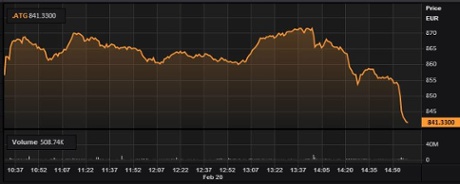
Greek shares have fallen into the red, with the ATG index down 1.7% at 841.6.
Malta: Germany is ready to let Greece go
The Maltese finance minister says countries led by Germany are prepared to see Greece leave the eurozone.
They are becoming increasingly frustrated with Greek government demands, according to Edward Scicluna.
He told newspaper Malta Today:
I think they’ve now reached a point where they will tell Greece: “if you really want to leave, leave”.
And I think they mean it because Germany, the Netherlands and others will be hard and they will insist that Greece repays back the solidarity shown by the member states by respecting the conditions.
The question at this stage is how to find a way for Greece to exit ‘nicely’ with its electorate accepting the programme, while showing that they are going to change something.
Greek investors are feeling less optimistic than they were at the beginning of the day.
The ATG index in Athens - up more than 1% this morning - is now roughly flat, up just 0.1% at 857.4.
Elsewhere in Europe, markets are mixed.
- FTSE 100: +0.3% at 6,913.22
- Germany’s DAX: +0.2% at 11,029.01
- France’s CAC 40: -0.3% at 4,818.58
- Italy’s FTSE MIB: -0.2% at 21,750.3
- Spain’s IBEX 35: -0.4% at 10,861
Greek PM: I'm certain a deal can be struck

It’s all beginning to feel a little bit fraught now as time ticks on. Conflicting views among some of the key players are muddying the waters.
Greece meanwhile appears determined to maintain a positive position ahead of this afternoon’s (delayed) talks.
Greek Prime Minister Alexis Tsipras told Reuters he is “certain” his government’s request for a six-month loan extension would be accepted, despite Germany’s objections.
He called on finance ministers to make a “historic political decision” by sealing a deal in Brussels later today.
I feel certain that the Greek letter for a six-month extension of the loan agreement with the conditionalities that accompany it will be accepted.
This is the moment for a historic political decision for the future of Europe.
The euro has fallen further against the dollar since Spiegel’s report that the ECB is making plans for a Greek exit from the euro.
It slipped below €1.13 at one point is now trading at $1.1307.
Some believe the reaction is overdone:
The market is making way too much of thie Spiegel | ECB report #FX #EURO #Greece
— Joshua Raymond (@Josh_CityIndex) February 20, 2015
Spiegel wailing about ECB contingency planning for a #Grexit. I would think they are; what incentive do they have to not?
— World First (@World_First) February 20, 2015
Eurogroup meeting pushed back to 16.30 (CET)
The emergency eurogroup meeting has been delayed by an hour and an half to 16.30 (15.30 UK time).
Start #Eurogroup rescheduled to 16.30. Very brief statement president Dijsselbloem somewhere around 15.00 at VIP entrance.
— Jeroen Dijsselbloem (@J_Dijsselbloem) February 20, 2015
Spiegel: ECB officials are preparing for a Greek exit
Officials at the European Central Bank are preparing for a Greek exit from the euro, German magazine Spiegel is reporting.
ECB staff are drawing up contingency plans for how the rest of the eurozone could stay together in the event of a Greek exit.
The ECB declined to comment.
Portugal appears to be taking a hard line on Greece.
The country’s prime minister, Pedro Passos Coelho, said it is “not acceptable” that Greece is not assuming responsibilities in exchange for funding.
He insisted however that was no bitterness towards Greece and its new government.
And with a self-congratulatory pat on the back, he added that he hoped Greece regains its financial autonomy like fellow bailout countries Portugal and Ireland did.
Portugal: Unacceptable to Extend Greek Loans Without Conditions
— Nikos Chrysoloras (@nchrysoloras) February 20, 2015
German government: further meetings might be needed
Both sides now appear to be playing down the prospect of a positive outcome from today’s emergency eurogroup meeting on Greece’s potential bailout extension.
Repeating the position of Wolfgang Schaeuble, Germany’s finance minister, a German government spokesman said that Greek proposals do not go far enough. But the position appears to have softened marginally, with the spokesman suggesting that the proposals could make the basis for further negotiations.
The spokesman also felt the need to defend Schaeuble and his tough stance, arguing there was no gulf between his position and the apparently more accommodative approach favoured by his boss Angela Merkel.
Reuters snaps:
- 20-Feb-2015 10:36 - GERMAN GOV’T SPOX SAYS WILL WAIT TO SEE RESULT OF EUROGROUP MEETING ON GREECE TO DECIDE WHETHER FURTHER MEETINGS ARE NECESSARY
- 20-Feb-2015 10:38 - GERMAN GOV’T SPOX SAYS LATEST PROPOSAL ON BAILOUT EXTENSION FROM GREECE DID NOT GO FAR ENOUGH
- 20-Feb-2015 10:40 - GERMAN GOV’T SPOX SAYS GOVT IS UNIFIED IN ITS POSITION ON GREECE, FIN MIN SCHAEUBLE IS DOING AN EXCELLENT JOB
- 20-Feb-2015 10:44 - GERMAN GOV’T SPOX SAYS GOVT WOULD NOT DISPUTE GREEK VIEW THAT TALKS BETWEEN MERKEL AND TSIPRAS WERE CONSTRUCTIVE
- 20-Feb-2015 10:45 - GERMAN GOV’T SPOX SAYSLATEST VAROUFAKIS PROPOSAL MAKES CLEAR GREECE INTERESTED IN EU HELP, THIS IS GOOD BASIS FOR FURTHER NEGOTIATIONS
- 20-Feb-2015 10:47 - GERMAN GOV’T SPOX SAYS WOULD CALL GREEK BAILOUT EXTENSION REQUEST A LETTER NOT A ‘TROJAN HORSE’
- 20-Feb-2015 10:49 - GERMAN GOV’T SPOX SAYS CHANCELLOR HAS FULL CONFIDENCE IN FINANCE MINISTER
- 20-Feb-2015 10:57 - GERMAN FIN MIN SPOX SAYS WRONG TO SAY SCHAEUBLE DOES NOT WANT A SOLUTION FOR GREECE
- 20-Feb-2015 10:59 - GERMAN GOV’T SPOX SAYS GREEK PEOPLE HAVE MADE ENORMOUS EFFORTS IN RECENT YEARS
- 20-Feb-2015 11:02 - GERMAN GOV’T SPOX SAYS GREEK REFORMS HAVE YIELDED SUCCESS, ECONOMY IS GROWING AGAIN
Greece is also saying today is just the beginning of discussions.
Helena Smith reports from Athens:
Highlighting the growing perception that today’s meeting could be one of many, Yiannis Amanatidis, an MP with the governing radical left Syriza party, has just told SKAI TV that “today the discussion will begin.”
“I am not expecting a final result, today it all begins,” he said. Asked if a solution would ultimately entail the Greek parliament having to endorse yet more austerity measures as creditors at the EU and IMF have demanded, the MP (looking a little pale) shook his head and said: “no, that is the difference between us and the previous government whose policies only ensured recession.”
Sitting next to the Syriza MP on the chat show, Yannis Droutsis, the former labour minister, said he feared debt-stricken Greece would be thrown “into great adventure” if there wasn’t a solution today. “It is crucial that we have a result otherwise the country will be plunged into great adventures,” he said.
There is already quite a lot of chatter about the possibility of ANOTHER summit (or two, or three) should today’s talks end in stalemate.
Helena Smith reports from Athens:
Officials are playing down talk of make-or-break decisions today, saying negotiations have only just begun.
For the Greeks this is not D-Day but very likely the first in a series of eurogroups and top-level meetings that will get down to the “to and fro” of negotiation.
“Today is the first day of real negotiation,” said one speaking on condition of anonymity. “What we have seen until now is a good old fashioned stand-off,” he added.
The possibility of European Union leaders holding another extraordinary summit next week has not been ruled out, according to Greek diplomats. “We are hearing that there may very likely be one on Tuesday or Wednesday,” said one well-briefed source.
#Greece will request EU summit should Eurogroup talks fail, a top ranking SYRIZA official has told dpa.
— Holger Zschaepitz (@Schuldensuehner) February 20, 2015
Investors still don't think #Greece will exit the #Euro. Greek bonds trade 24% above 5yr avg. http://t.co/LCkFY2wjzv pic.twitter.com/DFLoRag00c
— Holger Zschaepitz (@Schuldensuehner) February 20, 2015
Updated
A Greek government official has told Reuters that Greece and the rest of the eurozone are close to reaching a deal ahead of this afternoon’s all-important meeting in Brussels.
The official, who did not want to be named, said Greece had made a lot of concessions and that the eurozone should also be flexible.
We have covered four fifths of the distance, they also need to consider one fifth.
The official added that although Greece wanted to agree a deal at today’s eurogroup meeting of finance ministers, it will not be pressured into backing down.
Updated

Over in Athens, the Guardian’s correspondent Helena Smith says there is a lot of talk about whether or nor Greek banks can survive the massive surge in cash withdrawals in recent weeks.
People fearful of what the future holds for Greece are pulling their money out of Greek banks at an accelerating rate.
Helena reports:
In the corridors of power and on the street, there is a pressing issue that many now speak about only in hushed tones and confidential whispers: the solvency of Greek banks.
No society can exist for long without a properly functioning banking system. Since prime minister Alexis Tsipras’ far left Syriza party surged to power, the political uncertainty that has accompanied the drama over whether Greece pulls out of its EU-IMF funded bailout programme, has resulted in massive withdrawals from local lenders.
Worried depositors – and there is almost no one I know in Athens who is not amongst them - have been rushing to empty their accounts. The outflows have not reached the extent of those seen at the height of the crisis in mid 2012, but have most certainly assumed worrying levels: bankers in private speak of up to €1bn being withdrawn per day.
Tellingly, politicians have also joined the exodus: an MP with the ruling Syriza party whose home was burgled recently was found to have stashed €10,000 under his mattress. A leader of a political party, who spoke on condition of anonymity, told me he thought Greece could be heading for a “half-solution and half crisis” in which capital controls were enforced on banks.
Banking economists, in private, are also sounding the alarm, saying they believe it is only a matter of time before capital controls are enforced. “Ultimately it might be the only way of stopping financial collapse,” said the political party chief. “I see it as a distinct possibility. A lot, of course, will depend on the European Central Bank.”
Officially the ECB is distancing itself from such a prospect – although the fate of Greek banks, now surviving on ECB emergency funding, rests largely in the hands of its president Mario Draghi.
The euro is down against the dollar for a third day as traders remain cautious. It is currently trading at $1.1316, down 0.4%.
Adam Myers, European head of currency strategy at Credit Agricole, thinks markets are being too optimistic that an agreement will be reached between Greece and the rest of the eurozone.
The reason that the euro is not lower is that a lot of people still have this sanguine view that there will be an agreement because they have to reach one.
At the moment the market reaction is too sanguine.
Keith Skeoch, chief executive of Standard Life Investments, has also commented on the situation facing Greece:
There is clearly a very significant concern reemerging at the moment that we are seeing real issues surrounding the eurozone. If they have to impose capital controls to keep Greece in, that is really about a two-tier euro and is that then the beginning of the end?
Thank you for your comments so far this morning, please keep them coming.
There doesn’t seem to be much optimism about the outcome for Greece among readers.

Greek shares rise
Optimism reigns in Athens this morning if Greek share prices are anything to go by.
The main ATG index is up 1.4% at 868.27. The banks are the main gainers.
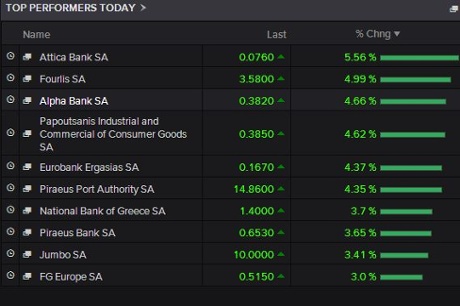
Finland’s finance minister says he is hopeful that a deal will be agreed to extend Greece’s bailout programme.
Speaking to newspaper Helsingin Sanomat, Antti Rinne said:
Last night a spark of hope arose that an understanding could be reached ... so that Greece could continue the underlying programme to strengthen its economy.
European markets open lower; euro falls
European investors are feeling cautious this morning before this afternoon’s crunch eurogroup talks.
Shares are modestly lower, suggesting that while the German finance ministry’s comments have knocked sentiment, investors are not giving up on the idea that a compromise can be reached.
- FTSE 100: flat at 6,887.83
- Germany’s DAX: -0.2% at 10,981.13
- France’s CAC 40: -0.1% at 4,826.31
- Italy’s FTSE MIB: -0.5% at 21,676.9
- Spain’s IBEX: -0.1% at 10,894.4
The Greek stock market opens shortly.
Meanwhile the euro has hit a seven-year low against the pound, at 73.40p.
It has been a challenging few weeks for the new Greek government, particularly for the Prime Minister Alexis Tsipras and his finance minister Yanis Varoufakis.
Jetting back and forth between parliament in Athens and meetings with his counterparts across Europe, Varoufakis is determined to keep some perspective despite the pressure.
Two nights ago I saw S, Beckett's Happy Days (Greek National Theatre). Splendid performance(s). Such a relief from you know what...
— Yanis Varoufakis (@yanisvaroufakis) February 20, 2015
Germany's EU commissioner: Greek deal may take longer
Will there be light at the end of the tunnel for Greece?
Guenther Oettinger, Germany’s EU commissioner, believes a deal is possible between Greece and its eurozone creditors but that it might take longer than a day to hammer out an agreement.
Oettinger told German radio Deutschlandfunk:
We are working so that Greece stays in the eurozone .
On this basis I think an agreement will still be possible in the next eight days - if necessary via a further meeting of government leaders.

Greek prime minister Alexis Tsipras had a series of telephone conversations with fellow eurozone leaders, to discuss Greece’s proposals.
Significantly, he spoke to the German Chancellor Angela Merkel, hinting that she does not share her finance minister’s uncompromising stance. It was Wolfgang Schaeuble’s office that rejected the Greek proposals on Thursday.
Greece is not giving up just yet.
Phone call w/Chancellor #Merkel earlier today: positive tone, and interest in finding a mutually beneficial solution for #Greece & #Eurozone
— Alexis Tsipras (@tsipras_eu) February 19, 2015
On the phone with @fhollande He sincerely wants to find a mutually beneficial solution #Greece pic.twitter.com/IgaRu20dNF
— Alexis Tsipras (@tsipras_eu) February 19, 2015
Crucial day for Greece as eurogroup meets to decide its fate

Good morning.
There have been a string of crucial days for the future of Greece and the wider eurozone and today is no exception.
Eurogroup finance ministers, led by president Jeroen Dijsselbloem, will meet in Brussels at 3pm (2pm UK time) to decide whether or not to accept the bailout extension plans put forward by Greece on Thursday.
We will bring you live coverage of events from our reporters in Brussels, Athens and London, including all the build up, the outcome of the meeting, and reaction.
#Eurogroup Friday in Brussels as of 15.00.
— Jeroen Dijsselbloem (@J_Dijsselbloem) February 19, 2015
The proposals included a six-month extension and a number of concessions which were interpreted as a Greek climbdown.
In one of the most significant concessions, Greek finance minister Yanis Varoufakis said in a letter to Dijsselbloem that Athens would be willing to remain under the supervision of the European Commission, the European Central Bank and International Monetary Fund – the unpopular troika that the Syriza-led government had insisted it would throw off.
Germany however threw a major spanner in the works by publicly rejecting the deal put forward by Greece, describing it as “not a substantial solution”.
Read our story on Thursday’s developments here.
Setting the scene for the talks, the Guardian’s economics editor Larry Elliott says that Germany is offering Greece a Carthaginian peace.
There is a phrase for what Germany is seeking to do to Greece: a Carthaginian peace. It dates back to the Punic wars when Rome emerged victorious in its long struggle with Carthage but refused to allow its opponent the chance of an honourable surrender. Instead, it enforced a brutal settlement, burning Carthage to the ground and enslaving those inhabitants it did not massacre.
A Carthaginian peace is what is being offered to Alexis Tsipras. On Thursday, the Greek prime minister made it clear that he was willing to see the white flag of surrender flutter over Athens. He accepted that he would have to swallow most of the conditions demanded of him by Greece’s eurozone partners but asked for a few concessions to sugar the pill.
Wolfgang Schaeuble, Germany’s finance minister, immediately slapped Tsipras down. What Greece was proposing was unacceptable, Schaeuble said. Unless the Germans are bluffing, and there’s nothing to suggest that they are, it leaves Greece with a binary choice: abject surrender or going nuclear.
Abject surrender means that Tsipras would have to explain to the Greek people why he was abandoning the policies on which he won the election less than a month ago. Going nuclear would involve capital controls, fresh elections on a “who governs Greece” basis and possible exit from the single currency.
Updated