European markets end mixed
Continuing concerns about Greece outweighed the prospects of the European Central Bank starting its quantitative easing programme this month, making for an uncertain start to the week for stock markets. The final scores showed:
- The FTSE 100 finished down 6.02 points lower at 6940.64 after hitting a new intraday peak
- Germany’s Dax edged up 0.08% to 11,410.36
- France’s Cac closed 0.69% lower at 4917.32
- Italy’s FTSE MIB slipped 0.18% to 22,297.60
- Spain’s Ibex ended up just 0.2 points at 11,178.5
- In Greece, the Athens market fell 2.45% to 858.95
In the US, the Dow Jones Industrial Average is currently up 100 points or 0.56% while the Nasdaq Composite - having climbed above 5000 for the first time in 15 years - is now dup 0.46% at 4986.
On that note, it’s time to close up for the evening. Thanks for all your comments, and we’ll be back tomorrow.
More talk of a possible third Greek bailout, this time from European Commission vice president Valdis Dombrovskis. Bloomberg reports:
Greece could need a third bailout deal when its current program expires in June because markets may still not be prepared to lend to its government, even with a euro-area credit line, Dombrovskis said.
Prime Minister Alexis Tsipras, elected in January, said Friday his government won’t need another bailout. Greece has received pledges of €240bn in aid from its two rescue packages, and Tsipras’s government must meet creditor demands to tap remaining funds.
Speculation over whether Greece would need a third bailout has been swirling for a year or more -- German Finance Minister Wolfgang Schaeuble said in August 2013 that a new aid program would be needed to help Greece meet its debt obligations -- and estimates of the country’s needs have ranged from €12bn to €50bn.

In a Monday interview in Riga, Dombrovskis said Tsipras’s government will have to meet the requirements of its current program in coming weeks, and then see what market conditions will dictate.
“Greece may need an additional arrangement after this program expires,” said Dombrovskis, whose portfolio includes the euro and monetary union. He said Tsipras faces different conditions from his predecessor, Antonis Samaras, and may not have the same range of options.
“With the previous government, we were discussing how Greece would move back to the market financing with the help of a precautionary arrangement or enhanced-conditions credit line,” Dombrovksis said. “Now this scenario, however, seems less likely, given recent financial instability.”
Full story:
Greece May Need Third Rescue, EU’s Dombrovskis Says
Over in Athens the government decision’s not to put the deal extending Greece’s bailout programme to a vote has brought cries of hypocrisy, reports Helena Smith from Athens:
The government had described the accord – reached after three eurogroups and tortuous negotiations – as a “great victory.” So why would it be opposed to bringing it the 300-seat House for debate? That is the question increasingly being asked tonight after the government spokesman announced that MPs would only be voting on individual bills.
“Either the government is afraid to publicly accept what it has signed or it doesn’t have faith in its MPs,” said Kostas Karagounis spokesman of the New Democracy party, until December the dominant force in Greece’s two-party coalition.
The KKE communist party also lashed out at the decision arguing there was “no justification” for the accord not to put before a ballot. Not doing so proved, it said, that the government had “the singular goal of hiding from the Greek people” what it had done: sign up to more laws and anti-austerity measures at the behest of creditors. Former leftwing MP Petros Tatsopoulos told SKAI TV on Monday: “It is absolute hypocrisy to expect the German parliament to vote on it and not the parliament here in Greece.” The accord has caused ructions within prime minister Alexis Tsipras Syriza party with up to 40% of its central committee members this weekend rejecting the deal outright.
Meanwhile:
GREECE'S MARCH FUNDING NEEDS COULD REACH E6 BILLION, GREECE TO LOWER T-BILL SALE REQUEST TO E2 BILLION - SOURCE - MNI
— Fabrizio Goria (@FGoria) March 2, 2015
GREECE TO SEEK ADDITIONAL FUNDING AT MARCH 9 EUROGROUP - SOURCE - MNI
— Fabrizio Goria (@FGoria) March 2, 2015
A third Greek bailout is not being discussed among eurozone finance ministers, Reuters is reporting a Eurogroup spokeswoman as saying.
Earlier there were reports that Spain’s Luis de Guindos had said there were talks about a new package.
Back with the US figures and James Knightley says the ISM survey might show a pickup in March after this month’s slightly disappointing number:
The ISM manufacturing survey has dropped to 52.9 in February versus 53.5 in January. The consensus prediction was 53.0 so is pretty much in line with expectations, but it is the weakest outcome since January last year. Bad weather may well have depressed activity a little and the West Coast port disruption could also have played a part. Consequently, we expect to see a better number for March.
In terms of the details, production fell nearly three points to 53.7 - a 12 month low – while new orders dropped to its lowest reading since May 2013. There was a pick-up in the backlog of orders, which is a sign of bad weather influencing the report.
Export orders deteriorated while the employment component fell nearly three points to the lowest level since June 2013. This is a concern, but the bulk of jobs growth has been driven by services so we will have to wait for Wednesday’s ADP and non-manufacturing ISM employment numbers to see whether there are downside risks to the consensus prediction of a 235,000 increase in non-farm payrolls.
The non-farm payroll numbers are due on Friday.
Here’s Reuters’ take on the comments from Spain’s economy minister on a new Greek bailout package:
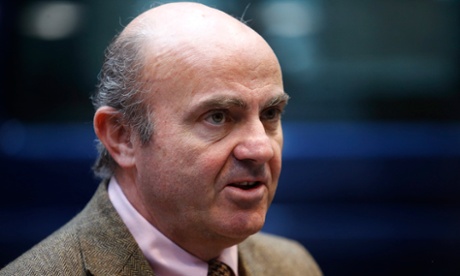
Spain’s economy minister Luis de Guindos on Monday said eurozone countries were in talks over a third bailout package for Greece worth between €30bn and €50bn.
Speaking at an event in Pamplona, in northern Spain, de Guindos said the new rescue plan would give more flexible conditions to Greece, which had no alternative other than European solidarity.
And the Institute for Supply Management is not as optimistic as the Markit survey of US factories.
The ISM said its index of factory activity fell to 52.9 in February from 53.5 the month before, the lowest reading since January 2014. Economists had been expecting a reading of 53.1.
But that has not dampened spirits on Wall Street, with the Dow Jones Industrial Average now up around 88 points or 0.49%.
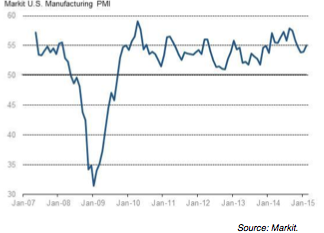
Over in the US, the manufacturing sector jumped in February with factories reporting their best gains since October.
The Markit purchasing managers index rose from 53.9 in January to 55.1 last month, compared to an expected level of 54.3, and chief economist Chris Williamson said:
Manufacturing braved the cold weather in February, reporting an upturn in the pace of growth. A flurry of activity towards the month end helped raise production to a greater extent than signalled by the earlier flash reading. The upbeat survey points to minimal impact from the adverse weather that affected many parts of the country during the month.
While growth of manufacturing output remained below the peaks seen last year, the survey is broadly consistent with production rising at an annualised rate approaching 4%.
A survey from ISM is due shortly.
Updated
Spain reportedly talks of third Greek rescue of €50bn
There will be a third Greek rescue package of up to €50bn and Spain will contribute up to 14%, according to comments reportedly made by Spanish economy minister Luis de Guindos.
Spanish EconMnin de Guindos `3rd Greek Rescue' Seen At Around EUR30b-EUR50b - BBG
— Live Squawk (@livesquawk) March 2, 2015
SPAIN TO PROVIDE 13-14% OF EU30B-EU5O 3RD GREEK RESCUE: GUINDOS
— Dealingroom (@Dealingroom_EN) March 2, 2015
Updated
Lunchtime summary
Time for a brisk recap.
The latest eurozone economic data has raised hopes that the region’s weak economy is reviving.
Unemployment across the eurozone fell by 140,000 people in January, pulling the region’s jobless rate down to 11.2%. Twenty four EU countries reported a drop in unemployment over the last year; it rose in France, Finland and Cyprus, and was flat in Belgium.
Fears of a deflationary spiral have also been calmed. Europe’s inflation rate was -0.3% last month, up from -0.6% in January, with falling oil prices to blame.
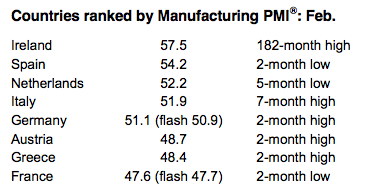
But the recovery remains patchy. New factory data showed that Ireland’s manufacturers grew at the fastest pace since 1999, but France suffered another downturn.
Greece’s factories also reported a drop in activity, probably due to political uncertainty.
Greece’s bailout drama also continues to loom over the eurozone.
Finance minister Yanis Varoufakis has declared that Greece would rather do without its final €7.2bn of aid, rather than implement more austerity.
Germany’s chancellor Angela Merkel has urged Athens to work on its reform programme, hours after eurogroup chief Jeroen Dijsselbloem hinted that aid money could be released once Greece makes progress.
And a diplomatic rift has opened up after Greece’s new prime minister claimed he was being deliberately undermined by Spain and Portugal.
And I’m handing over to Nick Fletcher...
Gov't economy cabinet meeting at 4pm GMT #Greece
— Loukia Gyftopoulou (@loukia_g) March 2, 2015
Back in Greece, the government has confirmed that parliament will not hold a single yes-or-no vote on its bailout extension.
Instead, MPs will vote on individual bills.
#Greece govt spox Sakellaridis said govt will pay all its obligations of March, will discuss agreement in Parliament without a vote
— Efthimia Efthimiou (@EfiEfthimiou) March 2, 2015
Govt officials confirm bailout extension will not be put to vote in parliament #Greece
— Derek Gatopoulos (@dgatopoulos) March 2, 2015
The European Commission is trying to play peacemaker following Greek prime minister Alexis Tsipras’s claim that Spain and Portugal had lead an “an axis of powers” against his government.
The AFP newswire reports that both countries have filed a formal complaint with the EC over the comments, prompting Commission spokeswoman Mina Andreeva to tell reporters in Brussels that:
“We are speaking to all actors involved in order to ensure there is unity among all EU states and especially all EU states of the eurozone,”
“We have received the complaints including a request to comment from the Spanish and Portuguese authorities that was communicated to the Commission over the weekend regarding the statements of Prime Minister Tsipras.”
“We are stressing very much the role of the Commission as a mediator in this process, which means we’re building bridges and bringing parties together.”
Newsflashes: German chancellor Angela Merkel has urged Greece to flesh out the reform agenda presented last week.
She’s also declared that she wants Greece to enjoy a “good future” in the eurozone.
- 02-Mar-2015 12:56 - MERKEL SAYS NOW GREECE NEEDS TO BE MORE SPECIFIC ABOUT ITS REFORM PROPOSALS
- 02-Mar-2015 13:01 - MERKEL SAYS THERE IS NEED FOR STRONGER ECONOMIC POLICY COORDINATION AMONG EURO ZONE MEMBERS
The ECB may also revise its economic forecasts for growth and inflation upwards at this week’s meeting.
Christopher Vecchio, currency analyst at DailyFX, explains:
With energy prices low and the Euro weak, we expect both real GDP and inflation forecasts to be boosted in the future, mainly 2016 and 2017.
While the 2015 real GDP forecast will probably be nudged higher, the 2015 inflation rate will likely not.
Updated

The European Central Bank’s top policymakers will be pondering Greece’s funding problems when they meet in Cyprus for their two-day meeting, starting on Wednesday.
Reuters has a good preview. Here’s a flavour:
Shut out of debt markets and faced with a steep fall in tax revenues, Athens is expected to run out of cash by the middle or the end of March. Without unlocking bailout funds by completing -- or at least beginning -- reforms it has vocally opposed, the government faces the prospect of defaulting in a matter of weeks.
With other options apparently closed for now, the ECB is central to the Greek government’s only other prospective funding channel: raising a 15 billion euro ($16.82 billion) cap on Athens’ issuance of Treasury bills, or short-term debt.
The cap has already been reached, and the ECB has a veto over lifting it. The issue here is that Greek banks have used the T-bills to access central bank funding and then invest in more T-bills, helping the state cover its short-term needs.
Raising the T-bill limit would be tantamount to putting central bank cash in the pocket of the Greek government. The ECB is prohibited from such central bank financing of governments.
One person familiar with ECB thinking said that any extension of the T-bill limit was “very unlikely”.
More here: ECB uncomfortable with leading role in Greek funding drama
European commissioner Pierre Moscovici tweets:
#Eurozone unemployment drops to lowest since April 2012 (11.2%). Need to continue reform efforts to accelerate this trend @EU_Commission
— Pierre Moscovici (@pierremoscovici) March 2, 2015
Moscovici was previously the finance minister of France - one of just three EU countries where unemployment rose last year...
Unemployment the plight of #Greece: stood at 25.8% in November according to #Eurostat (the best & brightest continue 2 leave)
— Helena Smith (@HelenaSmithGDN) March 2, 2015
Varoufakis: I won't continue with austerity
Helena adds that there was some tough talk from Yanis Varoufakis in his radio interview this morning:
Varoufakis said the new government would rather dispense with the €7.2bn outstanding disbursement of aid (yet to be drawn down from its original bailout agreement) if that means continuing with self-defeating austerity.
The days of doing everything for the next handout were over, he said. “If they ask me to continue with the work of austerity I won’t do it,” he said.
#EU tells #Greece to start implementing reforms if it wants bailout cash. Right now, feels a bit head in sand. Deal struck, then inaction
— Robin Bew (@RobinBew) March 2, 2015
Over in Athens the Greek finance minister has waded into the row over whether the new government sent the “wrong letter “ to Jeroen Dijsselbloem during the bailout negotiations.
That’s one claim made by Dijsselbloem, head of the eurogroup,in that interview with the FT this morning.
Helena Smith reports:
In his own interview this morning with the Athenian radio station Parapolitika 90.1, Yanis Varoufakis said he was “trying very hard” to keep quiet about the assertion that Greece has fired off the wrong proposal to the euro group during the month-long negotiations to extend the country’s bailout programme.
“I am making a huge effort not to respond to Dijsselbloem. We had our differences but at the last Eurogroup we found common ground. I am now going to go now into an analysis of the moves that happened before,” the Greek finance minister said.
“I don’t have the right nor the disposition to do this. At any rate, it was not at all like Dijsselbloem says it was.”
Varoufakis has also indicated that Greece might waive the final instalment of its bailout package (even though that would leave it struggling to meet looming debt payments):
#Greece FinMin Varoufakis says Greek gov't will pass on €7.2bn tranche if it would mean continuation of austerity policies ~@parapolitika901
— Yannis Koutsomitis (@YanniKouts) March 2, 2015
#pt (So since we'll accept the tranche, it would mean that any measure we'll introduce will not be austerity)
— Yannis Koutsomitis (@YanniKouts) March 2, 2015
Updated
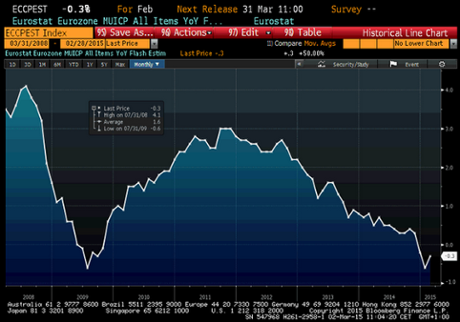
As this chart shows, eurozone inflation has been on a steadily downward path for the last three years:
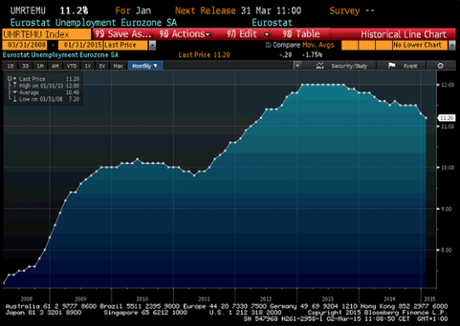
While the unemployment rate has slowly recovering after plateauing at record highs for most of 2013.
Better isn’t the same as good, of course.
At 11.2%, Europe’s jobless rate highlights the damage caused by years of austerity since the financial crisis. And the inflation rates also show an economy struggling to create demand.
As Bill Adams, senior international economist for PNC Financial Services Group, puts it:
With unemployment declining and deflation easing, the latest labor and price data for the Eurozone look less awful.
Nonetheless, these data provide little reason to expect the ECB to change its approach toward the risk of trend deflation in the Eurozone.
Updated
Ben Brettell, senior economist at Hargreaves Lansdown, says today’s data suggests Europe’s economy is picking up:
Here’s his take on the fall in unemployment:
Unemployment fell for the third month in a row to 11.2% in January – the lowest figure since April 2012. During the month, the number of people out of work fell by 140,000.....
The credit cycle looks to be turning, and a weaker euro should benefit both exporters and domestically-focused firms.
Falling energy costs should be of little concern to the ECB – they are essentially beyond its control, and in any case should prove positive for the euro zone economy as disposable incomes rise. Core CPI inflation, which excludes volatile items such as food and energy, remained steady at 0.6%. This is still a worryingly low level, but the fact it didn’t fall further is mildly encouraging.
Updated
Unemployment rose by just three EU countries over the last year -- Cyprus (15.7% to 16.1%), Finland (8.4% to 8.8%) and France (10.1% to 10.2%).
The largest decreases were registered in Spain (25.5% to 23.4%), Estonia (8.5% to 6.4% between December 2013 and December 2014), and Ireland (12.1% to 10.0%), Eurostat says.
Updated
As usual, the jobless data highlights sharp differences across the Eurozone.
The lowest unemployment rates for January were recorded in Germany (4.7%) and Austria (4.8%), and the highest in Greece (25.8% in November 2014) and Spain (23.4%).
Eurozone data: some instant reaction
Eurozone unemployment rate starts to crumble down. 11.2% in Jan. At this pace, it will only take another 2 yrs before leaving double-digits.
— Carsten Brzeski (@carstenbrzeski) March 2, 2015
Eurozone HICP up to -0.3% YoY in Feb (from -0.6%) on higher oil and food prices. Looks set to remain negative in the near-term though.
— Frederik Ducrozet (@fwred) March 2, 2015
Inflation stats are a bit like #TheDress at the moment. Some see an oil price induced stimulus & others the start of debt deflation spiral.
— Duncan Weldon (@DuncanWeldon) March 2, 2015
Eurozone unemployment rate hits 33-month low
Europe’s labour market may be turning the corner.
The eurozone’s unemployment rate fell to 11.2% in January, down from 11.3% in December. That’s its lowest rate since April 2012.
Eurostat reports that the number of unemployed people in the euro area fell by 140,000 in January, meaning 18.059 million were still out of work.
Euro area unemployment rate at 11.2% and EU at 9.8% in January 2015 #Eurostat http://t.co/FIYzl8vL2A pic.twitter.com/QLwM9ZpnId
— EU_Eurostat (@EU_Eurostat) March 2, 2015
Core inflation across the eurozone was unchanged in January at +0.6%
#Eurozone inflation rises to -0.3% yoy in Feb from -0.6% in Jan, ahead of consensus expectations of -0.4%. Core stable at +0.6% yoy. #ECB
— Nick Kounis (@nickkounis) March 2, 2015
Eurozone inflation rate rises to minus 0.3%
The Eurozone’s annual inflation rate inched up to -0.3% last month, showing prices didn’t fall as fast as expected.
That’s an improvement on the -0.6% decline in inflation recorded in January.
Statistics body Eurostat reports that service sector prices rose by 1.1%, and food, alcohol and tobacco prices rose by 0.5%.
So the decline was mainly due to falling energy prices; which should give the eurozone economy a fillip.
Fears that Europe is being dragged into a deflationary downturn may have been overstated.
Euro area annual inflation up to -0.3% in February 2015 - flash estimate from #Eurostat http://t.co/4S5qu0NtIj pic.twitter.com/c1dsimQNlh
— EU_Eurostat (@EU_Eurostat) March 2, 2015
The UK factory revival is also being fuelled by domestic demand; overseas orders declined:
UK #manufacturing growth being driven by domestic (especially consumer) demand. Exports fell in Feb. pic.twitter.com/d0EXslSJ9j
— Chris Williamson (@WilliamsonChris) March 2, 2015
Growth in Britain’s factory sector has hit a seven-month high, Markit reports.
The UK manufacturing PMI rose to 54.1 in February, up from 53.1 in January, suggesting economic conditions picked up last month.
One note of caution, though; consumer goods, rather than heavy-duty machinery, led the way. So it’s not a terribly well-balanced recovery:
Rob Dobson of Markit explains:
“Scratching beneath the surface and we see a lop- sided upturn, with the prime driver being a strong upsurge in new orders and production at consumer goods producers while a near-stalling of demand for plant and machinery points to ongoing weak business investment.
Good news for @matteorenzi - Italy unemployment rate dips slightly to 12.6% Youth jobless rate 41.2% http://t.co/zEuiC1pcXm
— Rosie Scammell (@rosiescammell) March 2, 2015
Italy’s unemployment rate fell last month, away from the record highs hit last year, but remains worryingly high.
The Italian jobless rate dropped to 12.6% in January, down from 12.7% in December. It struck 13.2% last autumn, as the country slipped back into recession.
And the youth unemployment rate remains over 40%; depression-era levels.
Italy youth unemployment rate was 43.3% in Q4 Men - 40.4% Women - 47.5%
— MineForNothing (@minefornothing) March 2, 2015
Greek factories hit by political uncertainty
Greece’s manufacturing sector shrank last month, as the political turmoil around January’s general election hits its economy.
Data firm Markit just reported that the Greek factory PMI came in at 48.4, up slightly from 48.3 in January, but still signalling a contraction in activity.
Factory output hit its lowest point in 16 months, as new orders shrank.
Markit said there was “anecdotal evidence” showing that political uncertainty had a disruptive impact on demand
Phil Smith, Economist at Markit, adds:
“The headline manufacturing PMI remained in contraction territory in February in a further sign that Greece’s economy continues to struggle under the weight of uncertainty.
Factories reported hesitancy among clients at home and abroad to commit to new orders, leading new business inflows to fall at an accelerated rate”
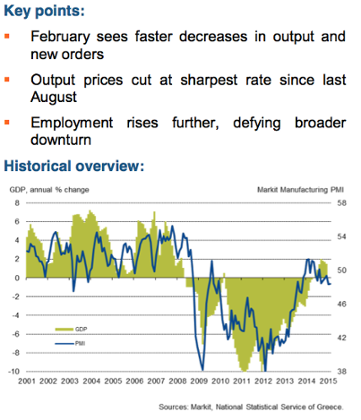
There is one optimistic sign, though. The survey showed a further rise in employment at Greek factories.
Eurozone factories: Ireland shines, France lags
The eurozone’s manufacturing sector only posted a little growth in February, according to Markit’s monthly healthcheck.
But that hides some remarkable national differences. While Ireland posted its biggest jump in activity since 1999 [see here], French factories suffered yet another contraction.
Markit’s Chris Williamson says:
“The euro zone manufacturing sector barely expanded in February, highlighting the malaise that still hangs over the region’s goods-producing economy as a whole.”
“However, beneath the disappointing headline figure, different parts of the manufacturing economy are clearly moving at very different speeds, ranging from an (Irish) boom to a (French) slump.”
EZ mfg #PMI: "Different parts of the mfg economy are clearly moving at very different speeds, ranging from a Celtic boom to a Gallic slump."
— Markit Economics (@MarkitEconomics) March 2, 2015
The overall eurozone manufacturing PMI came in at 51.0, just over the 50-point mark that separates expansion from contraction.
Nice to see Italy performing well too:
Euro-area manufacturing #PMI takes a break in February. Italy is catching up with peers, leaving France far behind. pic.twitter.com/MUoIu6zBkD
— Maxime Sbaihi (@MxSba) March 2, 2015
Once again Germany has outperformed France.
Germany Manufacturing PMI (Feb) comes in at 51.1, exp 50.9, prev: 50.9
— Michael Hewson (@mhewson_CMC) March 2, 2015
Eugh. France’s factory output shrank at a faster pace in February.
Markit reports that the French manufacturing PMI fell to 47.6 last month from 49.2 in January; deeper into contraction territory.
French mfg was the 10th straight month of contraction - Ou la la
— Steve Collins (@TradeDesk_Steve) March 2, 2015
#France manufacturing #PMI signals further contraction: Headline #PMI at 47.6 (49.2 in Jan) http://t.co/pVNOQKzzEK http://t.co/v9CrJv0RbW
— Markit Economics (@MarkitEconomics) March 2, 2015
Good news from Italy -- its factory sector has grown for the first time in five months.
The Italian manufacturing PMI jumped to 51.9, up from 49.9.
Any reading over 50 shows the sector expanded. So this might suggest that Italy’s long stagnation is ending....
ECB QE plan drives Footsie and DAX to record highs
Europe’s two largest stock markets have nudged fresh record highs this morning.
In London, the FTSE 100 has just hit a fresh intraday high of 6970, as investors anticipate the launch of the European Central Bank’s new quantitative easing programme this month.
Germany’s DAX has also nudged a new peak:
Let the QE begin: #Germany's Dax just hits fresh highs as #ECB's QE pushes savings into other assets, such as stocks. pic.twitter.com/XERHwSRP8Z
— Holger Zschaepitz (@Schuldensuehner) March 2, 2015
Spain’s factory sector has posted its fifteenth month of growth.
The monthly Spanish manufacturing PMI, measured by Markit, came in at 54.2; slightly down on January’s 54.7, but still showing a rise in activity.
New export orders rose at the fastest pace in almost eight years.
Britain’s housing market appears to be cooling. Prices fell by 0.1% in February, dragging down the annual rate of price inflation to 5.7%, from 6.8% in January.
This slowdown means that the average price of a UK home has fallen back to £187,964, from the recent peak of £189,306 it reached in August.
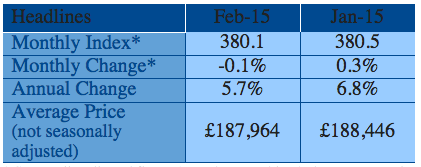
Here’s the full story: UK house prices fall 0.1% in February
Nationwide house prices fell 0.1% February, annual rate from 6.8% to 5.7%. Notes home-ownership drop to 30-year low: http://t.co/UhtNL3O4ZN
— David Smith (@dsmitheconomics) March 2, 2015
Eurogroup chief offers Greece funding lifeline

Jeroen Dojsselbloem, who led the talks with Greece over its bailout plan last month, has dangled a carrot towards Athens -- crack on with reforms, and we may release some funds this months.
Interviewed by the Financial Times, eurogroup chief Dijssesbloem said that the “first disbursement” of the €7.2bn remaining in Athens’ €172bn bailout could be released this month. That would help it handle some of this month’s debt demands, including €1.4bn owed to the IMF.
Dijssesbloem said:
“My message to the Greeks is: try to start the programme even before the whole renegotiation is finished.”
“There are elements that you can start doing today. If you do that, then somewhere in March, maybe there can be a first disbursement. But that would require progress and not just intentions.”
Greece’s parliament is due to debate four draft laws this week; tackling the “social impact” of the country’s austerity programme.
More here: Greece warned to start reforms to gain cash (£)
Spanish and Greek PMs lock horns
Greece’s prime minister has caused a diplomatic spat over the weekend by claiming that Spain and Portugal had led “an axis of powers” against the new Athens government.
Alexis Tsipras told an audience that Madrid and Lisbon were afraid of their own radical parties [eg: Spain’s Podemos], declaring:
Their plan was, and is, to wear down, topple or bring our government to unconditional surrender before our work begins to bear fruit and before the Greek example affects other countries…
And mainly before the elections in Spain.”
That earned a rapid rebuke from Spanish prime minister Mariano Rajoy, who insisted Tsipras’s problems are his own making:
“We are not responsible for the frustration generated by the radical Greek left that promised the Greeks something it couldn’t deliver on,” he said.
More here: Alexis Tsipras comes under fire from Spanish prime minister
Updated
Ireland’s recovery from its bailout woes continues; its manufacturing sector posted its biggest jump in monthly activity since December 1999.
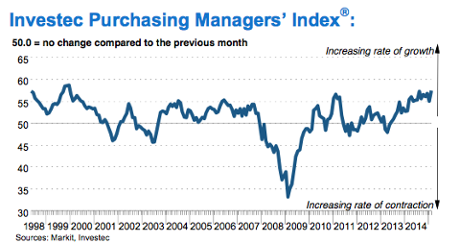
Markit, which compiles the report, says firms reported a rise in new orders from both domestic and export clients, and a sharp increase in employment.
That won’t hurt Ireland’s reputation as the ‘poster boy’ for eurozone austerity.
Ireland manufacturing PMI 57.5 vs 55.1 - highest this century, says Markit. http://t.co/FdsDvPCVi7
— F O'Brien (@fergalob) March 2, 2015
Activity across China’s factory sector nudged to a seven-month high last month, data released earlier today shows.
But it’s not all good news; today’s PMI survey also shows that export orders fell for the first time in 10 months. Firms also continued to cut staff, suggesting China is suffering from weaker demand from overseas.
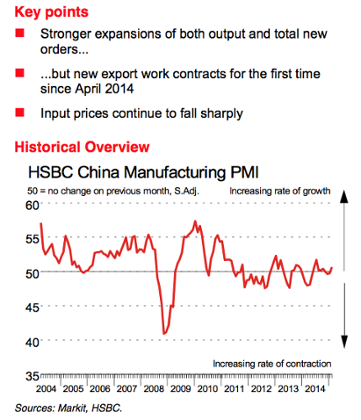
The data comes hours after China’s central bank announced an interest rate cut, the second since November.
The Agenda: Eurozone unemployment and inflation data
Good morning, and welcome to our rolling coverage of the world economy, the financial market, the eurozone and business.
There’s a sense that Europe is returning to normality this week (at least for a moment), after the recent drama over Greece’s bailout extension.
But normality, in European terms, means fretting about weak growth, low inflation and record joblessness.
A flurry of manufacturing data this morning is likely to show that factory growth in France and Italy remains weak.
Then at 10am GMT (11am CET), the latest consumer prices index data is likely to show that prices kept falling in February. The headline inflation rate is tipped to come in at -0.5%, compared with -0.6% in January -- due to falling oil costs and weak demand.
The latest unemployment data, for January, is also likely to show little progress in fixing Europe’s labour market. Economists think the eurozone jobless rate was unchanged at 11.4%, while Italy could be as high as 12.9%.
There’s also UK data to watch out for; including the latest health-check of Britain’s factories.
UK economy today: Nationwide house prices 7am, #BOE credit stats, Feb. manufacturing PMI 09:30. @business PMI forecast 53.3 vs 53
— F O'Brien (@fergalob) March 2, 2015
Not that Greece’s particular crisis is fixed, of course, just because Athens has been given a four-month bailout extension by its creditors.
The Greek government is due to propose legislation this week to implement reform programmes, in a bid to win bailout money from its creditors.
But there are growing rumours that members of the cabinet are unhappy about the deal reached with lenders, and even suggestions that Greece could head back to the polls....
Now Greek govt officials hint at new elections if Syriza leftwing opposition blocks a deal with the Institutions. Oh well...
— Yannis Koutsomitis (@YanniKouts) March 1, 2015
A new general election to get the same mandate you got some weeks ago. And end up with the same intra-party opposition. Only in Greece.
— Yannis Koutsomitis (@YanniKouts) March 1, 2015
I’ll be tracking all the main events through the day....