European markets move higher
Amid conflicting talk about the state of talks between Greece and its creditors, investors decided to accentuate the positive ahead of Monday’s key eurogroup meeting. Postive eurozone GDP data - particularly from Germany - also helped matters, with Germany’s Dax hitting a new peak. This weekend’s ceasefire in Ukraine added to the optimistic mood. Overall, the final scores showed:
- The FTSE 100 finished up 45.41 points or 0.67% at 6873.52
- Germany’s Dax hit a record close of 10,963.4, up 0.4%
- France’s Cac closed up 0.7% at 4759.36
- Italy’s FTSE MIB added 0.96% to 21,204.07
- Spain’s Ibex ended up 1.68% at 10,739.5
- As previously mentioned, the Athens stock market added 5.61% to 893.98
In the US the Dow Jones Industrial Average is currently 35 points or 0.2% higher.
On that note, it’s time to close up for the day and indeed the week. Thanks for all your comments, and we’ll be back again on Monday for what looks to be another crucial day for Greece and the eurozone.
#Greece govt sources: We havent covered the whole distance towards an agreement, but serious steps have been made via @capitalgr
— Efthimia Efthimiou (@EfiEfthimiou) February 13, 2015
.@J_Dijsselbloem "very pessimistic" of #Greece deal Mon. Tends not to bullsh*t. Not sure why markets so optimistic http://t.co/VikOQA3mdm
— Peter Spiegel (@SpiegelPeter) February 13, 2015
Updated
Despite the mixed signals coming from various sources, investors are hopeful a deal between Greece and its creditors can be done, pushing the Athens stock market up 5.61% to its highest level since the middle of December.
Greek bond yields are also falling, another sign of optimism, with the 10 year yield down 91 basis points at 9.4%.
Another negative ahead of Monday’s eurogroup meeting which is attempting to find a solution to Greece’s financial crisis. Eurogroup president Jeroen Dijsselbloem has said he was “very pessimistic” about reaching a final debt deal. Reuters reports:
Saying Greek voters’ expectations of their new government were “a mile high”, Dutch finance minister Dijsselbloem was asked whether a plan to resolve Athens’ financial problems would be achieved on Monday. He replied, in a remark aired on Dutch television: “I’m really still very pessimistic about that now.”

Updated
Back with Greece and it appears some believe that Grexit could be contained:
*EU SEES GREEK, CYPRUS EURO EXIT AS MANAGEABLE: SPIEGEL
— lemasabachthani (@lemasabachthani) February 13, 2015
Not clear yet who “EU” is in this case. And on the other hand:
*ESM CHIEF REGLING WARNS AGAINST GREEK EURO EXIT: SPIEGEL
— lemasabachthani (@lemasabachthani) February 13, 2015
The US confidence figure is still a strong one despite the fall and a June rate rise is in fact on the cards, says James Knightley of ING Bank:
The February preliminary reading of University of Michigan consumer confidence has come in at 93.6 versus the final reading of 98.1 in January. Markets had been looking for it to hold steady so it is a little disappointing. Nonetheless, it is still a strong reading that matches the figure recorded in December and is at a level historically consistent with decent consumer spending growth.
Looking at the breakdown the expectations component fell 3.5 points while the current conditions series dropped 6.2 points, but it is important to remember that the trend is still moving in the right directions.
With equity markets hitting new highs, mortgage rates falling, real incomes being boosted by falling energy prices and rising nominal wages at a time when employment continues to grow strongly, it is a pretty positive environment for the household sector right now. There has been some concern about the softness in retail sales, but we still take the view that the economy has strong momentum and that the Fed will start to tighten monetary policy at the June FOMC meeting.
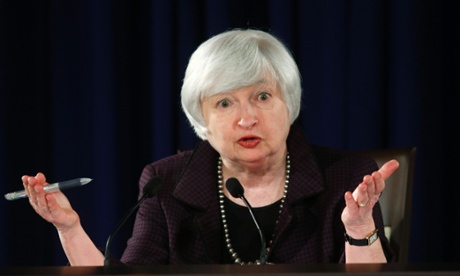
In the US, a survey of consumer confidence has come in lower than expected.
The preliminary reading of the University of Michigan sentiment index for February fell from 98.1 the previous month to 93.6. Analysts had expected an unchanged figure.
With weak retail sales despite the falling oil price, this is another indication the US economy might not be quite as strong as previously thought. In any case it may well push back the idea of a US rate rise in the middle of the year.
The Dow Jones Industrial Average has slipped back from its best levels in early trading and is now up just 19 points or 0.1%.
EU’s Juncker: Greece’s Budget Balance Is Of ‘Paramount Importance’
— Live Squawk (@livesquawk) February 13, 2015
But amid the optimism and hope that Greece and its creditors can come to a deal, there’s always someone to dampen the mood. Step forward Jean-Claude Juncker, president of the European Commission:
EU’s Juncker: Says Greece Is Far From A Deal With EU – France24
— Live Squawk (@livesquawk) February 13, 2015

Updated
With talks between Greece and its creditors starting today ahead of a key (another key) eurozone finance ministers meeting on Monday, here’s Reuters’ take on what is happening:
[Monday’s talks} are the last moment for the new Greek government to ask for a technical extension of the current bailout programme, which runs out on February 28.
Greece needs such an extension to ensure continued official financing at a time when market borrowing is too expensive for Athens and to be eligible for negotiations on more time to repay the euro zone loans already received.
But the left-wing government of Alexis Tsipras won elections in January on promises of ending the €240bn bailout and the belt-tightening reforms that came with it and does not want to ask for an extension, even by a few months.
“There have been very good political debates ... and now we need to get down to the hard facts, explaining what is in the (bailout reform) agreement and what are the quantified results of the new Greek government’s programme,” a senior EU official close to the talks said.
“On Monday we expect a description of what are the overlaps between the two, and I expect them to be non-negligible, and what are the divergences,” the official said.
If Greece wanted to remove a certain reform from the list agreed under the bailout, it would have to propose in its place a measure that would have a similar fiscal effect, he said.
The official noted that if Greece did not ask for a bailout extension on Monday, the programme, with the financial cushion it provided, would expire and Athens would have to apply for a new, fully fledged bailout - the country’s third.
“It’s not crucial to extend. One could also agree to start discussions on a new programme, That is a distinct possibility, I would not exclude it,” the official said.
Meanwhile, the website of #Greece's ministry of finance is facing a crisis too. Too much game theory to digest? pic.twitter.com/DyUJhurtlI
— wolf piccoli (@wolfpiccoli) February 13, 2015
Greek finance minister Yanis Varoufakis has caused a bit of a stir, by comparing the Troika’s actions to the CIA’s waterboarding of suspected terrorists.
Varoufakis keeping that charm offensive going. Via @Schuldensuehner pic.twitter.com/8Z5uQXFUGh
— Joseph Weisenthal (@TheStalwart) February 13, 2015
In it Varoufakis talks about how Greece was given “a few breaths” before being pushed back under water again. Those Troika officials sent to oversea Greece’s programme were in a “terrible moral dilemma”, he adds.
Varoufakis also talks about how a debt haircut would be better for all sides.
Varoufakis Insists On Debt Cut For Greece, Haircut Preferable To Loan Extension: Spiegel
— Steve Collins (@TradeDesk_Steve) February 13, 2015
A quick catch-up on Greece.
There have been encouraging signs of progress this morning, with Athens promising to stretch every sinew to reach an agreement.
Government spokesman Gabriel Sakellaridis told Skai TV.
“We will do whatever we can so that a deal is found on Monday,”
“If we don’t have an agreement on Monday, we believe that there is always time so that there won’t be a problem.”
The word “troika” may have been banished to history. Instead, Greece will be dealing with its institutions.
So, “institutions” it is. Berlin said “ja” Troika dead.Solid step ahead 4 a deal on Monday btw #Greece & creditors. Other issues irrelevant
— wolf piccoli (@wolfpiccoli) February 13, 2015
Although not everyone has got the memo, as Reuters reports:
Germany does not believe the Paris-based OECD can emulate the supervisory role of the European Commission, European Central Bank and International Monetary Fund in the Greek bailout, a spokesman for the finance ministry in Berlin said on Friday.
The OECD (Organisation for Economic Cooperation and Development) was welcome to provide its expertise to the Greek government, said spokesman Martin Jaeger, “but what we cannot envisage is an OECD role in the troika framework”.
Although this chart doesn’t include today’s data, it shows how Italy has been struggling badly since the eurozone crisis began:
G7 GDP performance, up to Q3 last year. Maybe the euro zone's biggest problem isn't Greece, but Italy... pic.twitter.com/M3buw6CQoa
— Jamie McGeever (@ReutersJamie) February 13, 2015
Here’s a full breakdown of all today’s growth data:
One for football fans:
Tiki taka is back. Catenaccio not so much pic.twitter.com/rCyw3QGNU5 (ht @RBS_Economics)
— Alberto Nardelli (@AlbertoNardelli) February 13, 2015
Growth figures push markets higher
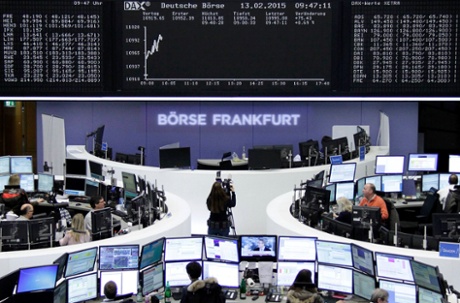
The better than expected eurozone growth data have driven European stock markets to seven-year highs.
Ben Brettell, senior economist, Hargreaves Lansdown, says the strong growth in Germany has cheered traders.
This is the latest in a series of signs that the economic climate might be improving, and the European Central Bank’s quantitative easing programme might therefore benefit from a following wind.
Most notably the credit cycle appears finally to be showing improvement - after two and a half years of contraction, euro zone bank lending to the private sector is growing again.
The Stoxx Europe 600 Index reached its highest level since 2007 in early trading while the German DAX index climbed to an all-time high over 11,000.
Finland’s economy also shrank in the last quarter, with GDP falling by 0.3% in the last quarter.
Its reputation as part of the eurozone’s strong northern core has been dented by the decline of Nokia, and lower demand for its forestry and paper products. Russia’s economic problems aren’t helping either.
Some instant reaction to the growth figures:
German GDP growth of 0.7% in Q4 means UK (at 0.5%) no longer the fastest growing large economy in Europe
— Joe Lynam BBC Biz (@BBC_Joe_Lynam) February 13, 2015
Q4 €zone GDP is a familiar tale: Germany fared relatively well, France/Italy stagnated and Spain is slowly healing. Little to rejoice about.
— Nicholas Spiro (@NicholasSpiro) February 13, 2015
#Euro area austerity apologists where is your #Grecovery now? As quarterly #GDP in #Greece falls 0.2% in Q4 OF 2014 #Depression
— Shaun Richards (@notayesmansecon) February 13, 2015
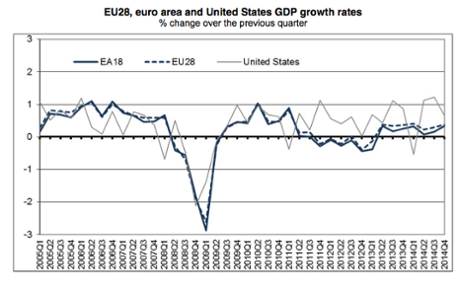
Eurozone GDP: the key chart
In short, Europe’s economy is picking up, but growth remains much weaker than the United States (which has recorded three strong quarters)
Updated
Cyprus’s economy shrank by 0.7% in the last quarter.
Greek economy shrinks
Greece’s economy has suffered a contraction, with GDP falling by 0.2% quarter-on-quarter in the last three months of 2014
That’s a blow to Athens, and suggests the recent political uncertainty has hurt its economy.
Eurostat: #Greece econ contracted by 0.2% in Q4 2014 - below expected, likely due to presidential election disruption http://t.co/rL0hEgiPPh
— Open Europe (@OpenEurope) February 13, 2015
Fall in Greek Q4 GDP a vivid example of how the economy is connected to politics.
— Yannis Koutsomitis (@YanniKouts) February 13, 2015
That 0.3% growth in the last quarter means that the Eurozone grew by 0.9% during 2014, compared to the 0.8% expected.
Eurozone GDP rose by 0.3% in Q4 2014
The eurozone economy grew by 0.3% in the last three months of 2014, faster than expected.
That’s an improvement on the 0.2% recorded in the previous quarter, primarily thanks to forecast-busting growth in Germany.
Updated
Summary: Germany drives eurozone growth
Time for a recap, while we wait for the overall eurozone growth reading at 10am GMT.
Germany’s economy has recorded unexpectedly strong growth, raising hopes that Europe’s powerhouse economy has shrugged off its recent weakness.
German GDP increased by 0.7% in the final three months, more than twice as fast as expected. Destatis reports that the German economy “gained momentum” at the end of 2014, driven by domestic demand, exports and business investment.
Economists predict that German growth will pick up in 2015, with the weak euro likely to help its exporters.
As Carsten Brzeski of ING put it:
The German economy ended a volatile year on a very strong note.
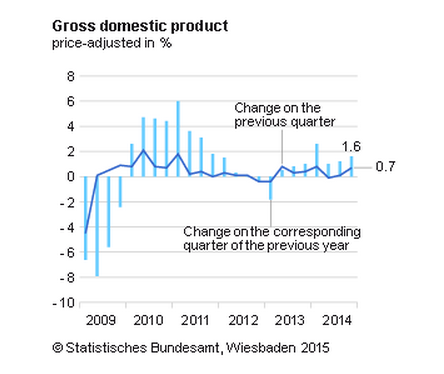
There was also encouragement that the Netherlands’ GDP rose by 0.5% in the last quarter.....
...a figure matched by Portugal.
France, though, lagged behind with growth of just 0.1% in the quarter. Business investment contracted again, showing French firms remain nervous and unwilling to spend.
Mathilde Lemoine of HSBC explains:
[French] exports accelerated but business investment declined. Consumer spending slowed down mainly due to weather-related reasons.
Italy’s slump has ended. GDP was flat quarter-on-quarter, better than the 0.1% contraction that economists expected. That still leaves Italy as the worst-performing major eurozone economy.
German economy rebounded with growth of 1.6% in 2014. France only managed 0.4%. Italy - GDP fell 0.4%. 14 consecutive Q's without growth.
— Gavin Hewitt (@BBCGavinHewitt) February 13, 2015
Let the Eurozone forecast upgrades cycle begin.
— Frederik Ducrozet (@fwred) February 13, 2015
Updated
That means that Portugal’s economy grew by 0.9% in 2014, after shrinking by 1.4% in 2013.
Portugal GDP rises by 0.5%
And finally, Portugal has posted another quarter of growth.
The Portuguese economy expanded by 0.5% in the fourth quarter of 2014, compared with the previous three months.
Portugal GDP firmer than expected at 0.5%
— Steve Collins (@TradeDesk_Steve) February 13, 2015
Keep the prosecco on ice. Italy Q4 GDP wasn't terrible (0% v -0.1% forecast), but the last positive quarter was Q2 2011. HT @RichardBarley1
— Jamie McGeever (@ReutersJamie) February 13, 2015
The FT’s Rome bureau chief, James Politi, suggests Italy’s economy may finally return to growth this year:
Italian GDP flat in Q4 2014 - compared to expectations of small drop. Will raise hopes of return to growth this year after -0.4% in 2014.
— James Politi (@JamesPoliti) February 13, 2015
Although Italy’s economy didn’t shrink again, the country is still lagging behind its neighbours.
Spain, for example, grew by a Germanic 0.7% during the last quarter.
Prime minister Matteo Renzi has a lot of work to do, out Nick Koutis of ABN Amro.
Still a laggard though...Italy's flat GDP compares to +0.7% growth in Spain in Q4. Big challenges for PM Renzi remain #Italy #eurozone
— Nick Kounis (@nickkounis) February 13, 2015
Some good GDP numbers out of the Eurozone today. Germany and Italy suprising to the up side
— Sam Barry (@LFXSam) February 13, 2015
Italian economy stops shrinking
Breaking: Italy’s economy stagnated in the last three months of 2014.
GDP was unchanged across the Italian economy in the fourth quarter, beating expectations of a 0.1% decline in GDP.
Italy's economy stagnated in fourth quarter: #GDP 0.0% in Q4, -0.1% in Q3. GDP down 0.4% in 2014 as a whole
— Markit Economics (@MarkitEconomics) February 13, 2015
Poland’s economy has slowed a little.
GDP rose by 0.6% in the October-December quarter, down from 0.8% in Q3 2014.
Germany's DAX breaches 11,000 points
Germany’s stock market has hit a new all-time high:
Dax reaches 11.000!
— Francine Lacqua (@flacqua) February 13, 2015
Germany should also benefit if the Ukraine ceasefire holds, says Christian Schulz of Berenberg bank:
The tailwinds from cheap oil, a weaker euro exchange rate and increasingly aggressive ECB monetary policy easing should more than offset the serious short-term risks such as Greece and Russia.
While the first half of 2015 could still be a little more subdued due to these risks, we expect German growth to reach trend levels a bit above 2% in the summer 2015.
Back to the GDP data... and Carsten Brzeski of ING reckons Germany is going to enjoy 2015:
Looking ahead, the German economy looks set to continue surfing on a wave of economic well-being.
With the strong labour market, wage increases, low energy prices and extremely low interest rates, consumers should continue to spend it. At the same time, the weak euro will definitely benefit German exports, letting them return as a growth engine.
Greek stock markets surges on deal hopes
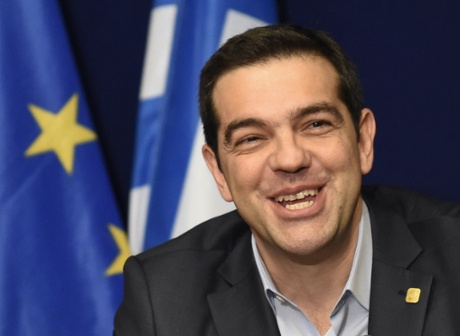
Optimism is growing that Greece and its lenders are going to hammer out a bailout extension in time.
The Athens stock market surged by 7.6% at the start of trading, and bank shares have surged by around 20%.
And Greek bonds are strengthening, pushing down the yields on Greece’s debt into less dangerous territory.
That follows the news last night that Greece and its creditors appear to be compromising, by agreeing to explore ‘common ground’ ready for Monday night’s eurogroup meeting [see opening post].
Bloomberg reports that Athens is looking for a “new contract” with the eurozone, and believes Berlin may be amenable:
Germany won’t insist that all elements of Greece’s current aid program continue, said two officials in Berlin.
As long as the program is prolonged, they said, Germany would be open to talking about the size of Greece’s budget-surplus requirement and conditions to sell off government assets.
Full story: Greece, Germany Said to Offer Compromises on Aid Terms
Greek delegation at EUCO sound elated but have conceded program continuity to kill Troika
— Paul Mason (@paulmasonnews) February 12, 2015
Greek government climbs down, agrees to talks with Troika as tax receipts collapse and banks get another €5bn in ELA. Reality dawns?
— Simon Nixon (@Simon_Nixon) February 12, 2015
If you change the perspective a bit French GDP doesn't look too bad. They just don't like sudden movements. pic.twitter.com/gF1oOlFxPJ
— grodaeu (@grodaeu) February 13, 2015
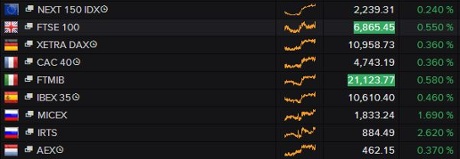
This morning’s GDP data is giving European stock markets a lift.
The ceasefire in Ukraine, and hopes of a breakthrough in the Greek bailout talks, have also helped to push the main indices up in early trading.
Here’s the situation:
France’s finance minister, Michel Sapin, is hopeful that the country’s economy might pick up this year, after ending 2014 with growth of just 0.1%.
He told French radio that:
“It’s obviously still too weak, but the conditions are ripe to permit a cleaner start of activity in 2015.”
Outside the eurozone, Hungary has also outperformed expectations; its economy grew by 3.4% year-on-year in the October-December period, compared to the 2.9% expected.
Updated
The eurozone could have grown by as much as 0.4% in the last quarter, reckons Claus Vistesen, macroeconomist for Pantheon Macroeconomics.
@graemewearden Yeah, the EZ consensus of 0.2% is way too pessimistic, more like 0.4% unless Italy is a complete stinker.
— Claus Vistesen (@ClausVistesen) February 13, 2015
Back to the Dutch data briefly, and Statistics Netherlands says the 0.5% growth was broad-based, with exports, household consumption and investments all rising.
The strong German growth figures are a “thunderbolt”, says economist Andreas Rees at Unicredit.
Rees told Reuters:
“Economic recovery in Germany started much earlier than expected. Some spoke of possible recession after the summer but instead Germany rebounded. The fact that the growth comes mainly from the domestic economy gives strong grounds for optimism,”
“Thanks to 2014’s strong finish we have a higher chance of seeing stronger-than-expected growth this year, which would help the rest of the euro zone.”
Dutch economy grows by 0.5%
The Netherlands has followed Germany’s lead by reporting faster than expected growth.
Dutch GDP grew by 0.5% in the last quarter, according to Statistics Netherlands, beating forecasts of 0.3%.
Growth in the third quarter has been revised up too, from 0.1% to 0.2%.
Another encouraging sign for the eurozone.
Netherlands Q4 GDP growth of 0.5% qoq. Notwithstanding France's worrying weakness, euro zone on track for welcome 0.3% Q4 aggregate growth.
— The EIU Europe (@TheEIU_Europe) February 13, 2015
The forecast-beating German growth data suggests the eurozone may have grown faster than the 0.2% economists had expected:
German growth at 0.7% on the quarter, well ahead of consensus of 0.3%. That should push up Eurozone growth to above the expected 0.2%.
— Duncan Weldon (@DuncanWeldon) February 13, 2015
The story so far:
#German growth accelerates on consumer spending as #France slows
— Francine Lacqua (@flacqua) February 13, 2015
The surge in German exports suggests Europe’s powerhouse economy is benefitting from the weak euro.
That’s ironic, given the Bundesbank’s attempts to prevent the European Central Bank launching its quantitative easing stimulus programme, which has helped pushed down the value of the euro.
#German #GDP powers ahead of forecasts. Economic growth of 0.7% in the fourth quarter from the third, driven by climb in exports #forexnews
— GDMFX (@GDMFX) February 13, 2015
Germany grows by 0.7% in Q4 - the details
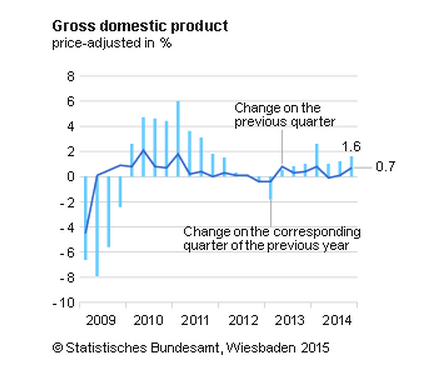
Destatis, the German statistics body, says that the country’s economy “gained momentum towards the end of 2014,” with its growth of 0.7%.
It adds:
In a quarter-on-quarter comparison (adjusted for price, seasonal and calendar variations), positive contributions were made mainly by domestic demand.
Especially households markedly increased their final consumption expenditure again. A positive development was also observed for fixed capital formation which was up on the third quarter of 2014 in machinery and equipment and especially in construction.
Also, exports of goods and services increased considerably again, according to provisional calculations; however, imports rose to a similar extent.
Updated
German exports also drove growth in the last three months of the year:
German GDP beat at .07% is basically due to 2 factors: weak euro helped exports and Germans went on a Q4 shopping spree. Very Un-German.
— HansNichols (@HansNichols) February 13, 2015
Germany’s stats office also reports that the economy grew by 1.6% during 2014 -- that’s four times as fast as France.
Instant reaction:
the German economy is showing off. Q4 GDP +0.7 after France announces a more modest 0.1% increase.
— kit juckes (@kitjuckes) February 13, 2015
German GDP jumps by 0.7%
Germany has smashed growth forecasts.
Its GDP rose by 0.7% in the fourth quarter of 2014, more than twice the 0.3% economists expected.
Domestic demand drove the pick-up in activity, according to the German statistics body.
BIG beat from Germany
— Jonathan Ferro (@FerroTV) February 13, 2015
Credit Agricole’s Frederik Ducrozet agrees:
(Lack of) investment is Eurozone's main problem, not only the periphery's.
— Frederik Ducrozet (@fwred) February 13, 2015
He’s also told Bloomberg that:
“The expectation is that now France will finally be pulled out of its stagnation trap by its neighbours.
“The external conditions cannot be more favorable and on top of that you have a domestic improvement driven by credit easing at the ECB.”
Updated
Sophie Pedder, Paris Bureau Chief at The Economist, is also concerned by that French investment keeps falling:
French GDP grew in Q4 21014 by 0.1% (0.4% for year). But investment was still DOWN (-0.5% in Q4). Worrying.
— Sophie Pedder (@PedderSophie) February 13, 2015
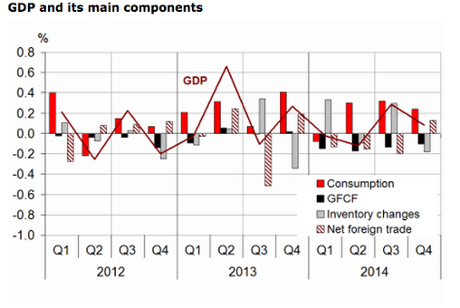
French GDP, the details
Today’s GDP data shows that French firms remain unwilling to invest.
Gross fixed capital formation shrank by 0.5% in October-December, following a 0.6% drop in the third quarter.
CHART:French GDP +0.1% in 4Q but investment continued to decline! No real recovery before the downward trend reverses pic.twitter.com/OiCrrqMBYK
— Maxime Sbaihi (@MxSba) February 13, 2015
Output across all French industry was flat, while the manufacturing sector shrank by 0.2%.
So it was left to household spending to drive growth, with consumption up by 0.2%.
But there’s good news on trade:
Exports accelerated markedly in Q4 (+2.3% after +0.7%), while imports kept on increasing (+1.7% after +1.3%).
4th quarter French GDP +0.1% - whoopee! annualised forecast 0.4% ( better than expected) but pretty average stuff!
— David Buik (@truemagic68) February 13, 2015
French economy grows by 0.1%
Here we go: The French economy grew by just 0.1% in the last three months of 2014.
INSEE, the French statistics body, also reports that GDP rose by just 0.4% during 2014.
That’s in line with forecasts, and confirms that Europe’s second-largest economy has been through a rather poor year.
French GDP rose by 0.4% in 2014. Used to be forecast at 1.5%, then 1.0%, 0.5%...
— Frederik Ducrozet (@fwred) February 13, 2015
More details to follow....
Updated
Eurozone GDP released today
Good morning.
Is the eurozone’s economy continuing to struggle, or is it starting to pick up after some tough times?
We’re about to find out, with fresh GDP data from countries across the single currency are released this morning, covering the final three months of last year.
We get data from France any moment, then Germany at 7am GMT. Then there’s a splurge of data - watch out for the Netherlands at 7.30am 8.30am , Italy at 9am, Portugal at 9.30am, and then the overall eurozone at 10a.
Economists aren’t too confidence, predicting that GDP rose by just 0.2% -- matching the weak growth in July-September.
Greece also on the agenda
We’ll also be tracking the latest developments around the Greek bailout. Last night, German chancellor Angela Merkel struck a tough line at the EU summit in Brussels, saying
“Europe always aims to find a compromise, and that is the success of Europe. Germany is ready for that.
However, it must also be said that Europe’s credibility naturally depends on us respecting rules and being reliable with each other.”
But there was also a glimmer of progress, as Greece government and its creditors agreed to start work on finding ‘common ground’.
PM Tsipras and PEG Dijsselbloem agreed today to ask the institutions to engage with the Greek authorities to start work on a technical (1/2)
— Jeroen Dijsselbloem (@J_Dijsselbloem) February 12, 2015
assessment of the common ground between the current program and the Greek government's plans in order to facilitate 16/2 EG discussions(2/2)
— Jeroen Dijsselbloem (@J_Dijsselbloem) February 12, 2015
Updated