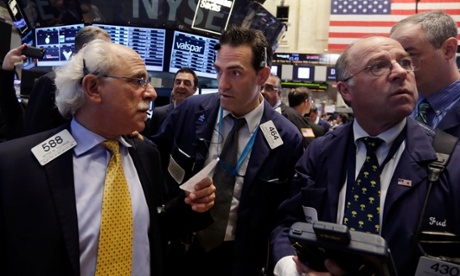
This isn’t a good sign. The labour force participation rate has dropped, to 62.7%, from 62.9% in November.
That means more many working age Americans dropped out of the workforce.
US wages fall by 0.2%
But there’s some bad news too. Average earnings paid to US workers fell by 0.2% in December, dashing hopes of a 0.2% rise.
Year-on-year, wages are only up by 1.7%.
That’s disappointing, showing that the recovery isn’t feeding into workers’ wallets. More people are getting jobs, but they’re not getting the pay rises needed.
Average hourly earnings -0.2%, which is quite disappointing.
— Neil Irwin (@Neil_Irwin) January 9, 2015
Average hourly wages fell 0.2%, lowering the 12-month increase to just 1.7%, the Labor Department said Friday. http://t.co/yABH5rEckm
— MarketWatch Economy (@MKTWeconomics) January 9, 2015
More jobs were created in November than expected.
The Bureau of Labor Statistics now says that 353,000 new employees were taken on, up from 321,000 initially expected.
And October’s reading has been revised up to 261,000, up from 243,000.
US unemployment rate hits new six-year low
The US unemployment rate has fallen to 5.6%, the lowest rate since June 2008.
Breaking: The US economy created 252,000 new jobs in December. More than expected, showing American firms continue to hire staff.
US unemployment, a preamble
Nearly time for the last major economic news of the week - America’s employment report for December.
The Non-Farm Payroll will show the latest US unemployment rate, how many new jobs were created last month, and whether wages rose during the month.
Economists reckon the NFP will rise by around 240,000. But there’s also the possibility that November and October’s data will be revised.
U.S. Dec #NFP @ReutersPolls forecast 240k (321k Nov). Range 168-305k. 7/10 best recent f'casters are below consensus pic.twitter.com/g65kr9qQDh
— Ross Finley (@rossfinley) January 9, 2015
A strong reading would be good news for the US economy, but might raise the chance of an early interest rate rise. That, though, would also be dependent on rising earnings.....
It’s due at 8.30am Washington time, or 1.30pm in the UK....
Lunchtime summary
A quick recap.
The European Central Bank is inching closer to launching a new stimulus programme. Staff have presented various options to the ECB’s governing council, ahead of the meeting in two weeks time.
According to Bloomberg, the programme could expand the ECB’s balance sheet by €500bn.
Financial analysts are sceptical that this would be enough, though.
ECB sources have told Reuters that there’s a stronger consensus that a quantitative easing programme is needed.
The latest economic data have shown the need for fresh stimulus.
German exports and industrial production both fell in November, and France also suffered a decline in factory output.
There’s a possibility that Russia could be downgraded later today, to junk status.
As it’s Friday, the main credit rating agencies will be publishing their latest decisions on several countries, including Germany, Portugal and Russia.
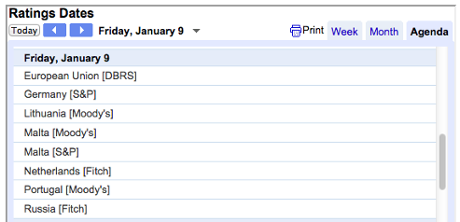
Olga Budovnits, credit analyst at Union Bancaire Privee, reckons a downgrade is highly likely given Russia’s currency crierir..
Budovnits told Bloomberg that:
“There were massive and rapid changes to Russia’s economic outlook in the last three months, driven by oil prices. This has caused a massive ruble devaluation, inflation and reduced access to credit.”
Reuters: Consensus for ECB QE has grown
Reuters has just published its own report on the ECB’s meeting this week, with a different take than Bloomberg.
Here’s the top lines:
The European Central Bank is considering a dual approach to government bond purchases which would involve both it buying debt and sharing the risk across the euro zone and, in a nod to German qualms, separate purchases by national central banks.
Sources familiar with the discussions said such a bond-buying option, also known as quantitative easing (QE), is among the tools the ECB is preparing ahead of its Jan. 22 policy meeting should it decide to act to address falling consumer prices and a growing risk of deflation in the euro zone.
Several QE plans are under discussion and nothing has been decided so far. But the debate reflects the ECB’s efforts to build a robust programme that meets German concerns about how much it would take of the risk yet convinces investors anticipating an unlimited money-printing pledge.
Markets and many economists believe anything short of an unlimited money-printing pledge will fail to revive a moribund euro zone economy.
The ECB Governing Council discussed the situation at a dinner on Wednesday night as it gathered for a regular non-policy meeting. One central bank source said there was “clearly more of a consensus than before” that QE might be necessary.
“On the rest, there are still pretty much divergent views on the whole range of issues - volume, open-ended or closed, risk sharing or not, whether there are contingencies and which ones. It’s still very open,” the source said.
Another central bank source said one of the options that was discussed was one where the ECB would buy a certain share of the total programme and in case of default the risk would be shared among national central banks depending on their capital share.
The remaining part of the programme’s volume would be bought by national central banks, but at their own risk.
“There was no fundamental opposition against this option on Wednesday,” said the source. “This could be an option, which the Bundesbank could go along with.” But the source said there was no decision yet and the discussion remained very much open.
“This is one option that is being discussed and it may go in this direction, but nothing has been decided,” the source said.
Reuters turn... #ECB CONSIDERS DUAL QE APPROACH THAT INVOLVES ECB BUYING GOVT BONDS W/EZ RISK-SHARING AND NCBs BUYING AT OWN RISK -SOURCES
— Ioan Smith (@moved_average) January 9, 2015
Shares dip after QE report
European stock markets have dropped since Bloomberg reported that the ECB is considering launching a €500bn stimulus programme.
The FTSE 100, German DAX and French CAC are all down around 0.5%. Another sign that the plan might underwhelm investors.
ECB bond plan in theory. QE well flagged. €500bn widely expected. But investment grade only is the perfect way to side-step the Greek issue!
— Jonathan Ferro (@FerroTV) January 9, 2015
Bloomberg has also concluded that a €500bn stimulus programme wouldn’t be enough to drag the eurozone away from deflation:
ECB’s QE Plan Too Small to Arrest Inflation Decline: By @davidjpowell24 & @MxSba {NSN NHWOS86JIJUQ<Go>} pic.twitter.com/ailjNJ2SbR
— Michael McDonough (@M_McDonough) January 9, 2015
Portuguese government debt could also be excluded from the ECB’s new QE programme if it decides to only buy investment-grade bonds, as it has a ‘junk’ rating.
#ECB considering EUR 500bn investment grade sovereign QE plan. This means Greece but also Portugal could be excluded from QE.
— Nick Kounis (@nickkounis) January 9, 2015
A €500bn QE programme would not be enough, on its own, to swell the ECB’s balance sheet towards its levels in 2012 when it topped €3trillion.
That’s Mario Draghi’s stated goal -- although several members of the ECB’s executive council refused to back him last month.
#ECB said to study bond-purchase models up to €500bn to boost balance sheet. http://t.co/huIZzD7U3Y pic.twitter.com/yhFYe619OS
— Holger Zschaepitz (@Schuldensuehner) January 9, 2015
Updated
Worth noting that many investors are dubious that a QE programme would do much good.
ECB readies €500bn QE, but 51% investors we polled think it will work only in financial markets. EU govts must do more on stimulus, reforms
— macrocredit (@macrocredit) January 9, 2015
Some analysts are cautioning that a €500bn quantitative easing programme wouldn’t give Europe’s economy enough of a jolt:
So potentially €500bn of Investment Grade QE coming - that's a gnat bite really - hard to see how that will help #euro
— Michael Hewson (@mhewson_CMC) January 9, 2015
Euro rallies a slice on EU500bn invt grade QE chatter. Half a trillion is towards the lower end of expectations (as strange as that sounds)
— World First (@World_First) January 9, 2015
Important but not enough!!! Bloomberg breaking news: ECB Staff Said to Have Outlined $590 Billion Investment-Grade QE Plan
— Sony Kapoor (@SonyKapoor) January 9, 2015
Bloomberg: ECB looking at €500bn QE plan
The European Central Bank is considering a new €500bn quantitative easing programme to stimulate the ailing European economy, according to a story just published by Bloomberg.
It says that staff at the ECB presented the proposal to the Governing Council this week. No decision has been taken yet.
Under the plan, the ECB would buy ‘investment grade’ assets only, which would rule out sovereign debt issued by Greece, for example. That might allow the ECB to unveil the plan at its January 22 meeting, even though the Greek general election is three days later.
The story is online here:
ECB Said to Study Bond-Purchase Models Up to 500 Billion Euros
Here’s a flavour:
European Central Bank staff presented policy makers with models for buying as much as €500bn ($591bn) of investment-grade assets, according to a person who attended a meeting of the Governing Council.
Various quantitative-easing options were shown to governors on January 7 in Frankfurt, including buying only AAA-rated debt or bonds rated at least BBB-, the euro-area central bank official said. Governors took no decision on the design or implementation of any package after the presentation, according to the person and another official who attended the meeting. The people asked not to be identified because the deliberations were private.
A 500 billion-euro purchase program would take the ECB halfway toward its goal of boosting its balance sheet to avert a deflationary spiral in the euro area. The institution is also buying asset-backed securities and covered bonds, and government bond-buying would be part of fresh stimulus to be considered at the Governing Council’s January 22 meeting.
#ECB scoop: treatment of junk-rated debt such as Greek Bonds not addressed in presentation
— Francine Lacqua (@flacqua) January 9, 2015
Reaction to follow....
UK's trade deficit with Germany hits record
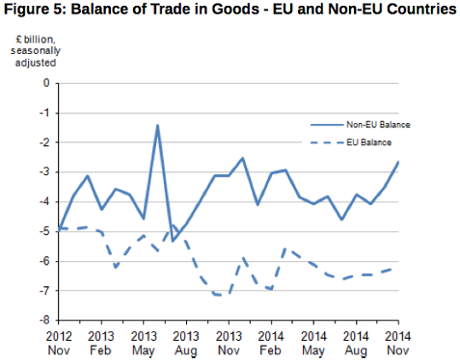
Here’s an interesting factoid from today’s trade data. The UK has recorded its largest ever trade in goods deficit with Germany, at £7.8bn in the September-November quarter.
That is due to a drop in exports, and a slight increase in imports, the ONS said.
The report (online here) also shows that the UK’s deficit on trade in goods with non-EU countries shrank by £900m. The deficit with EU countries only fell by £100m, though.
Updated
Oil slide narrows UK trade gap
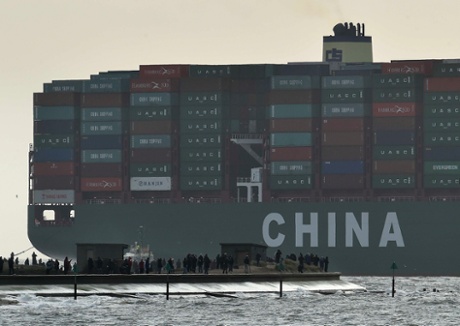
Britain’s trade gap has shrunk, mainly thanks to the recent tumble in the oil price.
The UK’s deficit on trade in goods and services with the rest of the world fell to £1.4bn in November 2014, down from £2.2 billion in October 2014.
Britain imported £8.8bn more goods than it exported, but also made a £7.4bn surplus on services.
The amount of oil imported fell by £700m during the month, the ONS said, meaning the drop in the cost of crude oil is having a beneficial effect.
UK manufacturing beats forecasts
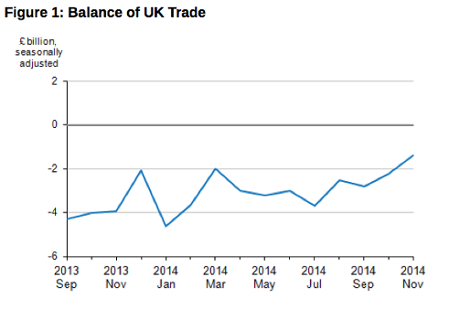
Britain’s manufacturers have just posted their strongest monthly growth since April.
Manufacturing output across the UK rose by 0.7% in November, and was 2.7% higher than a year ago.
The Office for National Statistics says transport equipment, and basic metals & metal product manufacturing, drove the increase.
Better news! Manufacturing output increased by 0.7% between October 2014 and November 2014. #GBP
— Shaun Richards (@notayesmansecon) January 9, 2015
But the wider measure of industrial output fell, by 0.1%, due to a big drop in oil and gas production as North Sea oil rigs went offline for maintenance.
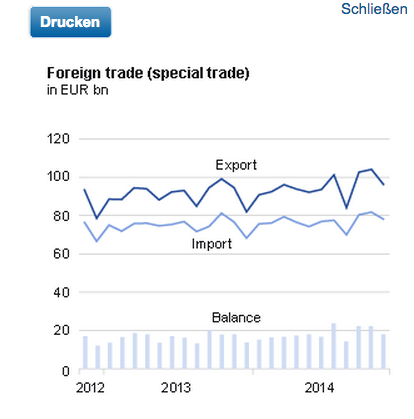
This chart from German stats body Destatis shows how the country has steadily run a trade surplus over the last two years.
The financial markets have not been spooked by the German and French data.
The FTSE, DAX and CAC indices are all broadly flat, while the euro is hovering just over $1.18, near a nine-year low.
The markets are still being driven by expectations that the European Central Bank will launch a new quantitative easing programme, perhaps this month. Today’s signs of factory weakness shouldn’t make that any less likely.
The Economist Intelligence Unit is also concerned by the French economy:
French industrial production down 0.3% mom and 2.6% yoy in November. Significantly worse than expected.
— The EIU Europe (@TheEIU_Europe) January 9, 2015
This chart, from stats body INSEE, also shows how France’s factories have been lagging for several years:
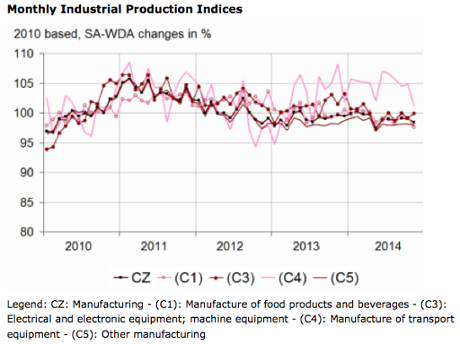
The drop in French industrial production may indicate that the economy shrank at the end of last year, warns analysts at BNP Paribas bank.
BNP Paribas sees risk of negative French GDP growth in Q4 following poor manufacturing and industrial production data
— Chris Whittall (@Chris_Whittall) January 9, 2015
First private NHS hospital provider Circle throws in towel

The big UK business news this morning is that healthcare company Circle has announced plans to pull out of its contract to manage Britain’s first privately run NHS hospital.
Circle blamed funding cuts, and a surge in demand for A&E services, for the decision to walk away.
The move comes as Britain’s hospitals are gripped by the biggest emergency care crisis in years; the future of the UK health service will be a major issue in the run-up to May’s general election:
Here’s Sean Farrell’s full story:
Circle in talks to exit private contract to run Hinchingbrooke
Some reaction:
Private failure Circle says it can't make a profit out of Hinchingbrooke Hospital so wants out from a 10-year NHS contract!
— Kevin Maguire (@Kevin_Maguire) January 9, 2015
Circle doesn't think can operate in current structure - will leave market. Medway NHS hospital clearly been failing for years - still there.
— Ryan Bourne (@MrRBourne) January 9, 2015
Flashy Circle admits defeat on its Hinchingbrooke hospital contract. Backs my theory that private sector will fail more than succeed in NHS
— MichaelWhite (@MichaelWhite) January 9, 2015
Today’s data highlights a broader trend; the eurozone’s factories are producing rather less than before the financial crisis struck more than six years ago.
This chart from Nordea Markets’ euro economist Holger Sande plots the industrial production of the major eurozone countries, (where 100 is their respective level in 2008):
Industrial production #US vs #eurozone countries: What a gap. pic.twitter.com/w3FdV1kwKH
— Holger Sandte (@HolgerSandte) January 9, 2015
On an annual basis, French industrial production was 2.6% lower in November than a year earlier.
German and French industrial production down, very few reasons to wake up bullish for 2015's underlying economy
— Matt Truman (@MattTrumanTC) January 9, 2015
French industrial production falls
Oh dear. France has matched Germany with its own drop in factory output.
French industrial production shrank by 0.3% month-on-month in November, dashing hopes of a 0.3% rise.
The narrower measure of manufacturing output was worse, dropping by 0.6%
More dire French data i/p -0.3% m/m v _0.3% expected mfg -0.6% v +0.6% expected
— Steve Collins (@TradeDesk_Steve) January 9, 2015
German and French IP both negative. Yep, the Euro project sure is working like a charm
— Stelios (@bbki2611) January 9, 2015
It suggests France’s economy continues to struggle, after several years of meagre growth or stagnation have pushed unemployment to record highs.
French industrial production Nov mm -0.3% vs +0.3% exp http://t.co/ZrO0c65k9n pic.twitter.com/VcKcw00d0p
— Forex News™ (@WorldForexNews) January 9, 2015
Updated
ING: Germany is still counting its bruises
Carsten Brzeski of ING has blamed geopolitical tensions and Eurozone stagnation for the drop in Germany exports and industrial production.
Today’s data provides further evidence that the German economy has not yet fully recovered from the soft spell of the summer. In fact, the German economy still counts its bruises.
Nevertheless, in our view, the economy should gain more momentum in the coming months, benefitting from its very special stimulus package which almost came for free. The sharp drop in energy prices and the weaker euro exchange rate are without any doubt a blessing for the economy.
German economy stutters in November
Good morning, and welcome to our rolling coverage of the financial markets, the world economy, business and the eurozone.
The day has begun with some downbeat economic news from Germany.
Industrial output across Europe’s largest economy fell by 0.1% in November, rather weaker than the 0.4% increase expected by economists.
Germany’s finance ministry blamed weaker construction activity, down 0.6%, and a 2.5% tumble in energy production.
On the upside, October’s figure was revised up. BUT, it still means Germany’s factories are producing 0.5% less than a year ago.
German industrial production unexpectedly falls in November. YoY -0.5%. pic.twitter.com/CcEFZNoVBp
— jeroen blokland (@jsblokland) January 9, 2015
German industrial production down by 0.5% yoy. This whole asymmetric adjustment approach not working for anyone.
— Megan Greene (@economistmeg) January 9, 2015
And in a second blow, separate data shows German exports fell for the second month running, down 2.1% in November.
Imports were up 1.5%, helping to narrow Germany’s trade surplus.
That indicates Germany is feeling the impact of the weak European economy, hitting demand for its products.
I’ll pull some expert reaction together now.
Did Britain’s factories do better? We find out at 9.30am, when the latest UK industrial production and trade data is released. French industrial production is due soon.
The main economic data of the day, the US Non-Farm Payroll, is due at 1.30pm GMT. It is expected to show that another 240,000 or so new jobs were created across the American economy in December.
While the stock markets are expected to be calm, after yesterday’s burst of optimism sent shares rallying across Europe. Traders are still anticipating fresh stimulus measures from the European Central Bank, while fretting about the Greek election in a couple of week’s time.
Then at 3pm, the NIESR thinktank publishes its estimate of UK growth in the last three months of 2014.
I’ll be tracking all the main events through the day...
Updated