PPS: A belated hat-tip to euronews for confirming this afternoon that Geece is repaying 750bn euros to the IMF.
Their Brussels correspondent, Efi Koutsokosta, flags up that they interviewed Yanis Varoufakis in Brussels:
@graemewearden http://t.co/IKRQmnyKBG
— EfiKoutsokosta (@Efkouts) May 11, 2015
Updated
PS: Here’s Ian Traynor and Helena Smith’s news story on today’s developments:
Closing summary

All in all, today went about as well as we could expect. But there are still some major issues to resolve, and not much time to prevent the Greek debt crisis exploding.
So, here’s a quick recap, with links to the main points in the blog:
Eurozone finance ministers have welcomed recent progress between Greece and her creditors, following a eurogroup meeting in Brussels, but also warned that “more time and effort are needed to bridge the gaps” on remaining issues.
Eurogroup statement on Greece
European commissioner Pierre Moscovici told reporters that the two sides still haven’t agreed on proposals for Greek pension and labour reform.

Greek finance minister Yanis Varoufakis also agreed that progress being made - mainly thanks to Greece - but ruled out implementing capital controls.
He also warned that Greece’s liquidity problem is a “terribly urgent issue”
It’s common knowledge, let’s not beat around the bush....We are talking about the next couple of weeks.”
Earlier, Varoufakis had told reporters that a deal was close:
Greek finance minister predicts a breakthough 'in the next few days' #Eurogroup http://t.co/7DW8aua6vW pic.twitter.com/L3ZM59Jycl
— Graeme Wearden (@graemewearden) May 11, 2015
We don’t yet know whether enough progress has been achieved to persuade the European Central Bank to relax its restrictions on Greece.
Greece has eased fears that it might default on its obligations to the International Monetary Fund, by announcing that it has already begun paying a €750m payment due tomorrow.
But Germany’s finance minister, Wolfgang Schauble, has stirred up the situation by suggesting Greece should hold a referendum over its bailout deal.
Photos from today’s eurogroup meeting are here.
Teneo Intelligence predicted that a Greek deal would only come at the last minute.
And UBS outlined four scenarios, including a full-blown default and Grexit.
While in Greece, protesters took over Siemens headquarters in Athens.....and sacked cleaning ladies celebrated getting their jobs back.
European ministers will be back in Brussels on Tuesday morning for an Ecofin meeting. I’ll be back with the blog too. Goodnight, and thanks for all the comments. GW
Updated
With no big breakthrough on Greece, our financial editor Nils Pratley is intrigued by Germany’s suggestion that Athens holds a referendum.
He writes:
The late news from the make-or-break talks in Brussels was no news at all, really. There were a few encouraging words for the progress Greece is making on its reform plans. Athens also ordered a €750m (£535m) repayment to the International Monetary Fund. But an agreement on releasing €7.2bn of bailout funds? No.
There was, though, one intriguing sub-plot. Germany, in the form of finance minister Wolfgang Schäuble, suddenly seems taken by the idea of Greece holding a referendum.
“If the Greek government thinks it should have a referendum, then it should organise a referendum,” said Schäuble. “Maybe this would be the right measure to let the Greek people decide if it is ready to accept what is necessary, or if they want to have the other thing.” By the other thing, he means an exit from the euro....
More here:
And finally, a question on whether Greece is considering implementing capital controls to prevent a bank run.
Capital controls and a monetary union are incompatible, Varoufakis replies. We have no plans to bring them in.
Varoufakis said capital controls not compatible with a monetary union. Cyprus proved that wrong.
— Yannis Koutsomitis (@YanniKouts) May 11, 2015
First rule of capital controls.. https://t.co/kmqQsBfngW
— Lorcan Roche Kelly (@LorcanRK) May 11, 2015
Updated
Today’s meeting with my German counterpart was the best since I became finance minister, Varoufakis smiles:
Varoufakis: "Meetings with Schaeuble are always friendly, particularly interesting & constructive. Today was friendliest" #Greece #Eurogroup
— Kathimerini English (@ekathimerini) May 11, 2015
Varoufakis confirms that Greece will be meeting the IMF’s €750m payment tomorrow.
Varoufakis: We'll have to row back on pre-election promises
Won’t you have to row back on some of the promises you made to get elected, to reach a deal with creditors?
Of course! That was an easy question, Varoufakis says. We have compromised to a great extent already.
And he reiterates that the debt deflationary cycle must be ended, which despite some ‘touching rumours’ didn’t finish in 2014.
And will the burden be transferred from the shoulders of the weakest, and onto those who helped caused the crisis?
If that happens, we’ll sign the deal.
Updated
Varoufakis has also insisted that Greece is prepared to compromise on many issues. Some red lines remain, though:
#Varoufakis: We will compromise, except on: 1) ending deflationary cycle 2) distribution of burden from weak to those who are unburdened.
— Open Europe (@OpenEurope) May 11, 2015
#Varoufakis: Responsibility for Crisis facing Greece has to be moved to shoulders of those who helped cause it who are currently unburdened.
— Open Europe (@OpenEurope) May 11, 2015
Varoufakis: "Just cutting pensions is not a reform" #Greece #Eurogroup
— Kathimerini English (@ekathimerini) May 11, 2015
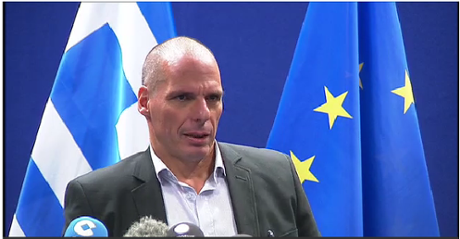
Varoufakis: Referendum not on the radar
Is the Greek government considering a referendum over a bailout deal?
That’s a matter for the prime minister, the cabinet, and the president of the republic, Varoufakis replies.
As finance minister, he can’t answer it in any detail.
Generally speaking, a referendum is always available….to elicit the support of the Greek people for pivotal issues.
However:
At the moment it is not on the radar screen as far as we are concerned.
Updated
More key points from the Greek finance minister:
Varoufakis says #ECB should reinstate waiver on Greek banks' collateral. #Eurogroup
— Yannis Koutsomitis (@YanniKouts) May 11, 2015
Varoufakis: "Liquidity issue is urgent," says government hoping to resolve it in "next couple of weeks" #Greece #Eurogroup
— Kathimerini English (@ekathimerini) May 11, 2015
Yanis Varoufakis concludes:
The quest for an agreement that resolves the five, six year-old crisis of the Greek social economy is continuing.
Agreement is getting closer, and the institutions, our partners, and representative of the Greek government continue to search for that solution in very good spirits.
Varoufakis: Eurogroup acknowledged our progress
Yanis Varoufakis says that Greece and her creditors have made real progress in recent weeks.
In recent weeks there has been considerable convergence, primarily due to our government’s great efforts and major concessions during the Brussels Group negotiations.
Unfortunately, agreement has not been reached as yet, he continues. But.....
Today’s Eurogroup meeting has acknowledged the strides we have made, and was conducted in a “thoroughly positive atmosphere.”
Varoufakis also take a pop at elements of the media for their reporting of the alst eurogroup meeting, in late April. :
Colleagues also condemned the awfully inaccurate and unhelpful supposed leaks that marred the aftermath of the previous eurogroup meeting in Riga.
[that was the meeting where sources claimed that Varoufakis had been ‘hammered’ by fellow ministers]
Yanis Varoufakis, the Greek finance minister, is briefing the media now.
There’s a live feed here (you might need to click around to find the right part)
So, in a nutshell, relations between Greece and its creditors are more constructive. But they have still not reached agreement on three crucial areas:
Another #Eurogroup passes w/out much change. For all talk of progress the 3 key gaps - pensions/labour mrkt/prim surplus - same as in Feb
— Open Europe (@OpenEurope) May 11, 2015
And finally, Jeroen Dijsselbloem says the negotiations are working better since Greece shook up its technical teams, including changing how prime minister Tsipras is briefed.
#grexit @J_Dijsselbloem - greeks want to change the bailout so they have to deliver 'detailed proposals and detailed calculations'
— Ian Traynor (@traynorbrussels) May 11, 2015
Give me two reasons why Greece will accelerate its work to meet its obligations in time...
Dijsselblom replies that the Greek authorities will simply do what they have to do, put in all the effort needed, to reach a deal in time.
And there’s a lot of detailed work to do, given Athens will not accept the old reform programme.
More Dijsselbloem: A lot more detailed work needed in Athens #Greece pic.twitter.com/BftvFls0e6
— Derek Gatopoulos (@dgatopoulos) May 11, 2015
Dijsselbloem denies that the eurogroup is putting pressure on the European Central Bank to give Greece more help. The ECB is independent.
#Eurogroup statement for #Greece cannot be a signal for the #ECB as it is independent says @J_Dijsselbloem
— EfiKoutsokosta (@Efkouts) May 11, 2015
Did the eurogroup discuss concerns that Greece might not be able to pay pensions and wages at the end of May?
As time goes by, liquidity becomes worse, including for internal payments, Dijsselbloem replies.
But it’s primarily an issue for the Greek authorities. We can’t manage the liquidity situation in Greece.
Would bailout payments be delayed if Greece held a referendum?
Presumably if you had a referendum you wouldn’t start implementing reforms before you had the result. So there is a time delay there, Dijsselbloem says.
#Dijsselbloem seems to realise of the back of a question that the #Eurogroup statement forgot to link disbursement to implementation...
— Open Europe (@OpenEurope) May 11, 2015
.@J_Dijsselbloem: disbursements to Greece take place after implementation of agreed reforms, not merely on agreement.
— Tom Nuttall (@tom_nuttall) May 11, 2015
Could bailout funds be paid in tranches?
Dijsselbloem says it’s possible that reforms could be cut into pieces, with disbursements being paid in stages too.
But disbursements can’t happen until reforms have been implemented.
.@J_Dijsselbloem says implementation of Greek reforms could be "cut into part" and disbursements could follow each part.
— Tony Connelly (@tconnellyRTE) May 11, 2015
Updated
Can we have more details about the progress which has been achieved?
I’ve already given it, Moscovici hits back (see earlier post).
Is the eurogroup concerned that the Athens parliament has approved legislation that unwinds recent austerity measures, including rehiring civil servants?
The agreements of 20 February remain our roadmap, Moscovici replies, and that does not encourage ‘unilateral’ actions. But he won’t go further....
Does Greece need a third bailout programme to cover its funding from the start of July, or could it get through the summer without one, if it receives the €7bn of outstanding bailout funds?
Dijsselbloem reiterates that there is no point talking about a third programme for Greece until the existing programme has been concluded.
Did Wolfgang Schauble propose a Greek referendum?
Dijsselbloem declines to reveal details of the meeting, but explains that it’s up to Greece whether or not to hold a referendum.
Q&A begins
Onto questions.
How much time do we have left to resolve the Greece crisis and draw up a third programme, given the current programme ends on 30 June?
Dijsselbloem jokes that he detects a bit of impatience.
We can’t discuss a third bailout until we have completed the current process.
We need to have a positive review of this programme, to adjust the agreements. We’re all committed to that.
Updated
Klaus Regling also points out that Greece is already paying a low interest rate on its national debt, saving it over €8bn per year in interest payments.
He says Athens made a small repayment to the EFSF today:
Phew, another hurdle taken. Greece paid EUR220,000 in fees to the EFSF today, says #Regling.
— Gabriele Steinhauser (@gksteinhauser) May 11, 2015
That’s important, Regling adds, as the legal impact of Greece missing a small payment is as serious as missing a big payment.
Updated
Klaus Regling, head of the EFSF, also welcomes the progress made by Greece in recent weeks.
Reminder: a fortnight ago, Athens reshuffled its negotiating team, to give more responsible to economist Euclid Tsakalotos, Greek deputy foreign minister.
Moscovici quite positive on #Greece. #Eurogroup
— Yannis Koutsomitis (@YanniKouts) May 11, 2015
Moscovici adds that time is running out for Greece, given its bailout extension expires at the end of next month.
.@pierremoscovici: need to get an agreement well before the programme expires at the end of June.
— Tom Nuttall (@tom_nuttall) May 11, 2015
Pierre Moscovici is now speaking (in French).
He says there is good convergence between Greece and its creditors on some issues, such as VAT rates and how to handle non-performing loans.
But there is still “significant divergence” on other subjects, namely the Greek labour market and the pensions sector [as regular readers could have predicted]
My sense of the Eurogroup statement - positive & showing progress. Reading between the lines: happy with changes in structure of Greek team.
— Duncan Weldon (@DuncanWeldon) May 11, 2015
The eurogroup also discussed Ireland’s strong economic performance.
It is an example of how adjustment programmes (bailouts) can work if the government is fully committed, Dijsselbloem adds. No prizes for guessing who that comment was aimed at....
.@J_Dijsselbloem: Ireland remains a strong example of the success of bailout programs provided they are supported by (local) authorities
— Tony Connelly (@tconnellyRTE) May 11, 2015
Reading between the lines, the Eurogroup appears to be urging the European Central bank to be patient and keep providing support to Greece’s banks:
This Eurogroup statement is codedly dovish on Greece. Need more time means “ECB don’t pull plug” - 20 Feb ref = Germans can’t rewind to MoU
— Paul Mason (@paulmasonnews) May 11, 2015
We also discussed the latest EC economic forecasts, says Dijsselbloem. Growth is picking up across the continent, and more jobs are being created.
But we cannot rely on cheap oil, a weaker euro and quantitative easing -- governments must implement structural, growth-friendly reforms.
Dijsselbloem is reading out the statement on Greece - confirming that faster progress is being made....but more time is needed to reach a comprehensive agreement.
The eurogroup welcomes Greece’s commitment to accelerate the negotiations , he adds.
And bailout money can’t be released until Greece has agreed a comprehensive list of reforms, he adds (as we already knew, of course)
.@J_Dijsselbloem: comprehemsive list of reforms needed for completion of review, Feb 20 deal still framework for discussion.
— Tom Nuttall (@tom_nuttall) May 11, 2015
Updated
Jeroen Dijsselbloem begins by paying tribute to Alexandre Lamfalussy, one of the Wise Men who laid the foundations for European monetary union, who has passed away.
ECB mourns Alexandre Lamfalussy, one of the euro’s founding fathers http://t.co/cq7DNDgEku
— ECB (@ecb) May 11, 2015
The press conference is starting now (reminder, there’s a livefeed here)
Eurogroup welcomes Greek progress, but wants more
Here’s the official statement, hot off the press (and then off Twitter)
Eurogroup statement on #Greece: More time and effort needed pic.twitter.com/MaIgaHPScQ
— Jorge Valero (@europressos) May 11, 2015
Updated
It’s official: The eurogroup has officially ‘welcomed’ the progress made by Greece and its creditors in recent days.
But, as sources predicted earlier, it has also called for more time and effort to fix the outstanding issues.
#Eurogroup welcomes the progress in talks and intentions of GR auth. to accelerate their work.More time&effort needed to address open issues
— Valdis Dombrovskis (@VDombrovskis) May 11, 2015
Reporters in Brussels are scrambling to the press room....
And the SMS goes out: #eurogroup has wrapped and presser to start shortly
— Peter Spiegel (@SpiegelPeter) May 11, 2015
Officials in Brussels are preparing the press conference room now.
We’ll be hearing from Eurogroup president Jeroen Dojsselbleom, and European commissioner Pierre Moscovici. Klaus Regling, who runs the European Financial Stability Fund (the main bailout vehicle) is also attending.
Still waiting for the eurogroup to wrap up.....
Greece invited to join New Development Bank
Here’s an odd curious development...Greece has been asked to join the club of BRICS countries represented by the New Development Bank, reports Helena Smith in Athens.
Helena explains all:
The Greek government has released a statement saying that the “surprise” offer was extended to prime minister Alexis Tsipras earlier today. Operated by Brazil, Russia, India, China and South Africa, the New Development Bank is seen as an alternative to the World Bank and International Monetary Fund.
It was set up to facilitate financial cooperation among the five emerging markets. “Greece has been asked to become the sixth member of the BRICS Development Bank!” a government non-paper said (complete with exclamation mark).
The offer was made during a telephone conversation between Tsipras and the Bank’s representative, Sergei Storchak who is also Russia’s deputy finance minister.
The statement said:
“The prime minister thanked Mr Storchak, at the same time expressing his positive surprise at the invitation that Greece becomes the sixth member of the BRICS development bank,”
“Alexis Tsipras conveyed Greece’s interest and commitment to studying the proposal.”
The leader, it said, would also have the opportunity to discuss it with counterparts heading BRICS states when he attends an economic forum in St Petersburg between 18-20 June.
#Greece has been asked by Russia's deputy finance minister to become 6th member of BRICS New Development Bank, government says
— Helena Smith (@HelenaSmithGDN) May 11, 2015
Updated
Here’s another photo, of Yanis Varoufakis chatting with Jeroen Dijsselbloem earlier today.

Updated
Heads-up: the eurogroup meeting may end shortly, which means we may get that much-awaited statement on Greece.
Plus a flurry of press conferences and briefings........
Eurogroup will wrap up in 15 mins or so, I'm told.
— Tom Nuttall (@tom_nuttall) May 11, 2015
Greece has given its eurozone partners the good news:
During #eurogroup session, @yanisvaroufakis confirmed to ministers that #Greece would make €750m #IMF payment http://t.co/KagpoBGdBb
— Peter Spiegel (@SpiegelPeter) May 11, 2015
Greece will actually hand over the €750m to the IMF tomorrow, confirms Athens correspondent Helena Smith.
#Greece general state accountancy office has been instructed to transact 750 debt repayment 2 IMF but it will arrive Tuesday, media reports
— Helena Smith (@HelenaSmithGDN) May 11, 2015
Although the payment process is underway, the cash may not land in Washington until Tuesday....
The Devil is in the details: #Greece has *executed order* to make #IMF payment. Actual payment to follow *tomorrow*.
— The Greek Analyst (@GreekAnalyst) May 11, 2015
Eurozone officials are more optimistic today than at previous meetings, flags up The Economist’s Tom Nuttall. Shame it’s taken more than three months....
EZ source: recent Brussels Group talks have been much more productive. If we'd been going at this pace since Feb, deal sewn up long ago.
— Tom Nuttall (@tom_nuttall) May 11, 2015
Greece now has a little leeway until its next major IMF repayment, early next month.
Next #Greece payment to #IMF: €300m due June 5: http://t.co/Q4hqJWTy7o
— Peter Spiegel (@SpiegelPeter) May 11, 2015
But before then, Athens must find the funds for another month of wage and pensions payments....
Eurogroup to issue Greek statement
Another important development.... Officials in Brussels are briefing reporters that the eurogroup of finance ministers will issue a short statement tonight welcoming the progress that Greece has made.
However, the statement will also warn that more effort is required to overcome the outstanding sticking points (such as pension and labour market reforms).
Reuters has the details:
“There will be a short statement and it will refer to the progress made and the work ahead, welcoming the Greek’s intention to accelerate their work,” said one official briefed on the statement.
Another official said the statement will say that “more time and effort is needed to bridge the gaps” in talks to avoid a Greek default.
Tom Nuttall, who write The Economists’ Charlemagne column, is feeling a little deflated....
Arriving at this Eurogroup feels a bit like going to see a movie whose entire plot has been given away by the trailer.
— Tom Nuttall (@tom_nuttall) May 11, 2015
Hat-tip to Reuters’ Athens bureau:
#Greece has made the 750 mln euro payment to the #IMF that had been in doubt - sources tell @Reuters
— Deepa Babington (@deepababington) May 11, 2015
Updated
Greece’s Athens News Agency has just confirmed that the order to hand over the €750m loan instalment to the IMF has been executed - backing up Reuters’ report, writes Helena Smith in Athens.
A case perhaps of the Greek government trying to make waves with a goodwill gesture - before the Euro Group releases its much-anticipated statement on the state of negotiations.
Here’s some reaction to the news that Greece has begun meeting tomorrow’s repayment to the International Monetary Fund:
Greece has paid IMF €750m. Thats from Greek finance ministry official. We should wait for the #IMF to say they received it. #EURO
— Joshua Raymond (@Josh_CityIndex) May 11, 2015
@graemewearden No relief for Greeks. This is not what we voted Syriza for, another giveaway.
— Zoe Mavroudi (@zoemavroudi) May 11, 2015
@graemewearden Will they pay 1,5 bil in June too? There'd better be clarity tonight. Support is waning.
— Zoe Mavroudi (@zoemavroudi) May 11, 2015
It emerged last month that Greece has broached the idea of delaying a repayment, but was firmly rebuffed by Christine Lagarde.
So, despite the cash crunch, Athens is still determined to preserve relations with the Fund.
Greece will pay IMF €750m on Tuesday. Was agreed by war cabinet on Sunday. Syriza know must keep lines open to Fund. But torn on EFSF/ECB
— A Evans-Pritchard (@AmbroseEP) May 11, 2015
And here’s the full story....
Greece has made a payment of about 750 million euros to the International Monetary Fund that falls due on Tuesday, two Greek finance ministry officials told Reuters on Monday.
“The order to pay the IMF has been executed,” a senior Greek finance ministry official told Reuters.
Athens is close to running out of cash and there had been doubt about whether it could make the IMF payment.
Greece 'executes order' for €750m IMF payment
Newsflash from Athens. According to government officials, Greece has begun the process of repaying around €750m to the International Monetary Fund (due tomorrow).
- 15:31:04 - GREECE HAS EXECUTED ORDER FOR IMF PAYMENT OF ABOUT €750m DUE MAY 12 - GREEK FINANCE MINISTRY OFFICIALS
Updated
Photos: Inside the eurogroup meeting:
Take a peek inside today’s eurogroup meeting, as ministers chat before getting down to business (thanks to AP, EPA and AFP/Getty)


Updated
Reminder: the talks between Greece and its creditors remain snagged on three major key points; reforming the pension system, shaking up the employment market (and keeping the minimum wage down), and selling off state assets.
Until real compromises are made on these three policy areas, "progress" for Greece is nonsense http://t.co/aQZQFBFjqq pic.twitter.com/BpQSYNJZkk
— Mike Bird (@Birdyword) May 11, 2015
Greek fin min @yanisvaroufakis tells reporters they will meet their IMF repayment tomorrow http://t.co/D0imHwNuGI
— Emily Purser (@EmilyPurserSky) May 11, 2015
Schäuble: A Greek referendum could help

Reuters has published details of Wolfgang Schäuble’s suggestion that a Greek referendum could be ‘helpful’:
Greek referendum on debt deal could be helpful - Schäuble
EU paymaster Germany said on Monday it could make sense for Greece to hold a referendum on painful economic reforms under negotiation with its creditors, changing tack as Berlin’s own lawmakers bridle at further aid for Athens.
Euro zone governments have previously opposed such a vote, saying there is no time and it could destabilise financial markets and trigger a run on struggling Greek banks.
When former Prime Minister George Papandreou surprised EU partners by proposing a referendum in 2011 at the height of the euro zone debt crisis, he was summoned to emergency talks with leaders of France and Germany and told bluntly to drop the idea.
But with Greece running out of money and desperate for a deal to avert a possible default and exit from the euro zone, German Finance Minister Wolfgang Schäuble said securing public backing for the necessary sacrifices might be useful.
A referendum could make it easier for leftist Greek Prime Minister Alexis Tsipras to climb down on election promises that are making a deal on economic reforms hard to achieve.
“If the Greek government thinks it must hold a referendum, then let it hold a referendum,” Schäuble said on arrival at a meeting of euro zone finance ministers.
“That might even be a helpful measure for the Greek people to decide whether it is ready to accept what is necessary, or whether it wants something different.”....
Schäuble didn’t say exactly what question Greeks would be asked to vote on; that would depend on the conclusions of the negotiations with creditors.
Eurogroup president Jeroen Dijsselbloem is speaking to reporters now. He says he doesn’t expect a Greek deal today; ministers will take stock of the situation.
He also played down the idea that the European Central Bank could be bounced into allowing Greek banks to buy more Greek government debt:
#Dijsselbloem says that ECB is independent and won’t be guided by #Eurogroup statements.
— Maria Aroni (@aronimar) May 11, 2015
#Dijsselbloem on the possibility of a referendum in #Greece: Whether is necessary is up to the greek politicians to decide and organise it.
— Maria Aroni (@aronimar) May 11, 2015
Photos: Arrivals at the Eurogroup
The gang’s all here, some looking happier than others....


EC vice-president Valdis Dombrovskis has warned that time is running out for Greece, even though relations with creditors have improved since the showdown in Riga late last month.
EU’s Dombrovskis: Lots of work still to be done. - Clear that time is limited and things need to move on. /via @livesquawk
— Zoe Moschopoulou (@Zoe_Mosch) May 11, 2015
Debt campaigners are watching events in Brussels with alarm.
Rather than haggling about how to loan Greece more money, the eurozone must accept that Greece’s debt mountain is simply unsustainable, argues Sarah-Jayne Clifton, Director of the Jubilee Debt Campaign:
“The Eurogroup should not be discussing more loans to Greece today, they should be agreeing how much debt they are going to cancel. The debt comes from loans to bailout irresponsible lending by European banks.
These debts, now owed to the IMF, ECB and other European governments, should be cancelled, including the payment to the IMF this week. The money to do so should be recovered from the banks which benefitted from the bailout.”
Updated
Greece’s optimism of an imminent deal wasn’t exactly shared by other members of the Eurogroup.
Bloomberg’s eurozone economist Maxime Sbaihi sums up today’s arrivals:
#Eurogroup doorstep: Varoufakis expects "a good meeting" Moscovici says it "won't be conclusive" Schaeuble thinks "we’re still far away"
— Maxime Sbaihi (@MxSba) May 11, 2015
Ireland’s finance minster, Michael Noonan, believes Greece might get a ‘positive’ statement after today’s meeting, but nothing more.
"I don't think there will be a conclusive statement" on #Greece, though a positive statement on progress likely, says #Ireland's @NoonanLive
— Peter Spiegel (@SpiegelPeter) May 11, 2015
Will it be positive enough to persuade the ECB to allow Greek banks to buy more Greek government debt? Unlikely...
Moscovici: Greece must reassure us today
A clip of commissioner Pierre Moscovici arriving in Brussels has just been uploaded.
He told reporters that he hopes today’s meeting will show there is “good progress” in the talks between the Greek authorities and its lenders.
That process is already “more efficient”. But there are still important gaps to fill, before an agreement can be reached “in the weeks to come.”
(so, no suggestion of a deal in the coming days, as Yanis Varoufakis suggested a few minutes ago)
Moscovici added that it’s vital that today’s meeting takes place in a better spirit than the last meeting in Riga, when finance ministers blasted Yanis Varoufakis for the lack of progress.
It’s the occasion for the Greek authorities to reassure their partners, to show their commitment to reach an agreement.
#Eurogroup meeting - Doorstep European Commissioner @pierremoscovici on #Greece http://t.co/wJcAZe7lZb pic.twitter.com/Vkl7cNos0g
— EU Council TV News (@EUCouncilTVNews) May 11, 2015
Yanis Varoufakis has also told reporters that the International Monetary Fund wil get its €770m tomorrow:
* Greek finance minister says Greece will make IMF payment on Tuesday - RTRS
— Fabrizio Goria (@FGoria) May 11, 2015
Germany’s finance minister had retained his sense of humour.....
Germany's Schaeuble on what's changed since last Greek talks: 'The weather is warmer'
— Danny Kemp (@dannyctkemp) May 11, 2015
While I was listening to Yanis Varoufakis, Germany’s finance minister Wolfgang Schäuble told reporters that Greece should hold a referendum if it wants. [there’s a video clip here, in German]
On #Greece referendum Schäuble said: "if they want a referendum they should hold one. It could be the right measure" #Eurogroup
— Open Europe (@OpenEurope) May 11, 2015
German FinMin #Schaeuble ahead of #Eurogroup: If #Greece wants to hold a referendum, it could be helpful
— Kathimerini English (@ekathimerini) May 11, 2015
European Commissioner Pierre Moscovici has also arrived at the Eurogroup meeting.
He told reporters that today’s meeting won’t be “conclusive”, but Greece must show that it is serious about reaching a deal.
#Moscovici: meeting important, has to show diffferent spirit. Greece has to show will committment to reach agreement
— Open Europe (@OpenEurope) May 11, 2015
Greek finance minister: We'll have a good meeting
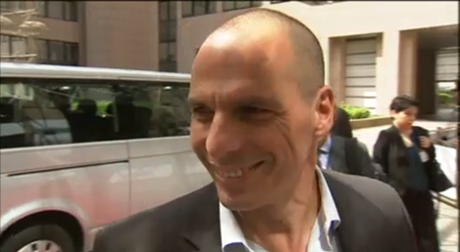
Greek finance minister Yanis Varoufakis has just arrived in Brussels, and told reporters outside the meeting that he’s confident of a deal within a few days.
He took four questions, according to this video clip.
Q: How are you feeling about the meeting today?
YV: Very confident. We are going to have a good meeting.
There is going to be a communique that establishes the progress we are making. And this will be a very good paving stone towards the final completion.
Q: Might there be flexibility in your red lines, sir?
YV: The red lines, by necessity, are inflexible. But our red lines and their red lines are such that there is common ground.
Q: What’s the time frame now?
YV: In the next few days, I think.
Q: What are you expecting from the ECB?
YV: To do its job, like we have to do our jobs. Everyone has to do their jobs in the eurozone.
And then he vanished inside:
#Eurogroup meeting - May 2015: Doorstep @yanisvaroufakis on the situation of #Greece http://t.co/41HjBja98f pic.twitter.com/niQdgvzzh1
— EU Council TV News (@EUCouncilTVNews) May 11, 2015
Anti-austerity protestors take over Siemens HQ
Just in - photos showing that protestors have occupied the offices of German engineering giant Siemens in Athens, and hung anti-austerity banners outside:
Anti-authoritarians have occupied @Siemens offices in Athens. #greece pic.twitter.com/YdhTZlBrdi pic via @kinimatini
— spyros gkelis (@northaura) May 11, 2015
(with thanks to university lecturer Spyros Gkelis)
Laid-out FinMin cleaners are hired back after 571 days of non-stop struggle #greece #katharistries Pic v @dromografos pic.twitter.com/v2esIHUy03
— spyros gkelis (@northaura) May 11, 2015
Elsewhere in Athens, the cleaning ladies who fought a 20-month campaign to win their jobs back have been celebrating after being reinstated.

The cleaners who were sacked from the FinMin in 2013 celebrate for getting back to work pic.twitter.com/9dJp3iQ5HL @dromografos #rbnews #Greece
— Joanna P. (@JoannaP___) May 11, 2015
The cleaners have been reinstated as part of a wider plan to rehire thousands of workers who had been laid off under previous austerity measures.
Elsewhere in Athens, former staff from the state broadcaster ERT have been protesting, demanding their jobs back immediately. Last week, MPs passed legislation to reopen ERT.


Back in Greece, a group of protesters have occupied the headquarters of German multinational Siemens in Marousi, north Athens.
#Greek "anti-establishment" protestors take over #Siemens HQ in #Athens. Cover facade of building with huge banner
— Helena Smith (@HelenaSmithGDN) May 11, 2015
The Enikos newspaper says:
The protesters have raised a banner asking the Greek government to end all negotiations with the lenders regarding a Greek bailout.
Protesters #occupy #Siemens headquarters in #Athens - PHOTO- http://t.co/bKVofLl1EV
— enikos_en (@enikos_en) May 11, 2015
UK interest rates unchanged
Just in: The Bank of England has voted to leave UK interest rates at their current record low of 0.5%.
That means borrowing costs have been unchanged since March 2009. There’s also no change to the Bank’s QE programme, under which £375bn of money has been pumped into the economy.
Today’s announcement was delayed because of Thursday’s general election.
#BOE decision. On a Monday. Surely that calls for a little excitement. (Followed by disappointment when you realise tomorrow's not Friday)
— F O'Brien (@fergalob) May 11, 2015
Updated
Slovakia’s finance minister has tweeted, somewhat exasperatedly, that Greece knows what it needs do to to get bailout funds....
Discussions cannot replace needed actions, which are key precondition to unlock the funds for #Greece
— Peter Kažimír (@KazimirPeter) May 11, 2015
It is no rocket science. Money for #Greece is available, they just need to do what was agreed #eurozone #Eurogroup
— Peter Kažimír (@KazimirPeter) May 11, 2015
Updated
Varoufakis to hold 'ice-breaking' meeting with Schäuble

Today’s hastily arranged meeting between finance minister Yanis Varoufakis and his German counterpart Wolfgang Schäuble could allow the two men to mend relations before the official event, insiders say.
The fact they are meeting at all shows just how crucial today’s Eurogroup is, as Helena Smith reports Athens:
Given that there is absolutely no love lost between the two men, the fact they are meeting ahead of today’s euro group should not be taken lightly.
That is the message being conveyed here in Athens where insiders are also saying the hope is that Varoufakis will “break the ice” when he has his sit-down with Schäuble.
The two men have not held direct talks for months - with euro zone officials speaking of an almost total breakdown in contact between the politicians. As Europe’s most vocal anti-austerian, the Greek finance minister is widely seen as Schäuble’s nemesis.
Ratcheting up the pressure this morning Varoufakis said:
“the Greek government has done whatever is humanly possible.”
An agreement was “visible,” he said, but Athens’ leftist-lead administration would not be giving its support to a deal that did not solve the big problems of Greece’s austerity-fuelled economic nosedive: debt, unemployment and recession.
Updated
Any deal between Greece and its creditors will come at the last minute, predicts Wolfango Piccoli of Teneo Intelligence.
He writes:
In preparation of today’s Eurogroup meeting, the Greek cabinet had a long gathering followed by a convention of the ruling SYRIZA’s political secretariat. None of the two gatherings yielded any specific outcomes; the government is going into this Eurogroup meeting in wait-and-see mode. However, it does seems that the cabinet had an intense debate on whether or not to pay the installment worth €770m due to the IMF on 12 May in case that the outcome of today’s Eurogroup meeting is negative (i.e. no positive statement).
It is clear that both within the cabinet and the party, a group exists advocating a hard line towards the creditors. Yet this does not seem to be Prime Minister Alexis Tsipras’ chosen path. But in the meantime, leaking noise about Greece’s potential willingness to play hardball may help with domestic public opinion. A poll published on Sunday shows well the government’s current conundrum: 65.9% of Greeks want a compromise with lenders, but at the same time, 56.7% say that the government should not give in on pensions and labor reform.
Updated
It’s not us, it’s you.....
#Greece "we are waiting to see political will of our partners so we can reach an honourable compromise," says gov spokesman
— Helena Smith (@HelenaSmithGDN) May 11, 2015
*VAROUFAKIS TO MEET SCHAEUBLE AT 2:15PM CET TODAY:GREEK OFFICIAL
— Dealingroom (@Dealingroom_EN) May 11, 2015
Interesting.... the finance ministers of Greece and Germany are reportedly planning a face-to-face meeting before the meeting kicks off.
#Greece FinMin Varoufakis & #Germany FinMin Schäuble to meet 1115 GMT ahead of Eurogroup mtng ~@euro2day_gr http://t.co/RDVS42IP7j
— Yannis Koutsomitis (@YanniKouts) May 11, 2015
Updated
Heads-up. The official Eurogroup ‘doorstep’ will take place at 2.45pm Brussels time, or 1.45pm BST (3.45pm for readers in Greece).
That gives finance ministers an opportunity to throw some choice quotes to the ravenous Brussels press pack outside the meeting, as they arrive for the session.
Doorstep #Eurogroup at around 14.45.
— Jeroen Dijsselbloem (@J_Dijsselbloem) May 11, 2015
Updated
Spokesman Gavriel Sakellarides has denied that Athens could refuse to repay the IMF tomorrow, if today’s Eurogroup meeting goes badly.
- 11-May-2015 10:48:32 - GREECE DOES NOT LINK LOOMING IMF PAYMENT WITH MONDAY’S EUROGROUP OUTCOME- GOVT SPOKESMAN
#Greece gov spokesman ahead of #eurogroup "we haven't made any ultimatums and we hope we don't receive any"
— Helena Smith (@HelenaSmithGDN) May 11, 2015
#Greece "the gov feels it has wide support of Greek society," says gov spokesman, raising prospect of referendum being held
— Helena Smith (@HelenaSmithGDN) May 11, 2015
Greece: We don't have a Plan B
The Greek government is insisting that there is no Plan B over its bailout -- it wants to reach a deal that suits both sides.
Spokesman Gavriel Sakellarides is also telling reporters that Athens wants the eurogroup to give it some credit today, for progress made towards a deal.
#Greece "our goal is mutually beneficial agreement" says gov spokesman Gavriel Sakellarides "we do not have a plan B."
— Helena Smith (@HelenaSmithGDN) May 11, 2015
EU CONCERNED OVER GREECE'S ABILITY TO PAY IMF TUESDAY-SOURCES
— Guy Johnson (@GuyJohnsonTV) May 11, 2015
Greece hopes for emergency eurogroup this month
Over in Greece, government insiders are already saying they are hoping an emergency eurogroup meeting will be held towards the end of May.
May 25 is being suggested as a possible date, if this afternoon’s meeting in Brussels is successful.
Helena Smith reports from Athens:
“This meeting has to be huge department from Riga,” said one insider, referring to Greek finance minister Yanis Varoufakis’ disastrous encounter with his counterparts last month [where he was heavily criticised by the eurogroup].
“We are looking at an extraordinary euro group meeting being held on May 25 if things go well today.”
Officials have begun to acknowledge openly that the longer negotiations continue, the worse things become for the economy.
Speaking to Kokkino radio earlier Varoufakis said a cash for reform deal was possible “as long as there is the political desire [for one] from lenders.”
But Varoufakis insisted that the newly installed anti-austerity government would not agree to a deal that did not “give the prospect” of exit from the crisis.
UBS: Four scenarios for Greece

Negotiations between Greece and her creditors are entering a “crucial phase”, says Swiss bank UBS.
In an analyst note released this morning, they say:
The talks are overshadowed by a precarious fiscal situation, heavy debt redemptions, and concerns about the stability of the banking system.
The time pressure is enormous: the stalled review of the current Troika programme has to be closed by end-June, and a follow-on programme would have to be in place soon after for Greece to manage very high debt service in July/August.
Failure to reach a deal over the coming weeks would likely mean default and might put Greece on a slippery slope that could lead to Grexit.
UBS also outlined four scenarios for Greece:
-
In Scenario 1 – our base case scenario – the negotiations eventually end successfully and Greece stays in the Eurozone.
-
In Scenario 2, Greece suffers default, but Grexit can still be avoided thanks to a belated deal.
-
In Scenario 3, the talks break down, leading to default, the end of ECB liquidity provisions, and quick Grexit.
-
In Scenario 4, the Greek government increasingly issues IOUs, which would become a parallel currency, but over time this still leads to default and Grexit. As negotiations continue, we will reassess the likelihood of the different scenarios and our judgement of the likely base-case scenario.
More fighting talk from Athens:
#Greece | Syriza parl group head Filis: There is no money for the creditors. We either reach agreement or we call referendum ~@AvgiOnline
— Yannis Koutsomitis (@YanniKouts) May 11, 2015
Greece: Negotiations have reached a 'very sensitive stage'

Today’s eurogroup meeting will almost certainly define the Greek government’s actions in the coming days, amid rumours that it could threaten not to make tomorrow’s IMF repayment.
Helena Smith reports from Athens:
“Our next moves will depend on today’s developments,” Syriza’s parliamentary spokesman, Nikos Filis, told Mega TV this morning, adding that the government hopes that headway would be made in Brussels.
But, he cautioned, much would also depend on how positive the statement released by Athens’ euro zone partners would be.
Filis said:
“[It depends] if it is a signal of crisis or a signal that we are a little before an agreement.
We are at a very sensitive stage of the negotiations. Lenders have toughened [their stance].
They have put issues on the table that had been closed previously during negotiations, perhaps because they think they can pressure us like they did in the past.”
Party insiders are suggesting that the government may go so far as to threaten non-payment of tomorrow’s €780m loan instalment to the IMF if the Eurogroup statement tonight is lukewarm.
When asked whether tomorrow’s debt repayment should be met Filis said: “We are in constant session [talking about it].”
Updated
ECB policymaker Ewald Nowotny has already weighed in, saying Greece’s financial problems are “much more a political question than an economic question”.
ECB unlikely to lift limits on Greek banks soon
Greece’s hopes of a breakthough with the European Central Bank have been dashed, by the FT’s Peter Speigel.
He reports that eurozone insiders are not expecting a big breakthrough today:
After a quick pre-#eurogroup ring-around, sounds like a #Greece statement that will allow @ecb to lift t-bill cap still very unlikely.
— Peter Spiegel (@SpiegelPeter) May 11, 2015
As flagged up earlier, Greece hopes that the eurogroup will declare that progress has been made.
But even if there is a statement, it’s not likely to be positive enough to give the ECB leeway to raise the limit on short-term Treasury bills (t-bills) that Greek banks can buy.
Such a move would give Greece more flexibility to avert bankruptcy, but many on the ECB reckon Greek banks hold quite enough sovereign debt already.
Today's #Eurogroup is the 6th since #Greece got a new govt 4 months ago. And we're still only hoping for a progress-making statement (sigh)
— Maxime Sbaihi (@MxSba) May 11, 2015
Investors are anxious about the €770m repayment which Greece is due to send the IMF tomorrow, says RBC’s head of European rates strategy, Peter Schaffrik:
“The crucial information that nobody seems to know is how much money do they have left.”
“Defaulting on the IMF would have major ramifications and increase the chances of an exit.”

Greece is top of the agenda at today’s Eurogroup meeting, which kicks off in around five hour’s time.
Here’s the official statement:
Greece
Ministers will continue the discussion on the situation in Greece. They will be briefed on the state of play in the ongoing discussions between the Greek authorities and the three institutions - the European Commission, the European Central Bank and the International Monetary Fund on the list of reforms that the Greek government is expected to complete under the current agreement.
The reform list is a necessary step to complete the ongoing review and thus unlock the payment of the remaining tranche of financial assistance.
Eurozone ministers will also discuss Ireland’s progress since exiting its own bailout at the end of 2013.
Agenda highlights of today's #Eurogroup meeting: http://t.co/ln32RLjyAQ #ECForecast #Greece
— EU Council Press (@EUCouncilPress) May 11, 2015
#Greece's stock market starts lower to the week as another cash deadline looms. FTSE Athex bank index down >5%. pic.twitter.com/HCvv8NwEby
— Holger Zschaepitz (@Schuldensuehner) May 11, 2015
Greek stock market falls
The Greek stock market has dropped in early trading, as investors in Athens brace for little progress at today’s Eurogroup meeting in Brussels.
The main ATG index is down 2.4%, with the banking sector leading the fallers. Attica Bank tumbled 10%, followed by Piraeus Bank and Eurobank Ergasias.
Here’s the worst-performing shares in Athens this morning:
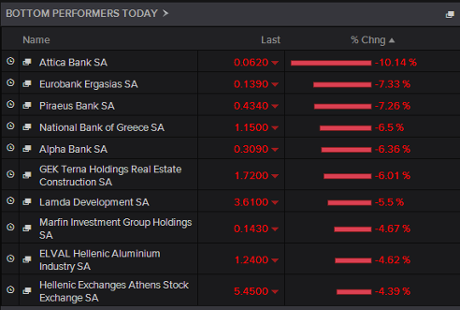
Greek bonds are under pressure too, pushing up the yield on its two-year debt from 20.5% to 20.8%.
Updated

France’s finance minister then warned that it could take a “few more days or weeks” to reach a deal between Greece and her creditors.
Reuters has the story:
Michel Sapin said he had no doubt on the political will on both sides and no worries over whether a deal would be reached eventually.
He declined to say if the Eurogroup would agree a statement on Greece and also declined to give a new deadline on when a deal should be reached.
”This remains a complex and delicate process,” he told a news conference. “Things are tense on the Greek side.”
Updated
French finance minister: Time not ripe for a deal
The time simply isn’t ‘ripe’ for a deal on Greece, says France’s finance minister, Michel Sapin.
Speaking in Paris a few minutes ago, Sapin said that today’s Eurogroup meeting will be “important but not decisive.”
“Things have progressed but are not ripe enough to allow to conclude.”
Reminder: Greece owes a lot of money to the International Monetary Fund over the next six weeks....
#Greece's latest IMF payment is due in 24 hours — and Athens is desperate for positive news. http://t.co/lZlmjLKzmx pic.twitter.com/KiUQTvwkch
— Holger Zschaepitz (@Schuldensuehner) May 11, 2015
It also must find funds for wage and pension payments at the end of this month.
The interminable Greek bailout drama is weighing on the financial markets today.
The euro has dipped by 0.3% to $1.1171 against the US dollar, on fears that today’s Eurogroup meeting will be a(nother) disappointment.
And the main European stock markets also mostly in the red. The FTSE 100 is up, though, with mining stocks boosted by China’s decision to cut interest rates yesterday.
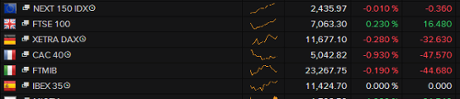
The Greek debt negotiations could be a key driver of market sentiment today, says Mike van Dulken of Accendo Markets.
He told clients:
Greek officials have been preparing for today’s Eurogroup summit in Brussels following a weekend of ‘feverish’ negotiations as the pressure mounts on Athens to take action to avoid defaulting on its debt. PM Tsipras’s government is due to repay €750mn to the IMF on Tuesday this week.
Eurogroup officials are concerned that a very real chance of Greece going bankrupt exists at the current time.
Updated
Greece wants eurozone to confirm progress

Greece’s top government ministers met yesterday to discuss their strategy ahead of today’s Eurogroup meeting.
And the tone of the meeting was pretty robust, with Athens sticking to its ‘red lines’ on pension reforms, collective wage bargaining, and sales tax.
Prime minister Alexis Tsipras told his ministers that he wants the eurogroup to acknowledge that a deal is coming closer, saying:
“We want a clear confirmation of the progress that has been made.
Another attendee told the Telegraph that Tsipras’s government was refusing to cave in:
“We have agreed on a tougher strategy to stop making compromises. We were unified and we have a spring our step once again.”

Updated
EU #daybook: BOE will probably leave benchmark rate unchanged. Euro-zone finance ministers gather in Brussels. Germany, France sell bills.
— Francine Lacqua (@flacqua) May 11, 2015
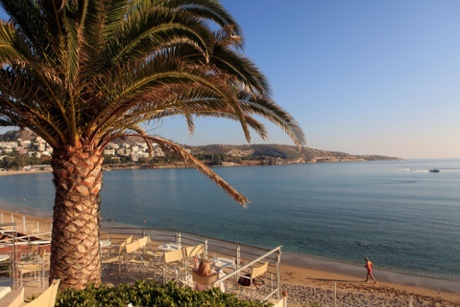
Our Southern Europe editor, John Hooper, has been interviewing people on Athens’ Vouliagmeni beach (tough gig!), and found that many Greeks remain relaxed about the debt crisis.
He writes:
“Nothing will change this week,” said Aris Karnachoritis confidently as the waitress handed out bottles of beer and frosted glasses to him and his friends.
Constantinos Neocleous, sitting beside him at a table on the beach at Vouliagmeni near Athens, nodded in agreement. “It’s not in anyone’s interests to have a crisis now,” he said.
Beyond the beach lay shallow waters of radiant turquoise. Children paddled. Teenagers romped. And from nearby, where a group of young men were playing beach tennis, came the comforting “plock-plock” sound of bat on ball.
The talks between Alexis Tsipras’s government and its creditors have dragged on for so long that it has become hard to believe there will ever be a decisive make-or-break juncture. And never has that been harder to believe than now, with the arrival of summer and the entrancing distractions it brings to a country like Greece....
Good morning all. #Greece eyes a 'positive statement' at today's #Eurogroup meeting, yet such a statement won't unlock #ECB liquidity.
— Yannis Koutsomitis (@YanniKouts) May 11, 2015
The Agenda: Eurogroup and the Bank of England
Good morning, and welcome to our rolling coverage of the world economy, the financial market, the eurozone and business.
It’s a new week, but the same old story. Eurozone finance ministers will be gathering in Brussels this afternoon to discuss the Greek debt crisis, as the risk of the country defaulting continue to rise.
Today’s Eurogroup meeting is the start of a very tense week for Greece; tomorrow, it is due to repay around €750m to the International Monetary Fund.
Let’s not pretend that a deal will come today; both sides have dampened expectations ahead of the talks:
Today sees the latest Eurogroup meeting, heading into which Dijsselbloem has said the meeting will not see any accord reached on Greece
— RANsquawk (@RANsquawk) May 11, 2015
Athens’ best hopes is that eurozone ministers agree that it is making progress towards an acceptable programme of economic reforms. That might then persuade the European Central Bank to throw Greece some slack, by allowing it to issue more short-term debt.
But with Greece’s government vowing to stick to its ‘red lines’ on issues such as labour reform and pensions, there’s a risk of renewed deadlock at today’s meeting.
Officials spent last weekend locked in talks, in an effort to produce some progress for ministers to chew on.
But Germany’s finance minister, Wolfgang Schäuble, warned over the weekend that the situation could easily escalate.
Schäuble told the Frankfurter Allgemeine Zeitung newspaper that:
“Such processes also have irrational elements.
Experiences elsewhere in the world have shown that a country can suddenly slide into insolvency.”

Also coming up.....the Bank of England will announce its decision on interest rates at lunchtime, and also consider whether to alter it £375bn quantitative easing programme.
This meeting has been delayed from last week, because of the General Election. We confidently expect a chorus of ‘no change’ at noon.
Today’s Agenda:
- Bank of England interest rate decision: noon BST
- Eurogroup meeting: From 2pm BST
- Eurogroup press conferences: Evening (perhaps 6pm BST?)
I’ll be tracking all the main events through the day.....
Updated