Eurogroup rebuff fuels talk of early elections
Over in Athens there is more talk of early elections from senior government officials - despite attempts by the government spokesman to douse such speculation earlier today.
Helena Smith reports from Athens
The Greek government had hoped to quash reports of either early elections or a referendum being called to end Athens’ stand-off with creditors. But on what soon became another explosive day in parliament, Nikos Filis, who is the governing Syriza party’s parliamentary spokesman, once again raised the prospect of early polls telling the 300-seat House that unlike their political opponents, the leftists were “not afraid of elections.”
“They said that elections would destroy the economy. It didn’t happen,” he railed. “Now they are saying the same thing again. Some have every reason to fear elections. We don’t fear them. If our political plan needs to be endorsed by public opinion, it will be. We want a compromise, but if this agreement needs to be legitimised by the people, we won’t be afraid of it.”
Earlier in the day, the government spokesman Gavriel Sakellarides staunchly denied that the coalition was entertaining “such scenarios.” The Syriza led government has been frequently accused of making contradictory statements. Filis’ assertion - only hours after Sakellarides had addressed the issue - was described as “a bombshell” by the Greek media.
Financial Times: Slovenia suggested 'Plan B' for Greece
Peter Spiegel of the FT has confirmed that Slovenia suggested the eurozone could need to start preparing a Plan B, in case Greece’s negotiations do not move fast enough to avert a default.
The suggestion, slapped down by Yanis Varoufakis, is another sign that relations between the two sides have deteriorated badly.
From Riga, Peter writes:
Months of mounting tensions between Greece and its creditors boiled over at a high-level EU meeting on Friday with eurozone finance minsters angrily accusing their Greek counterpart of backtracking on commitments and failing to grasp the deep differences that still divide them.
Athens is running desperately short of cash and many eurozone officials fear without an agreement to release some of the remaining €7.2bn in its bailout programme, the government could default as early as mid-May.
Eurozone officials briefed on the closed-door, three-hour meeting said Yanis Varoufakis, the Greek finance minister, specifically warned that cash was so tight that government coffers may run dry in a matter of weeks.
The antagonism between Mr Varoufakis and other ministers became so severe during the eurogroup session that Slovenia’s finance minister suggested if bailout talks did not progress more quickly the eurozone should prepare a “Plan B” to deal with a Greek default.
According to three eurozone officials, other ministers from smaller, vulnerable economies expressed similar sentiments. The comments prompted a sharp rebuke from Mr Varoufakis, who accused his Slovenian counterpart of being “undignified” for raising the scenario and suggested the remarks were “profoundly anti-European”.
More here: EU frustration over Greece hits boiling point at eurogroup meeting
#Slovenia FinMin suggest #eurogroup should discuss #Greece "Plan B"; @yanisvaroufakis calls talk "anti-European" http://t.co/2Fg1ZMjVbW
— Peter Spiegel (@SpiegelPeter) April 24, 2015
Despite the ructions in Riga; the FTSE index of leading shares inched towards a new record high today.
Chris Beauchamp of IG says some traders had already become exasperated with Athens’ glacial reform pace:
Signs of hope in the never-ending Greek drama were dashed this morning, and in spectacular style (for eurozone meetings at least). Most investors have long lost their patience with Greece, and it seems the eurozone’s politicians are thoroughly fed up as well. Finance minister Yanis Varoufakis was denounced as a ‘time-waster’ and ‘a gambler’, as opinion hardened against Athens. Such an atmosphere makes it hard to envision any progress today – yet another deadline missed, the latest in a litany of missed opportunities to put the eurozone back on course. In the end, we’ll just have to wait for the next instalment.
$FTSE rallies thanks to $HSBA but eurozone worries linger. IG afternoon market comments: https://t.co/FmB76Inu8t Losses can exceed deposits.
— Chris Beauchamp (@ChrisB_IG) April 24, 2015
The lack of progress in Riga is pushing Greek bond yields higher this afternoon; still below the highs set earlier this week.
Greek 3yr yields jump as EU frustration over #Greece hits boiling point at eurogroup meeting. http://t.co/0lkjHknykh pic.twitter.com/sDOKkgtJKe
— Holger Zschaepitz (@Schuldensuehner) April 24, 2015
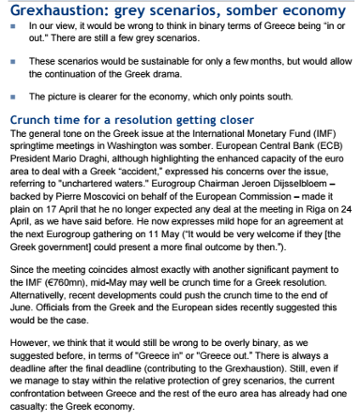
Bank of America Merrill Lynch have made their own contribution to the eurozone lexicon (grexicon?), warning that the Greek economy is heading south.
Here’s a flavour of their latest research note:
Spain’s finance minister has confirmed that Yanis Varoufakis was urged to make more progress, fast, at today’s meeting.
Spain's Guindos tells reporters Greece's @yanisvaroufakis got “urgent call to action” in eurogroup on "both form and substance"
— David Roman (@dromanber) April 24, 2015
Varoufakis: We're willing to compromise

Here’s the details of Varoufakis’s comments this afternoon, via Reuters:
Greece is willing to make compromises to reach a deal on its debt, Finance Minister Yanis Varoufakis said on Friday after tense talks with his euro zone peers on this issue.
“We want an agreement and we are willing to make compromises to achieve this,” Varoufakis told reporters. “The cost of not having a solution would be huge for all of us, Greece and the euro zone.”
Varoufakis said the process to achieve to a deal was difficult but that “we will have a solution in the end.”
Greek FinMin @yanisvaroufakis now says #Greece is ready to make "big compromises" to reach a deal. We are getting there. Slowly but surely.
— Maxime Sbaihi (@MxSba) April 24, 2015
Another rumour important development from Riga....
It seems that Slovenia said during the Eurogroup meeting that the eurozone needs a "Plan B" in case the talks with #Greece fail.
— Jorge Valero (@europressos) April 24, 2015
Updated
Summary: Exasperated Eurogroup hammer "amateur" Greek finance minister

Eurozone finance ministers have blasted Greece for failing to make more progress towards a bailout deal, at an acrimonious eurogroup meeting in Riga today.
Ministers laid into Greek finance minister Yanis Varoufakis for not having reached agreement with creditors, two months after being given a four month extension to Greece’s loan programme.
Although there are positive signs, there are still “wide differences to bridge on substance”.
We are all aware that time is running out...too much time has been lost.
Dijsselbloem: still some big problems to be solved #Greece
— Famke Krumbmuller (@FKrumbmuller) April 24, 2015
Dijsselbloem also warned that it is very hard to consider a new programme for Greece to cover its funding needs beyond June, given the lack of progress recently. And he ruled out giving Greece a slice of the €7.2bn bailout cash that is being held back until reforms are agreed.
ECB president Mario Draghi also showed exasperation over the slow pace, and warned that the ECB could potentially impose tougher conditions in return for keeping Greek banks afloat.
Draghi said:
“The higher are the yields [on Greek bonds], the bigger is the volatility, the more collateral gets destroyed,”
“Time is running out as the president of the Eurogroup said, and speed is of the essence.”
Ministers looked stern-faced as the meeting began:
Lots of serious faces at the Eurogroup this morning #greece . Live updates -> http://t.co/wOmWjK4gAt pic.twitter.com/22rnhOAQEZ
— Graeme Wearden (@graemewearden) April 24, 2015
Insiders in Riga say that Varoufakis came under sustained fire behind the closed-doors meeting.
According to Bloomberg, the academic-turned-finance minister was called “a time-waster, a gambler and an amateur.”
Astonishing bad mood at Riga #Eurogroup. #Varoufakis called a time-waster, amateur,a gambler by his counterparts. #Greece
— Jeff Black (@Jeffrey_Black) April 24, 2015
Despite the bruising encounter, Varoufakis remains adamant that a deal will be reached in time to avoid Greece defaulting on its debts.
Associated Press explains:
Greece’s Varoufakis conceded there were differences that still need to be bridged but insisted that a deal “will happen and will happen quickly as it’s the only option we have.”
He also sought to counter claims that talks had not advanced. He said there’s been a lot of progress on issues such as privatization, reforming the tax system, the judiciary, the bureaucracy and product markets.
“We look at the last few weeks and what we see is convergence,” he said.

It’s hard to believe that Varoufakis was at the same room as Malta’s finance minister, Edward Scicluna.
Scicluna emerged to declare:
“I would describe today’s meeting as a complete breakdown in communication with Greece.”
There’s now speculation that Greece’s creditors could sent more technical officials back into Athens in an attempt to kick-start the process.
Outcome of today´s Eurogroup: serious warning to @yanisvaroufakis & return to the previous model (namely troika) to speed-up process #Greece
— Jorge Valero (@europressos) April 24, 2015
Updated
With Greece’s kicking out of the way, ministers and officials are now gathering for a photo op before vanishing for more meetings.
Yanis Varoufakis looks unbowed:
Looking for bruises on @yanisvaroufakis after his reported "hammering" in Riga. pic.twitter.com/obvtrzEclc
— HansNichols (@HansNichols) April 24, 2015
From #Riga with nothing. #Eurogroup
— Damian Mac Con Uladh (@damomac) April 24, 2015

The FT’s Peter Spiegel has heard that some eurozone officials want to move the negotiations back to Greece, rather than meeting in Brussels or (last weekend) in Paris.
That must have been firmly resisted by the Greek side, who are adamant that the dsays of Troika officials stalking Athens were over.
Many in #Eurogroup room want talks to be centralised in #Athens like it was during troila days. #Greece
— Peter Spiegel (@SpiegelPeter) April 24, 2015
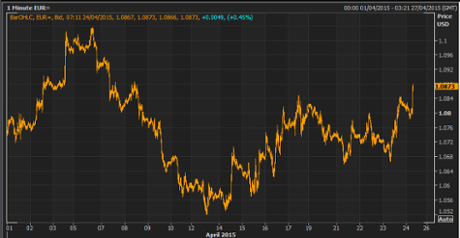
The lack of progress in Riga has wiped out the euro’s rally this morning - it’s back at $1.082, where it began the day.
And the Greek stock market has also subsided - up just 1%, having jumped over 3% this morning.
Here’s a sign that the two side are still divided.
Varoufakis has just suggested that the negotiation process would be speeded up if lenders would agree to a “partial disbursement” in return for a ‘narrower list of reforms”
But just minutes ago, Eurogroup chief Jeroen Dijsselbloem told the press conference this was not an option.
Dijsselbloem: no partial disbursal of bailout package for #Greece unless full agreement
— Famke Krumbmuller (@FKrumbmuller) April 24, 2015
Yanis Varoufakis’s claim that the two sides are “converging” is turning into a Twitter meme:
Converged like this? pic.twitter.com/m2qvywSNno
— Katie Martin (@katie_martin_FX) April 24, 2015
@katie_martin_FX converging like this.. https://t.co/Bvc0aoR0vv
— Lady FOHF (@LadyFOHF) April 24, 2015
@graemewearden More like this apparently @TheStalwart pic.twitter.com/0BfJBgXFOe
— The EIU Europe (@TheEIU_Europe) April 24, 2015
@graemewearden @TheStalwart maybe not like this pic.twitter.com/HLfxDzeYLz
— Mehreen (@MehreenKhn) April 24, 2015
Newsflashes from Yanis Varoufakis’s press briefing in Riga just arrived:
- GREEK FINANCE MINISTER VAROUFAKIS SAYS THERE WAS A CLEAR INDICATION THAT THE PROCESS OF NEGOTIATION HAS CONVERGED IN LAST WEEKS
- GREEK FINANCE MINISTER VAROUFAKIS SAYS FORECLOSURES LAW DEMANDED BY CREDITORS IS ALSO COUNTERPRODUCTIVE
- GREEK FINANCE MINISTER VAROUFAKIS SAYS GREECE WANTS DEAL ON PRIMARY SURPLUSES WHICH DOES NOT UNDERMINE GROWTH, DIFFERS FROM CREDITORS
- GREECE’S VAROUFAKIS SAYS AGREEMENT WITH LENDERS WILL BE DIFFICULT BUT WILL HAPPEN, AND QUICKLY, AS THERE IS NO OTHER CHOICE
- GREECE’S VAROUFAKIS SAYS GREECE OPEN TO ANY SUGGESTIONS THAT WOULD SPEED UP TALKS
- GREECE’S VAROUFAKIS SAYS GREECE AND CREDITORS HAVE COME CLOSER ON MATTERS OF PRIVATISATION IN LAST TWO WEEKS, ON JUDICIARY
Varoufakis still confident of a deal
Yanis Varoufakis is speaking to the media, and the Greek finance chief is undaunted by today’s hoofing.
He’s declaring that he’s still confident of a deal soon, despite having been blasted at today’s ‘highly critical’ meeting:
Efi Koutsokosta of Euronews is there, and reports:
Greek finmin @yanisvaroufakis said an agreement is difficult but it will happen because there is no other option. #Eurogroup
— EfiKoutsokosta (@Efkouts) April 24, 2015
*VAROUFAKIS PREDICTS GREECE TO REACH AID ACCORD WITH PARNTERS
— Marco Zanoni (@MarcoAZanoni) April 24, 2015
Updated #Eurogroup summary: little progress, tone very critical of #Greece, lots of frustration. Big problems remain to be solved.
— Open Europe (@OpenEurope) April 24, 2015
And that’s the end of the Eurogroup press conference -- journalists are scrambling from the room, presumable in search of Yanis Varoufakis....
Dijsselbloem: We were "very critical" of Greece
Last question: Is it true that you hammered Greece’s finance minister today?
“To be frank, it was a very critical discussion,” replies Jeroen Dijsselbloem.
He reminds reporters that Greece had been asked to make serious progress by the end of April, when it was given a four-month extension in late February.
Today we had hoped to hear a positive result and an agreement, so we could take a decision.....and we are still far from that.”
So, no denial that Yaroutakis was “hammered” at this morning’s meeting.
very critical discussion 2day,hoped to hear abt an agreemnt still far from it says @J_Dijsselbloem shows how bad it was for @yanisvaroufakis
— Eleni Varvitsiotis (@Elbarbie) April 24, 2015
*DIJSSELBLOEM SAYS BIG, BIG PROBLEMS TO BE SOLVED FOR GREECE
— Dealingroom (@Dealingroom1) April 24, 2015
You say there has been progress, but can you tell us what exactly?
No I can’t, Dijsselbloem replies. That might upset the process.
[Hmmm - that may also fuel fears that there hasn’t been much progress at all.]
There are still “big, big” problems to resolve, he adds.
Updated
Q: Is the eurogroup worried that Greece might default, if it doesn’t get a deal soon?
Dijsselbloem says he’s confident that Greece is committed to all its financial obligations to its creditors.
Could another eurozone meeting be called, to speed up the situation with Greece?
That’s the wrong way round, Dijsselbloem replies. We need to see progress, and an agreement, and then the eurogroup might meet
“We’re not going to lock ourselves up for weeks”.
Did any eurozone ministers argue that you should just give up on Greece?
No, Dijsselbloem replies.
We are all still determined to find a solution and support Greece. But it has to be a sustainable programme.
Time is running out, and speed is of the essence, Draghi adds.
Updated
Draghi: We may have to rethink Greek haircut
Mario Draghi can’t get away without saying anything - he’s asked how long the ECB will keep supporting Greece’s banks.
Emergency liquidity will be given for as long as Greek banks are solvent and have adequate collateral, he says.
But Draghi then points to the fragility of the situation, the ongoing outflows from Greece’s banks, and the fact that Greek bond yields are now at their highest since 2012.
The higher the yields, the bigger the volatility, the more collateral gets destroyed.....
And that means the ECB might have to revisit the rules of the emergency liquidity, to demand more collateral from Greek banks.
*DRAGHI: ECB MAY EXAMINE CHANGE IN HAIRCUTS FOR GREEK FUNDING
— lemasabachthani (@lemasabachthani) April 24, 2015
Next question: Given Greece’s financial state, is there any chance of a partial disimbursment of funds?
No, says Dijsselbloem. We are talking about a deal for these four months (March-June)
Onto questions, and Peter Spiegel of the FT gets first crack at the officials.
What happens if there is no deal in time? Will these negotiations about Greece’s bailout extension run into a review on a new programme (a third bailout)?
Dijsselbloem replies: You have a point.. as time runs out we get near to June and the end of the extension, we must start talking about what happens after.
But first we must talk about these four months, before we can talk about the future.
It is very hard to talk about the future if you can’t agree about four months.
We know what’s coming next, right?
— Joseph Weisenthal (@TheStalwart) April 24, 2015
Klaus Regling, head of the ESM, speaks next. He warns that money is only available to Greece until the end of June (when the bailout expires).
Regling also points out that Greece has benefitted from debt relief in the past, which cut its debt servicing costs by around €8bn per year.
Updated
Over to Mario Draghi, the most powerful central banker in Europe, whose emergency liquidity is keeping Greece’s banking sector afloat.
What does he have to say about the crisis?
I have nothing to add to your words.
Thanks Mario
Moscovici is much more upbeat about Spain, congratulating Madrid for the progress is has made. No room for complacency, though.
Updated
Here’s the key quote from Moscovici on Greece:
'We are far from it,' says @pierremoscovici on Greece. 'Acceleration now, intensive efforts… for Greece to remain anchored in eurozone'
— Bruno Waterfield (@BrunoBrussels) April 24, 2015
Can kicked - does anyone think Euro Finance Ministers are serious about bridging gap with Greece. No nearer now than a month ago?
— Michael Hewson (@mhewson_CMC) April 24, 2015
EU Commissioner @pierremoscovici on #Greece: Progress has been made, but very little. Time is running out. #Eurogroup pic.twitter.com/3BTGju03zZ
— Elena Becatoros (@ElenaBec) April 24, 2015
Pierre Moscovici: Time is running out
Pierre Moscovici is now speaking, in French... he says that it’s wrong to say that no progress has been made in recent months. Today’s meeting included a lot of talking, he says.
"We spoke a lot, which is always a good thing," says @pierremoscovici on Greece talks. #alwaystheoptimist
— Gabriele Steinhauser (@gksteinhauser) April 24, 2015
Greece must now accelerate the pace of reforms, he insists.
And then he switches to English to emphasis that “Time is running out”, but a deal can still be reached that it in the best interests of Greece and the eurozone.
Dijsselbloem is also welcoming the news that Cyprus’s bailout programme is back on track, with MPs agreeing to legislation to speed up foreclosures (repossessing houses).
He’s also pleased that capital controls have been lifted, two years after its bailout began.
“Free circulation of capital has now been restored.”
On Spain, the Eurogroup welcomes the signs of economic and financial improvement in Spain.
But debt and unemployment is too high, so more work needs to be done, Dijsselbloem says.
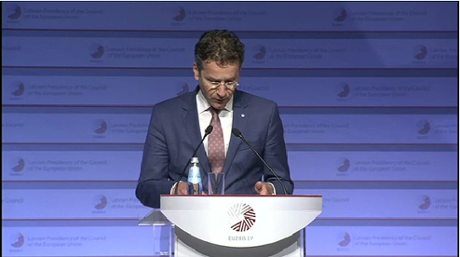
Dijsselbloem: Still wide differences between Greece and its creditors
Dijsselbloem says the Institutions (Greece’s lenders) informed us of the situation in Greece
I must reiterate that we need to see a “comprehensive list of reforms”.
There are “positive signs, but still wide differences to bridge on substance”.
We are all aware that time is running out...too much time has been lost
And the responsibility for closing the gap falls primarily on Greece, he adds.
Updated
Dijsselbloem speaks first. He realises that “all eyes are on Greece”, but the eurogroup actually discussed a range of issues including Cyprus, and Spain.
And we begin #eurogroup pic.twitter.com/Ggi5IadWFq
— Peter Spiegel (@SpiegelPeter) April 24, 2015
Updated
Press conference begins
Heads-up: The eurogroup press conference is starting now.
On the stage, we have eurogroup chief Jeroen Dijsselbloem, European Commissioner Pierre Moscovici, ECB president Mario Draghi, and also Klaus Regling, who runs the European Stability Mechanism (the eurozone’s bailout fund).
It’s being streamed live, here.
And here:
#Eurogroup press conference live stream also available here: http://t.co/jnJD3V5HiM. #Greece
— EU Council Press (@EUCouncilPress) April 24, 2015
Malta’s finance minister, Edward Scicluna, has reportedly told journalists in Riga that there was a “complete breakdown” in communication between the two sides today:
*SCICLUNA ON GREECE TALKS: `COMPLETE BREAKDOWN IN COMMUNICATION'
— stewart hampton (@stewhampton) April 24, 2015
Pierre Moscovici is also tweeting, suggesting that the meeting has ended
#Greece, #BankingUnion, #Spain, #G7, growth and jobs discussed at the #Eurogroup in Riga today @EU_Commission
— Pierre Moscovici (@pierremoscovici) April 24, 2015
Now hearing that the eurogroup meeting has ended (for the second time), so the press conference may start soon.
It’s official. European Commission vice-president Valdis Dombrovskis tweets that Greece has been told to ‘urgently’ speed up negotiations.
Concerns in #eurogroup #Riga about limited progress in talks with #Greece. Urgent need to speed up negotiations.
— Valdis Dombrovskis (@VDombrovskis) April 24, 2015
Bloomberg: Varoufakis takes hammering from the eurogroup
Jeeze. Bloomberg are reporting that Yanis Varoufakis was accused of being “a time-waster, a gambler and an amateur” in Riga this morning, as the eurozone’s patience ran out.
Greek Finance Minister Yanis Varoufakis was heavily criticized by his euro-area colleagues amid mounting frustration at his refusal to deliver measures to fix his country’s economy and release financial aid, according to three people familiar with the talks.
Euro-area finance chiefs said Varoufakis’s handling of the talks was irresponsible and accused him of being a time-waster, a gambler and an amateur, one of the people said. Ministers are meeting in Riga, Latvia, to assess progress in negotiations over financial aid for Greece.
Varoufakis Said to Take Hammering From Frustrated Euro Ministers
Hello..... sounds like the eurogroup meeting has burst back into life....
Presser already 30mins late and it appears #Greece discussion has restarted
— Peter Spiegel (@SpiegelPeter) April 24, 2015
We usually have to read between the lines of these EU briefings -- but ‘hammering’ doesn’t require much interpretation.
*VAROUFAKIS SAID TO TAKE HAMMERING FROM FRUSTRATED EU MINISTERS. Editors note: "hammering" is diplomspeak for something much worse.
— HansNichols (@HansNichols) April 24, 2015
#Greece's default probability jumps as Greek FinMin Varoufakis said to take hammering from frustrated EU ministers. pic.twitter.com/lr6D4UalOk
— Holger Zschaepitz (@Schuldensuehner) April 24, 2015
I'd put my money on Yanis
— Jonathan Ferro (@FerroTV) April 24, 2015
Could someone in Riga please pass Yanis Varoufakis a sponge and a towel? Sounds like he’s had a bad morning.
Varoufakis Said To Take Hammering From Frustrated EU Ministers
— Steve Collins (@TradeDesk_Steve) April 24, 2015
(that’s a Bloomberg newsflash)
Journalists are gathering in the press conference room in Riga...
Quite impressive venue for the press conference @ #Eurogroup in Riga #Greece pic.twitter.com/D1WZgUpSDX
— Jorge Valero (@europressos) April 24, 2015
The FT’s Peter Spiegel has heard that the meeting in Riga was “pretty heated”:
Source says #Greece debate in #eurogroup room was pretty heated. Talks continuing outside, too. Presser may be delayed a bit
— Peter Spiegel (@SpiegelPeter) April 24, 2015
Greek government promises reforms once agreement is reached

Over in Athens prime minister Alexis Tsipras’ leftist-led government is now saying that it will enforce reforms just as soon as the country’s credit crunch is solved
Helena Smith reports:
As eurozone finance ministers gathered for their meeting in Riga this morning, the Greek government spokesman Gavriel Sakellarides felt fit to say that once a cash-for-reform deal was sealed with the debt-stricken nation’s international creditors, Athens will set forth on implementing structural changes. “We are ready for reforms but are waiting for an agreement,” he told Mega TV.
Reforms, he insisted, would be impossible to make if “the country’s liquidity has dried up. We want to resolve the issue of liquidity.”
Another step in the game of brinkmanship? Government insiders this morning say not, taking encouragement from Tsipras’ positive meeting with the German chancellor Angela Merkel yesterday.
Sakellarides said he was optimistic a deal could be reached by May 11 when euro area finance ministers hold their next scheduled meeting in Brussels - and for the first time vigorously denied that the anti-austerity government was preparing to solve the conumdrum Athens now faces by calling fresh elections or holding a referendum. “Grexit is not a solution despite the pressure that is being exerted,” he said.
“We are not studying scenarios of holding a referendum or elections. We have no reason to put them on the table. With our policies we are enforcing our popular mandate against austerity.”
EU officials are giving Greece a tough time in Riga today, according to Eleni Varvitsiotis of the Kathimerini newspaper:
Extremely unfriendly the environment towards #Greece inside #eurogroup main message "get your act together" says EU official.
— Eleni Varvitsiotis (@Elbarbie) April 24, 2015
A reminder of how the day began (for anyone just joining us)
Dijsselbloem: "They know that time is running out" #Greece pic.twitter.com/Tm7KkzBoxx
— Derek Gatopoulos (@dgatopoulos) April 24, 2015
Benedict James, a lawyer at Linklaters, just emailed over his views on the Greece crisis, and the possibility of a default.
Worth a read, as we wait for finance ministers to emerge from their talks in Riga:
“There is a lot of loose talk, but there is no legal mechanism to force Greece to exit the euro, whether or not it defaults on its sovereign debt. Also, Greece doesn’t seem to want to exit voluntarily so it’s more likely that, at least for the time being, the government will simply run progressively out of euros.
This is likely to lead to the imposition of capital controls and issuance of government IOUs as a sort of quasi-currency (as happened in Argentina and California). That may be a precursor to a full exit of the euro. The legality of capital controls is complicated under the EU treaties and the IMF framework, the imposition of a quasi-currency may be in breach of the eurozone rules, and departure from the eurozone would definitely be a breach of them. This would all therefore be a highly complex legal situation, both for the relevant countries, and for businesses and financiers trying to work out whether their contracts are enforceable, and if so in what currency.”
Although the euro has rallied this morning, City traders aren’t expecting a major breakthrough today.
Arnaud Masset, market analyst at Swissquote, says:
Today we do not expect much from this Euro Finance Ministers meeting in Riga as several of them already lowered their expectations, the next key date for Greece being the payment of €200m to the IMF on May 1, while on May 6 Greece has to find €1.4bn at its 26-week Bill [see our chart for details].
More photos from the Eurogroup
Eurozone finance chiefs looked pretty serious as talks began this morning in Riga:


Back in Athens, Greek bank shares are now up almost 9% -- despite the cautious words from eurozone finance ministers this morning.
Greek penny stocks (banks) didn't get the Schaeuble memo +8.8% pic.twitter.com/m1FDXtmCEP
— Jonathan Ferro (@FerroTV) April 24, 2015
Confused about how much money Greece can lay its hands on, and what debt repayments it faces?
Worry not - my colleague Katie Allen has written the definitive explanation:
And here’s a handy chart:
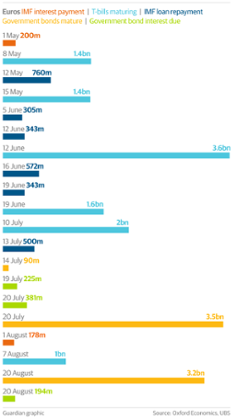
We’re expecting eurozone finance ministers to emerge in about one hour’s time for a press conference - it should be broadcast live here.
Greek government bonds are inching up this morning, pushing down the yield on the debt.
That suggests investors are slightly more confident of a deal soon. But bonds are still trading at dangerously levels.
- The yield on Greece’s 2-year debt has fallen to 24.6%, from 25.4% last night.
- And the 10-year Greek bond yield has dipped to 12.27%, from 12.35%.
Over in Riga, the press pack are hard at work too <waves>.
Στο #Eurogroup press room περιμένοντας για τα αποτελέσματα pic.twitter.com/7WVCtOLYWg
— Eleni Varvitsiotis (@Elbarbie) April 24, 2015
Open Europe analyst Vince Scarpetta sums up this morning’s soundbytes:
Doorsteps of Dijsselbloem, Dombrovskis and Schäuble confirmed what we already knew: There will be no deal at today's Eurogroup. #Greece
— Vincenzo Scarpetta (@LondonerVince) April 24, 2015
But today’s meeting is still important, simply because Greece and its creditors are running out of opportunities to make progress.
If you’re just joining us, you might want to scroll back to 7am for live coverage of finance ministers arriving in Riga for today’s meeting, and discussing the Greek crisis.
Photos: Eurogroup meeting begins
With Eurozone finance ministers now locked in talks, here are some photos from the start of the meeting:


Before a while... #Eurogroup chief @J_Dijsselbloem together w the Greek pm @yanisvaroufakis... In a good mood??? pic.twitter.com/qtLRbi9zSK
— EfiKoutsokosta (@Efkouts) April 24, 2015


There’s a new sense of optimism in Athens this morning that Greece and its creditors will hammer out a deal in time.
The Athens stock market has jumped by over 3% in early trading, with bank shares up 8%.
Earlier this week, Greek stocks slumped to their lowest level since 2012, on fears of a disorderly default and exit.
Apologies to anyone eating breakfast:
The Economist cartoon on Tsipras' poker game - PHOTO - http://t.co/2r96y69rd0 pic.twitter.com/bjA3ae5bEV
— enikos_en (@enikos_en) April 24, 2015
The Economist: Athens is "on the Gredge"
First we had #Grexit, then #Graccident, then yesterday Citi coughed up #Grimbo.
Now The Economist has got in on the act, warning that Athens is on the Gredge.
In an editorial this morning, the newspaper warns that Greece is unlikely to reach a concrete deal in time.
Here’s a flavour:
There are ways for Greece to defer disaster. It could save hard currency by issuing scrip, a type of IOU, in lieu of payments to its citizens. But that would be an open invitation to Greeks to take their remaining euros out of the banks. So the government could impose capital controls. Cyprus has had these for two years without leaving the euro, but that was done in concert with its partners. If Greece ever got to this stage—a parallel currency in circulation, capital controls in place and bail-out cash withheld—the gap between default and exit would be paper-thin.
More here: On the Gredge
The euro has hit a two-week high this morning, partly driven by hopes that the Greek crisis can be resolved in time.
Updated
James Bevan, chief investment officer at CCLA, reckons the two sides won’t reach any final agreement until June (when Greece’s existing bailout expires):
Greece's short of cash but default can be avoided if Eurozone policy makers want. Cd see a tentative deal by June. 20th July still key.
— James Bevan (@jamesbevan_ccla) April 24, 2015
In July, Greece faces hefty repayments to the European Central Bank, meaning a third bailout will be needed by then (as it can’t borrow in the financial markets today).
Varoufakis: Disagreement is not 'unbridgeable'
Overnight, Yanis Varoufakis has announced that Greece will compromise on some key issues in order to reach a deal.
In a new blogpost, Greece’s finance chief says that the gap between the two sides is “not unbridgeable”, and cites pension reforms and privatisations:
Our government is eager to rationalize the pension system (for example, by limiting early retirement), proceed with partial privatization of public assets, address the non-performing loans that are clogging the economy’s credit circuits, create a fully independent tax commission, and boost entrepreneurship.
However.... the two side remain at odds over the impact of reforms on the Greek economy. Varoufakis is adamant that wages and pensions mustn’t be cut further:
Such measures will merely cause further damage to Greece’s already-stressed social fabric, rendering it incapable of providing the support that our reform agenda desperately needs.
A New Deal for Greece – a Project Syndicate Op-Ed http://t.co/iALKa3MMkk
— Yanis Varoufakis (@yanisvaroufakis) April 23, 2015
Updated
Although this is a eurozone-only meeting, the UK has a presence at the table - Jonathan Hill, European Commissioner for Financial Services.
Surely the addition of some UK nous will help them reach a deal?
Scandalous. RT "@SpiegelPeter: A Brit in the #eurogroup room! Alert security! cc: @JHillEU pic.twitter.com/BrrRHl3Siw”
— Roel (@RoelD_) April 24, 2015
(that’s Hill on the left)
Updated
Here’s a video feed from outside, and inside the eurogroup meeting, showing ministers arriving and taking their seats (you’ll need scroll backwards a few minutes)
Updated
There’s no lack of urgency among the Greek delegation this morning.
Yanis Varoufakis has taken his seat around the table and looking ready for business.
As other FinMins chat, @yanisvaroufakis & Theocarakis wait #eurogroup start. I leave body language analysis to others pic.twitter.com/ZmMjo8oGhf
— Peter Spiegel (@SpiegelPeter) April 24, 2015
Will the Greeks look any happier after the meeting?
European commissioner Pierre Moscovici has arrived, and tells the press pack that progress with Greece are still “too slow”, although talks are also more consistent.
And Austria’s finance minister Hans Joerg Schelling is also cautiopus, saying he can’t confirm whether the two side have made “essential progress” yet.
Here’s a video clip of Eurogroup chief Jeroen Dijsselbloem speaking as he arrived at the Eurogroup meeting a few minutes ago.
#Eurogroup meeting - Arrival and doorstep Eurogroup President @J_Dijsselbloem http://t.co/t83MI2f1M9 pic.twitter.com/q7HBDc6g5b
— EU Council TV News (@EUCouncilTVNews) April 24, 2015
He says:
We will hear from our Greek colleague on the progress made. I hope there is a lot of progress to be reported, and then we’ll talk to you later.
Asked whether he’s optimistic about a deal, Dijsselbloem says he’s going to listen to the institutions first. He’s heard some “positive news” last week, but he wants to hear more....
Schäuble doesn't expect decisive progress
Now Germany’s finance minister, Wolfgang Schäuble, arrives at the eurogroup meeting.
Schäuble says he doesn’t believe there will be “decisive progress” today, but first he wants to hear the state of play from the institutions (formally known at the Troika).
Schäuble says he waits to see the 'Institutions' report, says it's obvious there is not enough progress on #Greece. #Eurogroup
— Yannis Koutsomitis (@YanniKouts) April 24, 2015
Updated
Slovakia’s finance minister, Peter Kazimir, may be losing patience with Greece.
He tells reporters in Riga that there is no more time for “chit chat”; but also suggests the crisis could drag on until the end of June.
- SLOVAK FINANCE MINISTER SAYS EUROGROUP AND GREECE HAVE 2 MONTHS TO REACH A DEAL
- SLOVAK FINANCE MINISTER SAYS STILL WAITING FOR SUBSTANTIAL REFORM PROPOSALS WITH DETAILS AND FIGURES FROM GREECE
- SLOVAK FINANCE MINISTER SAYS NO MORE TIME FOR POLITICAL AND DIPLOMATIC CHITCHAT WITH GREECE
Disappointing! Yanis Varoufakis swept into the eurogroup meeting without speaking to the press.
Greek finmin @yanisvaroufakis just arrived. No doorstep. #Eurogroup #Greece
— EfiKoutsokosta (@Efkouts) April 24, 2015
#Eurogroup chief @J_Dijsselbloem said deadline more important for #Greece. They know time is running out. pic.twitter.com/BezJDKCy7u
— EfiKoutsokosta (@Efkouts) April 24, 2015
Dijsselbloem: Great urgency for a deal
Here comes the head of the Eurogroup, Jeroen Dijsselbloem.
Dijsselbloem tells reporters in Riga that there is a “great urgency” to reach a deal with Greece.
Asked about the prospects of a deal soon, Dijsselbloem says that “April isn’t over yet”.
"April isn't over yet," @J_Dijsselbloem chuckles when asked why #Greece won't get agreement on reforms before deadline at end of month
— Peter Spiegel (@SpiegelPeter) April 24, 2015
And then there’s a kerfuffle as Yanis Varoufakis appears....
#Greece has to accelerate on the reform list.Technical talks not sufficient so far says @VDombrovskis #Eurogroup pic.twitter.com/Acxu0XiK6z
— EfiKoutsokosta (@Efkouts) April 24, 2015
Dombrovskis: We need more progress from Greece
European vice-president Valdis Dombrovskis has just arrived in Riga, and told reporters outside the Eurogroup that Greece must accelerate the work on its reform programme.
Without a credible list, there is no chance of a deal today in Riga, Dombrovskis says.
#EU’s Dombrovskis says not enough progress on #Greece talks; Greece must accelerate work on reforms; technical work not done, no Riga deal
— Yannis Koutsomitis (@YanniKouts) April 24, 2015
French finance minister: Greece is becoming more complicated
Everyone involved in the Greek negotiations must do everything they can to an “accident”, France’s finance minister has warned.
Michel Sapin told Reuters a few minutes ago that:
“Every day that passes (without a deal) makes things more complicated....We must avoid an accident.”
And we’re off....
Latvian breakfast of champions. Finance ministers starting to arrive for #eurogroup. @eu2015lv #Riga pic.twitter.com/ceGRqqUFqJ
— Peter Spiegel (@SpiegelPeter) April 24, 2015
Updated
The Agenda: Eurogroup gathers in Latvia
Good morning.
Greece’s debt drama switches to Riga today. Eurozone finance ministers are gathering in the Latvian capital to discuss the crisis that is gripping Europe and worrying the financial markets again.
A few weeks ago, this was seen as the crunch meeting that would decide if Greece received any of its outstanding bailout funds. But this deadline, like so many before, has slipped -- and we’re not expecting a big breakthrough today.
But the Eurogroup is still an important moment, with Greece running steadily short of funds as fresh funding demands loom.
Politico sums up the mood:
WHY DOES TODAY MATTER? BEGINNING OF THE LAST CHANCE SALOON:
The new left-wing Greek government was supposed to present detailed reform plans today to eurozone and wider-EU finance ministers. This would have allowed lenders to unlock the next round of funds Greece needs to pay everything from creditors to pensions. No deal will happen today in Latvia, but all are desperate for signs of progress.
Angela Merkel set the tone for the meeting last night, warning of the risk that Greece runs out of cash before a deal is done. The German chancellor was speaking after a sitdown chat with Greece’s PM in Brussels. Alexis Tsipras urged to help speed up the negotiating process.
Merkel: Must prevent Greece running out of cash - http://t.co/CZhILG6Pm8 pic.twitter.com/OrpsgrIG54
— enikos_en (@enikos_en) April 24, 2015
Finance ministers are gathering in Riga right now, and we’re expecting a press conference before lunchtime.
We’ll be tracking all the developments through the day...