Growth across the eurozone economy has accelerated, driven by a strong performance from the exporting powerhouse Germany.
Eurozone GDP rose by 0.3% in the final three months of 2014. That is an improvement on the 0.2% growth in the previous quarter, raising hopes that Europe’s weak economic recovery is picking up pace.
The wider EU expanded by 0.4%, Eurostat reported.
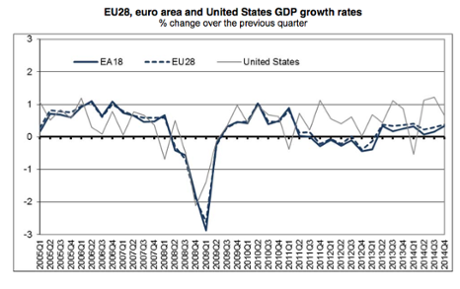
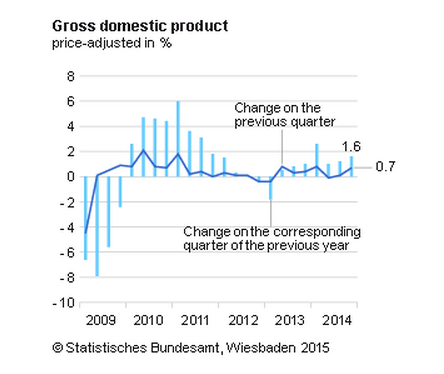
Germany outperformed its neighbours, and confounded City expectations, with growth of 0.7%, well ahead of forecasts of about 0.3%. France, however, grew by only 0.1% while Italy’s economy stagnated.
Germany’s statistics office, Destatis, said strong domestic demand and rising exports helped its economy to gain momentum at the end of 2014.
Economists believe German economic growth could accelerate this year. “Looking ahead, the German economy looks set to continue surfing on a wave of economic wellbeing,” predicted Carsten Brzeski of ING, adding:
“With the strong labour market, wage increases, low energy prices and extremely low interest rates, consumers should continue to spend it.
At the same time, the weak euro will definitely benefit German exports, letting them return as a growth engine.”
Andreas Rees of Unicredit said the economic recovery in Germany started much earlier than expected; shrugging off fears of a recession in Europe’s largest economy. “The fact that the growth comes mainly from the domestic economy gives strong grounds for optimism,” Rees added.
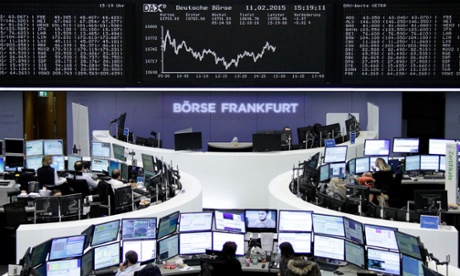
Optimism over Germany’s economy drove its stock index, the DAX, to a fresh record high this morning.
Did anyone tweet a DAX chart? Here it is. Record high. pic.twitter.com/ik1FKDW3WV
— Jonathan Ferro (@FerroTV) February 13, 2015
While Germany grew by 1.6% in 2014, France only managed growth of 0.4% during the year. Its statistics body, INSEE, reported that business investment contracted again while consumer spending slowed.
The economy minister, Michel Sapin, admitted that France must improve. “It’s obviously still too weak but conditions are met to allow a more definite upturn in activity in 2015,” Sapin said.
Both the Dutch and Portuguese economies grew by 0.5% during the last quarter. Although Italy avoided another contraction, Europe’s third-largest economy has not recorded any growth since 2011.
Analyst Nick Spiro pointed out that the eurozone economy remained weak:
Q4 €zone GDP is a familiar tale: Germany fared relatively well, France/Italy stagnated and Spain is slowly healing. Little to rejoice about.
— Nicholas Spiro (@NicholasSpiro) February 13, 2015
Eurostat also reported that the Greek economy contracted by 0.2% in the last quarter, as its recent recovery petered out. Analysts blamed the recent political upheaval in Greece, culminating in last month’s general election won by the left-wing Syriza party.