Prices are falling in the eurozone – by more than financial analysts expected. The culprit is not just oil, where the price has more than halved since last summer, but all the commodities that tumble in price when global growth falters.
Surpluses of copper, zinc and aluminium have also pushed down prices. Decent harvests and intense competition among the big supermarkets have kept food prices low.
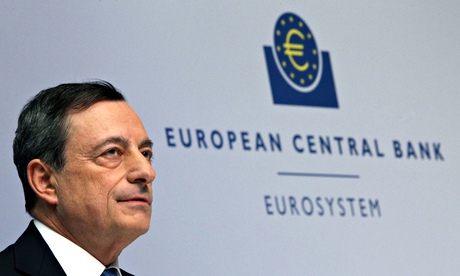
Most German commentators reckon falling prices are a temporary phenomenon and should be ignored. Low oil prices will drive growth and the economy will recover. Why ease credit to spur economic activity – as European Central Bank (ECB) chief Mario Draghi is about to do – when it will happen soon without any help?
No cuts in interest rates or money creation by quantitative easing (QE) are needed, they argue.
This thinking, they say, fits with the policy adopted by the Bank of England back in 2011 when UK inflation spiked at 5%. Threadneedle Street refused to react, even when there were economists clamouring for it to raise interest rates. The situation sorted itself out.
The ECB has ignored the German protestations and announced €1.1tn of QE over the next year. The question is, can it make a difference?
The majority view inside the ECB’s Frankfurt bunker is that falling prices are an indication of weak demand. If it can use QE to buy government debt, preferably not from banks but from other lenders that will use the cash to boost consumer and business borrowing, then the eurozone economy might just gain some momentum.
Following the same line of argument, prices will reflate, or at least stabilise, as confidence rises among consumers and businesses.
But €1.1tn of QE is not very much in the context of a €10tn eurozone economy. Spread across the 19 euro members it amounts to only a fraction of the support most economists believe is needed for a noticeable boost to credit.
And the eurozone economy is still dogged by the imbalances that brought financial crisis in 2010, when Greece ran out of money and Germany ruled out transfers within the currency loan, instead offering only more loans.
As HSBC’s chief economist Stephen King said this week, it is not deflation that is slowly strangling the eurozone economy so much as the continuing dominance of Germany, which likes everyone to buy its goods while it shuns imports. “Germans struggle to understand that a large BoP [balance of payments] surplus means their savings are used to acquire foreign rather than domestic assets. And that those foreign assets may, at times, offer the wrong mix of risk & reward. Creditors and debtors two sides of same coin,” he said in a couple of tweets summing up his views.
He was referring to Greece, but could as easily have included Italy, Portugal and Spain – even though the latter is growing these days. These countries need a change in the balance of power more than they need QE.
As Richard Batley, a senior economist at Lombard Street Research, said on Friday: “We need to remember that the real imbalances of the euro area cannot be solved by monetary policy alone. ECB policy is ultimately little more than a painkiller – but at least ECB QE is now prescription strength.”