Closing summary
… and on that note, it’s a wrap for today!
Hungarian election winner Péter Magyar has signalled Hungary would seek a political agreement on reforms needed to unfreeze EU funds after Orbán years as the new government faces a August cliff to agree on spending or lose money (16:02).
Magyar called the talks with the EU “constructive” and joked that he would urge officials to take short holidays this summer as the new government will have just under three months to get the EU money flowing again (12:16, 16:25, 16:38).
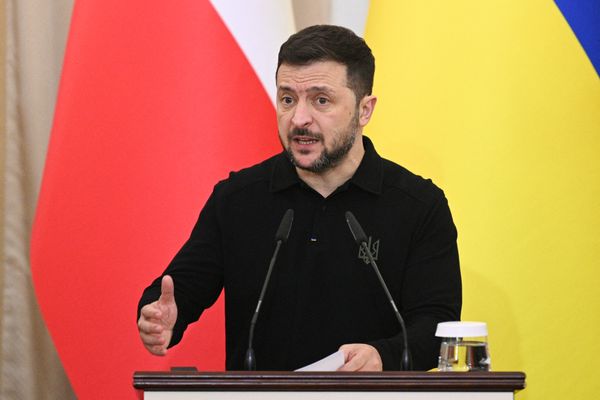
The incoming prime minister also confirmed he would drop Hungary’s veto over the €90bn Ukraine loan as soon as oil deliveries through the Druzhba pipeline are restarted, urging Ukraine’s Volodymyr Zelenskyy to do it as quickly as possible (16:22).
The issue is expected to formally be discussed at the EU level on Wednesday (17:15), with France’s Emmanuel Macron saying he is “reasonably optimistic” that the loan will finally be paid out (17:12).
Magyar also named first ministers in his incoming government (14:55), and repeated his warning to Orbán-era officials, urging them to step down by end of May or face removal by the new parliamentary majority as he seeks a break from the past (15:22).
Separately, Poland’s Donald Tusk has confirmed that Magyar asked Poland to help with repairing the relations with the EU (17:01), as we reported over the weekend.
Separately,
Spain’s Pedro Sánchez has led the calls for the EU to suspend its association agreement with Israel, as the issue is expected to return to the EU forum on Tuesday (17:45).
EU and Nato leaders congratulated Bulgaria’s former president Rumen Radev on winning the country’s parliamentary election on Sunday (12:30, 13:33, 13:41), amid some concerns over his future government’s stance towards Russia and Ukraine after the Kremlin praised his call for “pragmatic” relations with Moscow (11:49).
Romania and Slovenia could soon also experience political problems after difficulties were reported in their ability to form stable governments (11:37).
If you have any tips, comments or suggestions, email me at jakub.krupa@theguardian.com.
I am also on Bluesky at @jakubkrupa.bsky.social and on X at @jakubkrupa.
45 Ukrainian children forcibly moved to Russia tracked down by Europol
Some 45 children forcibly removed from Ukraine have been tracked down by Europol in an initiative also involving the International Criminal Court and experts from around the EU and the US.
Over two days, experts from 18 countries including the UK and the US, used open source intelligence including information on military units assisting deportation of children from Russian occupied territory, platforms showing photos of alleged deported children and information on individuals who received children to track them down.
It was the third event of its kind and is aimed at assisting Ukrainian authorities at repatriating the children and building evidence of potential war crimes.
Two years ago the International Criminal Court with the backing of the EU and the US established the International Centre for the Prosecution of the Crime of Aggression (ICPCA) in bid to systemically build evidence for potential trials after the war.
The number of children tracked is a tiny fraction of the 19,500 Ukrainians have estimated have been deported or forcibly removed from occupied territories during the four year war.
Participating countries were: Austria, Belgium, Czechia, Denmark, Finland, France, Germany, Ireland, Italy, Malta, Netherlands (co-organiser), Norway, Portugal, Romania, Spain, Ukraine, United Kingdom, United States.
Organisations involved were the International Criminal Court - Office of the Prosecutor, Mnemonic, Global Rights Compliance, Osint for Ukraine and Truth Hounds.
Spain's Sánchez leads calls for EU to end association agreement with Israel
Sam Jones in Madrid and Jennifer Rankin in Brussels
Meanwhile, Spain’s prime minister, Pedro Sánchez – who has been among the most vocal European critics of Israel’s war in Gaza – has said he will ask the European Union to end its association agreement with Israel on Tuesday.
“The time has come for the EU to break its association agreement with Israel,” Sánchez said on Sunday.
“We have nothing against the people of Israel – quite the contrary. But a government that breaks international law – and thus breaks the values and principles of the EU – cannot be our partner.”
The Israeli government has hit back at Sánchez, accusing him of hypocrisy and double standards.
“We won’t accept a hypocritical lesson from someone who has a relationship with totalitarian regimes that violate human rights, such as Erdoğan’s Turkey and Maduro’s Venezuela,” Israel’s foreign minister, Gideon Sa’ar, posted on X, alongside a photograph that apparently showed a poster of Sánchez’s face and his criticisms of Israel’s war on Iran on an Iranian missile.
In a reference to the poster, Sa’ar said the Spanish government had received thanks “from Iran’s brutal regime and terrorist organisation”, adding that it has “dedicated itself to spreading antisemitism”.
He then threw Sánchez’s words back at him:
“We have nothing against the citizens of Spain – quite the contrary – but we do against the double standard of the government of [Pedro Sánchez].”
More than 390 former EU ministers, ambassadors and top officials have recently urged the EU to wholly or partly suspend the agreement, which created a free trade area and deepened joint work in energy, environment and research agreement.
Signatories included the ex-EU foreign affairs chief and former Spanish foreign minister Josep Borrell, the former Swedish foreign minister and UN weapons inspector Hans Blix, and the former European Commission vice-president Margot Wallström.
Ireland, Spain and Slovenia – among the staunchest supporters of the Palestinian cause in Europe – have called for a discussion of Israel’s human-rights obligations under its association agreement with the EU, when EU foreign ministers meet on Tuesday.
“The European Union can no longer remain on the sidelines,” wrote the foreign ministers of the three countries in a letter to the EU foreign policy chief Kaja Kallas, referencing “unbearable” conditions in Gaza and “escalating violence against Palestinians” in the West Bank.
Diplomatic relations between Spain and Israel have plummeted following Sánchez’s repeated criticisms of Israel’s actions in Gaza and Iran.
In September last year, the Spanish prime minister accused Benjamin Netanyahu’s government of “exterminating a defenceless people” by bombing hospitals and “killing innocent boys and girls with hunger”.
Announcing a raft of measures designed to increase the pressure on Netanyahu to stop the military campaign, Sánchez added:
“What prime minister Netanyahu presented in October 2023 as a military operation in response to the horrific terrorist attacks has ended up becoming a new wave of illegal occupations and an unjustifiable attack against the Palestinian civilian population – an attack that the UN special rapporteur and the majority of experts already describe as a genocide.”
Sánchez’s speech drew an immediate and furious response from the Israeli government, which accused his administration of deploying “wild and hateful rhetoric” and of using a “continuous anti-Israel and antisemitic attack” to distract from corruption allegations.
Sa’ar also announced that two senior leftwing Spanish politicians – the labour minister and deputy prime minister, Yolanda Díaz, and the youth minister, Sira Rego – would be banned from entering Israel because of their criticisms of Israel’s conduct in Gaza.
Updated
EU diplomats set to discuss releasing funds from €90bn Ukraine loan on Wednesday
In fact, it looks like it’s not only Macron who is reasonably optimistic about the next steps.
A spokesperson for Cyprus, which holds the EU’s rotating presidency, said the EU countries will seek to give the final greenlight to release the €90bn for Ukraine on Wednesday, AFP reported.
He said the item will be on the agenda for their meeting on Wednesday, with hopes this could be finally approved after months of delays under Viktor Orbán.
Macron hails 'new era' in relations with Hungary as he is 'reasonably optimistic' about breakthrough on €90bn Ukraine loan
Responding to a question on Hungary, Macron also hails Péter Magyar’s win over Viktor Orbán as a chance for a “new era” in relations with Hungary.
He says he is “reasonably optimistic” that the change of government will unblock the €90bn loan for Ukraine, “which is a good thing both for Ukraine and for ourselves and our credibility.”
Tusk confirms Poland will help Hungary in restoring ties with EU
In their presser, Tusk and Macron focus primarily on bilateral cooperation, including on nuclear “information sharing,” defence and joint exercises, but Tusk makes a small detour to talk about Hungary, too.
He says Poland and Hungary are “traditionally very close partners,” and repeats how pleased he is about having “a European democrat” as the next prime minister in Budapest.
He also indirectly confirms our reporting from over the weekend as he says that Magyar “requested that Poland help Hungary fully return to every day European life” in politics.
“Of course, we will help our Hungarian friends in this certainly difficult process,” he says.
So, yup, it’s exactly as we reported over the weekend:
Updated
Macron and Tusk speak at press conference in Poland
Meanwhile, France’s Emmanuel Macron and Poland’s Donald Tusk are speaking at a press conference in Gdańsk, Poland.
The pair are meeting for further talks on bilateral partnership, including on defence, in a bid to build on last year’s cooperation treaty signed in Nancy.
You can follow it live here:
Updated
Kallas hints that Hungary could change its policy on Israeli settlers after change of government
Over in Brussels, the EU’s foreign policy chief, Kaja Kallas, spoke this afternoon at a press conference about Palestine and the EU’s policy towards violent Israel settlers – and she made it clear she hoped for a change of position on this issue from the new Hungarian government.
She said:
“We have 27 countries, and 26 countries want to put the violent settlers sanctions in place. One doesn’t, and because we have the working methods as they are, so far, the one who doesn’t want the sanctions on violent settlers has got the upper hand.
Now this country [has recently] had the elections and will [soon] have a new government.
I will not speak for the new government, but definitely I think we can look into all these policies and see whether they have a new approach.”
Our team of foreign correspondents explained the context in more detail over the weekend, with this – now prescient – quote:
“Hungary’s veto was the only thing preventing the package of sanctions against violent settlers,” said Maya Sion-Tzidkiyahu, the director of the Israel-Europe relations programme at the Mitvim thinktank and a lecturer at the European forum of the Hebrew University of Jerusalem.
“I expect once the [new] Tisza government is in place, that would be one of the first things the EU would like to push, and it should be easy for [Péter] Magyar to say yes. Netanyahu is on the wrong side of history from the perspective of many Europeans, and he is a symbol for Orbán.”
For what it’s worth, Magyar also confirmed during his press conference that the new government would stop the process of Hungary’s withdrawal from the International Criminal Court, prompting new questions over his government’s future relations with Israel under Netanyahu.
And that ends Magyar’s press conference in Budapest, but in the meantime there has been another development in Brussels, so let’s go over there…
Magyar also confirmed parts of the plan that includes moving and shuffling some of the funds, including by allocating them to special purpose vehicles, or SPVs, that would give them more flexibility on how the funds can be deployed and by what deadlines.
Lots of that chimes with our reporting over the weekend that his team has been involved in talks with various senior Polish officials, offering their advice on exactly this sort of solutions. For what it’s worth, Poland’s current government also used SPVs when accessing EU funds frozen under the previous illiberal government.
Magyar said his government saw “several possible solutions” and would proceed with “utmost care” to make sure all proposals are in line with the EU’s expectations and rules.
Magyar jokes about short holidays this summer as focus on reforms needed to unblock EU funds
On the critical issue of EU funds, Magyar added that the first talks with the European Commission were “constructive” as he joked he would ask officials “not to plan too long holidays” as the focus this summer will be on unlocking the EU funds.
He says there is a lot of technical fixes needed to get the funds flowing again, not just at the political, but also at the administrative level.
“We definitely have to implement this by August,” he said, adding that the new government will try to “do in three months what Orbán could not and did not want to do in three year.”
Updated
Magyar urges Zelenskyy to reopen Druzbha pipeline as soon as its functional
Magyar was also asked about his position on the Druzhba pipeline given earlier suggestions – including from the outgoing prime minister, Viktor Orbán (9:56) – that Ukraine could be about to restore the oil flow after months of disruption.
He said he was aware of suggestions that this could happen in the coming days, and warned Ukraine’s Volodymyr Zelenskyy – with whom he didn’t hold any talks yet – against using the pipeline to pressure Hungary or the EU on related issues, including the €90bn loan for Ukraine.
Magyar said if the pipeline has been repaired and is ready to use, it should be reopened as soon as possible so Russia can resume oil shipments to Hungary.
But he also confirmed that his government would lift the veto on the loan as soon as the pipeline becomes operational (something that Orbán also suggested earlier today, 9:56).
Magyar eyes political deal with EU on reforms needed to unfreeze EU funds
Magyar has also offered a bit more detail on how he wants to negotiate with the EU on releasing the billions of euros in frozen EU funds earmarked for Hungary.
He suggested he could sign a political agreement with the EU in mid-May – suggesting somewhere between 15 and 20 May – which would include a schedule of Hungary’s planned reforms between then and the end of August.
If necessary, further talks would be held daily, he said, as the release of the funds would help rebuild the investors’ confidence in the country.
Updated
Magyar sets out ultimatum for president, judicial leaders to resign by 31 May or face removal by new government
During his press conference, Magyar also repeated his warning to senior Orbán-era appointees, including the country’s president (picked by parliament) and key judicial leaders, that they should resign from their posts by 31 May or face removal by the new parliamentary majority.
Some people will no doubt find it slightly confusing that the incoming foreign minister Anita Orban has the same surname as the outgoing prime minister, Viktor Orbán despite no link between them whatsoever (it’s a relatively common surname, though).
When the pair met with Poland’s Donald Tusk in Munich in February, Magyar rushed to reassure the Polish PM that there is no link at all.
Amused Tusk replied that he knew the problem well, saying apologetically: “My name is Donald” in what was no doubt a swipe at the Other Donald (no, not Donald Duck), the US president, Donald Trump.
You can watch the exchange here.
Updated
Hungarian election winner Magyar names first ministers in incoming government
Hungarian election winner Péter Magyar’s press conference is now under way in Budapest.
We are getting the first names of ministers in his incoming government, with former MFA official and Vodafone executive in London Anita Orban (no links to ousted PM Viktor Orbán) confirmed as the future foreign minister.
András Kármán will serve as the finance minister, and former senior Shell executive István Kapitány will take the role of the economy and energy minister.
Hungarian-British doctor Zsolt Hegedűs, who served for years in the UK’s National Health Service system and rose to immediate global fame with his dancing moves on the election night, will take the health portfolio.
Former chief of Hungarian defence forces Ruszin-Szendi Romulusz will be the new defence minister.
László Gajdos will take environment, and Szabolcs Bóna will be responsible for agriculture and food.
Ágnes Forsthoffer will be the party’s candidate for the new parliament’s speaker.
More names are expected in the coming days, with the government on course to be formed on 9-10 May.
Updated
Hungary’s incoming PM seeks Polish help to renew EU relations
Over the weekend, we reported that Magyar was eyeing a special relationship with Poland’s prime minister, Donald Tusk to draw on the neighbouring country’s experience of repairing relations with the EU after years of illiberal rule.
And while EU officials held their first informal talks with the incoming administration in Budapest, behind the scenes, Polish and Hungarian officials have already been talking for months about how Poland’s recent efforts to reverse years of illiberal rule could apply to Hungary.
The informal talks, launched in early 2026, months before the election, were “essentially about salvaging as much as possible of what would be otherwise lost under Orbán”, said one senior Polish official involved in the process.
But the clock is ticking as Hungary will have to hit its “super milestones” by the end of August to access the first tranche of €10.4bn. About €2.12bn has already been lost permanently.
The Polish officials, granted anonymity to talk about the confidential process, said they hoped swift progress could be made, but told their Hungarian partners “promises will not be enough; they will have to actually change things - and quickly”.
We should hear more about “extremely constructive” talks between the incoming Hungarian administration and the European Commission (12:16) when the PM-elect Péter Magyar is expected to speak to the media later today after his first meeting with new Tisza parliamentarians this afternoon.
We will keep a close eye on the lines coming out from his presser.
Nato's Rutte congratulates Bulgarian election winner
Nato’s secretary general Mark Rutte also adds his congratulations for Radev.
In a brief post on X, he said:
“Spoke with Rumen Radev following his election victory in Bulgaria I look forward to continued cooperation on shared security challenges.”
EU's von der Leyen congratulates Radev for win in Bulgaria
The European Commission’s (unsustainable) position on why they are not offering a line on Bulgaria (12:51) appears to have been abandoned.
With 98.78% of votes counted (so still not 100%!) its president, Ursula von der Leyen, has just congratulated Rumen Radev on his win last night.
“Congratulations to Rumen Radev on his victory in the parliamentary elections.
Bulgaria is a proud member of the European family and plays an important role in tackling our common challenges.
I look forward to working together, for the prosperity and security of Bulgaria and Europe.”
Updated
Bulgaria's Radev unlikely to take Orbán role as EU's disrupter-in-chief, but questions about his Russia views remain
Europe correspondent
and Eden Maclachlan in Sofia
Bulgaria’s Moscow-friendly former president has won an absolute majority in parliamentary elections that could bring the country political stability after years of short-lived coalitions, but leave it walking a tightrope on EU issues.
With more than 97% of ballots counted, the Progressive Bulgaria party of Rumen Radev, a former fighter pilot and air force chief, had scored 44.7% of the vote, giving it an estimated 131 of the 240 seats in the national assembly.
The election was Bulgaria’s eighth since 2021, when huge anti-corruption rallies brought down the government of long-serving pro-European premier Boyko Borissov, and Radev’s majority is the first for a single political formation since 1997.
Radev, 62, who stepped down from the largely ceremonial role of president in January to campaign on an anti-graft ticket, has criticised a recent defence agreement signed between Bulgaria and Ukraine and opposed Sofia sending arms to Kyiv.
He has, however, pledged not use Bulgaria’s veto to block future EU decisions, and analysts note that he has consistently denied being aligned with the Kremlin, backed EU membership, and appeared deliberately vague on foreign policy.
In a message perhaps designed to calm concerns about possible pro-Russia drift, one of Radev’s closest associates, Slavi Vassilev, said last week Bulgarians “do not want closer ties to Russia, but rather … continued active participation in Nato and the EU”.
EU diplomats have said they do not expect Radev to seek to take over from Hungary’s pro-Moscow, anti-Brussels prime minister Viktor Orbán, whose 16 years in power were dramatically ended last weekend, as the bloc’s disrupter-in-chief.
However, Dimitar Keranov, a Bulgarian fellow of the German Marshall Fund’s European resilience programme in Berlin, warned that “the corrupt system remains” and while “the mere prospect of stability is significant … stability is not reform”.
“A Kremlin-friendly leader governing a Nato and EU member state on the Black Sea, days after Hungary voted Orbán out, is bad news for the EU and for Ukraine,” he added.
Updated
In the absence of any comment from the European Commission, we have our Europe correspondent Jon Henley and Eden Maclachlan in Sofia with more on Radev’s victory…
Over to Jon and Eden.
Updated
After its refusal to comment on Bulgarian election (12:25), the commission now gets (rightly, I would say) called out for the fact that it had not exercised similar caution last week as the EU rushed to celebrate Péter Magyar’s win over Viktor Orbán.
Deputy chief spokesperson Gill insists that it’s all down to the votes still being counted – although the situation was literally the same last week and yet the commission was very happy to comment on the results.
Also, given the massive lead with 90%+ votes counted, it’s not like anything is going to change…
Pushed on whether this reaction suggests a lack of enthusiasm on the EU’s side, he replies that:
“The commission always works with all governments in the European Union to promote the interests of their citizens and European interests, and that’s all I can say at the moment, given that votes are still being counted in Bulgaria.”
Updated
The commission also got asked about the Italian proposals for a “wild west-style bounties” that could be paid to Italian lawyers if they successfully convince their immigrant clients to return home.
Our Rome correspondent Angela Giuffrida reported on the controversial proposal over the weekend:
But the commission declined to comment at this stage, saying they don’t comment on “ongoing legislative discussions.”
But after a follow-up, a commission spokesperson pointed out that “individuals subject to return procedures have a right to an effective remedy, as guaranteed by article 47 of the EU charter,” which appeared to hint at some potential legal issues if the law gets passed.
Updated
No jet fuel shortage in EU, commission says, as it hints at 'flexibilities' that could help
The European Commission has also insisted that there is no jet fuel shortage in the EU, despite the continuing impact of the Middle East disruption.
Commission spokesperson Eva Hrncirova said that as “part of the preparedness, we talk to the citizens and inform them … as we know the situation is not ideal” with the crisis in the Middle East.
“Our role is mainly to coordinate and to prepare for different scenarios. We have the oil coordination group that has met last week, and the group will also meet at the end of this week.
The availability of the jet fuels, obviously, is a priority, and it’s important to say that here in the European Union, we have also a significant capacity to refine the crude oil and to produce the jet fuel, so we are preparing for possible actions, but everything depends on the development of the situation.
At this stage, there are no fuel shortages in the EU.”
Asked directly if Europeans should book their summer holidays without worrying about potential disruptions, she said:
“I cannot give you such an advice from the podium. It’s totally up to you where do you want to go during the summer.”
She added there are some flexibilities that the EU could explore to help with the situation, and confirmed that the bloc’s upcoming energy package – set to be presented on Wednesday – “will address different elements that are connected to the current crisis.”
But the European Council president, António Costa, isn’t that cautious as he just posted his congratulations for Radev for his electoral win in Bulgaria.
In a social media post, he said:
“Congratulations to Rumen Radev on your outright victory in yesterday’s legislative elections in Bulgaria. It is a pleasure to welcome you back to the European Council.
As conveyed in our phone call this morning, I look forward to working together with you in the #EUCO on our shared agenda for a prosperous, autonomous and secure Europe.
I wish you all the best in your new function.”
As far as I can tell, Costa is the first EU leader to publicly congratulate Radev on his win.
Asked about Bulgaria and the new government’s potentially tricky position on Russia, the commission’s spokesperson declined to comment for now.
“My understanding is that votes are still being counted, therefore it would not be appropriate for me to offer any comment at this point,” Gill said.
EU praises 'extremely constructive' early talks with incoming Hungarian government
The European Commission has offered a brief update after this weekend’s early talks with the incoming Magyar government in Hungary.
The commission’s deputy chief spokesperson, Olof Gill, told reporters that the meetings were “extremely constructive and positive in tone.”
He said it was “a very useful starting point for the necessary work that needs to happen, particularly in order to unblock funds for the benefit of the Hungarian people.”
Asked for the new Hungarian government’s position on Ukraine, Gill declined to offer more details, but in a telling hint he said:
“The point here is that we are engaging with the incoming Hungarian government to move forward on a range of issues that for too long have been blocked.”
Separately, Gill was also asked about the reported progress on restoring oil deliveries on the Druzhba pipeline (9:56), saying the commission “tried to fulfil a coordinating role here, a mediating role to try and move this issue forward.”
Updated
Kremlin 'impressed' by Bulgarian election winner Radev's call for pragmatic dialogue with Moscow
In one of the first reactions to the Bulgarian vote last night, the Kremlin has just said it was impressed by Radev’s words about pragmatic dialogue with Moscow, Reuters reported.
In full quotes reported by AFP, Kremlin spokesperson Dmitry Peskov said:
“Of course, the words of Mr Radev ... as well as some other European leaders about their readiness to resolve problems through dialogue, appeal to us.”
During the campaign, Radev spoke about the need to engage more closely with Russia, prompting concerns about his future government’s approach to Moscow, including on energy imports.
Updated
Government crises loom in Romania and Slovenia
Meanwhile, it looks like we are likely to see government crises in Romania and Slovenia in the coming days and weeks…
Reuters reported that Romania’s Social Democrats are widely expected to withdraw their support for liberal prime minister Ilie Bolojan, likely ushering in months of political instability that will pressure debt, credit ratings and the receipt of EU funds.
Bolojan’s coalition government of four pro-European parties came together 10 months ago after a polarising presidential election in an attempt to keep the surging far right from power but they have constantly clashed over reform measures.
Reuters noted that as Bolojan has said he will not resign, the leftists would then pull their six ministers from the cabinet later this week, leaving the coalition without a parliamentary majority.
An early election would most likely see the far-right Alliance for Uniting Romanians decisively win the vote.
Meanwhile over in Slovenia, the country’s outgoing prime minister Robert Golob, whose party secured a razor-thin majority in last month’s parliamentary elections, said that he had failed to form a government and will work in the opposition.
He said he had not found a partner among the parties of the centre-right to join a potential governing coalition.
Golob’s failure to form a new government opens the door for runner-up Janez Janša, a close Trump ally, to return in his role as the country’s PM, AFP noted.
Updated
Radev's win raises tricky questions for younger voters amid concerns about his EU policy
But as Eden Maclachlan reported in his correspondence from Sofia for us over the weekend, younger voters are not particularly convinced by Radev’s platform – which concerns he could prove to be another tricky partner in the bloc, like Viktor Orbán.
Here is what Eden wrote before the Sunday vote:
Compared by some to Viktor Orbán, Hungary’s recently defeated rightwing populist, Radev [was] leading in the polls, buoyed up by the support of older, rural voters who hope he can smash what he calls an “oligarchy” of corrupt veteran politicians.
For voters like Aleksandar Tanev, 22, Radev is not a credible option. The law student believes Radev, who resigned as president in order to run in this election, “is part of this same model” of politicians and “had the opportunity to use the caretaker governments to fight this mafia” as president but did not.
Dimitar Keranov, a Bulgarian fellow at the German Marshall Fund’s European resilience programme in Berlin, said voters were split along broadly generational lines.
“I don’t think [Radev] would be a straightforward vote for young Bulgarians, because I think he represents the same status quo young Bulgarians would like to see dismantled,” he said. “He’s representing the same old guard or the usual political elite.”
A victory for Radev’s Progressive Bulgaria (PB), a left-leaning but Moscow-friendly coalition, could prove another headache for Brussels and its allies just as the EU breathes a sigh of relief over Orbán’s demise.
On Wednesday, amid concern over the rising cost of living, Radev took aim at the previous government for its introduction of the euro “without asking” voters. “And now, when you pay your bills, always remember which politicians promised you that you would be in the ‘club of the rich’,” he said.
'Europe has fallen victim to its own ambition to be moral leader,' Bulgarian election winner Radev says
The latest results, after more than 91% of votes were counted, confirm that Radev will have an absolute majority in the new parliament as he appears to be on course for some 130 seats in the 240-seat parliament.
AFP notes that the landslide victory marks the first outright parliamentary majority for a single formation in Bulgaria since 1997 when a centre-right, pro-European grouping won.
But in a sign of tensions to come, Radev said that “a strong Bulgaria and a strong Europe need critical thinking and pragmatism.”
“Europe has fallen victim to its own ambition to be a moral leader in a world with new rules,” he told reporters.
Guess we will have to wait and see what that means in practice.
Morning opening: Eighth time is the charm
Bulgarian ex-president Rumen Radev – an EU critic who has called for renewing ties with Russia – on Sunday hailed a “victory of hope” after his formation topped the eighth parliamentary elections in five years.
Projections from polling agencies put his Progressive Bulgaria (PB) grouping at 44%, which would give him an absolute majority of at least 129 seats in the 240-seat parliament.
This morning’s partial results – after over 80% votes counted – suggest the polls were broadly correct, raising hopes for a stable government in Bulgaria.
But there was little of the international enthusiasm that we saw a week ago in Hungary, with no European leaders taking to social media to congratulate the winner just yet.
Radev, Bulgaria’s president between 2017 and 2026, is a Eurosceptic, who regularly opposed further military support for Ukraine amid continuing Russian aggression, prompting some concerns that he could replace Hungary’s Viktor Orbán as tricky partner in the European Council.
But his focus is likely to be on domestic reforms and fight against corruption, as his foreign policy remains to be properly defined. On Sunday he declared that Bulgaria “would make efforts to continue on its European path” after joining the eurozone earlier this year.
I will bring you more on this during the day.
Separately, France’s Emmanuel Macron is expected in Poland where he will meet with the prime minister, Donald Tusk, and the Nobel prize winning former leader of the Solidarity movement, Lech Wałęsa.
Meanwhile, Brazil’s Lula is in Germany, meeting with the chancellor, Friedrich Merz, for talks on trade, among other things.
Hungary’s Orbán also suggested Ukraine could restore oil deliveries through the Druzhba pipeline as early as today.
The issue has been at the centre of tricky Hungarian-Ukrainian relations in recent months, and if confirmed, he suggested that he would be ready to drop the Hungarian block on the EU’s €90bn loan for Ukraine – even before Péter Magyar gets in in early May.
I will keep an eye on all of that and bring you the latest here.
It’s Monday, 20 April 2026, it’s Jakub Krupa here, and this is Europe Live.
Good morning.