The ability to cross oceans has long been a marker of human endeavour, but when did the seas change from being barriers to movement into the maritime highways we know today?
For many years the answer was thought to lie in the Neolithic period – the time when humans made the profound transition from hunting and gathering to practising agriculture and living in settled societies.
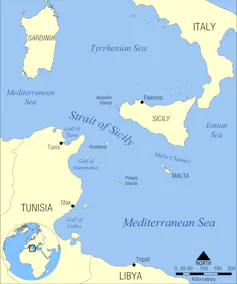
Our team’s discovery of the presence of European hunter-gatherers on the tiny Mediterranean island of Malta, reported last year, has overturned this view. It showed that people reached Malta from their starting point in Europe (presumably Sicily) at least 8,500 years ago.
In a new study, we show that these populations were engaging in repeated long-distance sea journeys of at least 100km, well before the advent of farming.
Researchers have known that the occasional very ancient sea crossing must have been made. The most famous example may be the colonisation of Australia, tens of thousands of years before the present.
However, sustained, long distance sea voyaging – particularly to small and remote islands – was long thought to have been beyond the capabilities of hunter-gatherers, who are dependant on the bounty, or deprivation, of natural resources.
This was also the case for Europe’s last hunter-gatherers, in the period of time known as the Mesolithic, the era before the Neolithic. During the Neolithic, a new population introduced agriculture to Europe from Anatolia (which comprises most of the landmass of modern Turkey).
Enter the recent findings from the site of Latnija, on Malta. Did the surprising presence of European hunter-gatherers on Malta reflect a one off, accidental crossing – or perhaps people who somehow became marooned on the island? Conversely, was this Mesolithic presence a reflection of something altogether different, and more complex?
Shifting seas
To explore these possibilities, we investigated whether Malta could support a viable forager population size that could have lived in isolation for the 1,000 year occupation of the island during the Mesolithic.
First, we explored the impacts of changing sea levels since the Last Glacial Maximum (the height of the last ice age), from around 21,000 years ago. This was when waters began to rise from their lowest levels of around 130m below modern sea level. By doing this, we were able to track changes in the size of Malta and its connectivity with surrounding islands and land masses.
During the Last Glacial Maximum, Malta was connected to Sicily by a land bridge, and this connection remained as sea levels continued to rise until around 14,000 years ago, when the land bridge began to be inundated. Continued sea level rise meant that within less than a thousand years, Malta had become far smaller and remote from Sicily, needing a long-distance sea crossing for connectivity.
By the time of the Mesolithic occupation, Malta had almost reached its present configuration, with no significant difference in distances to Sicily. Having understood how sea level rise impacted the size and accessibility of Malta, we next explored how its specific ecological conditions impacted its ability to support forager populations. Since hunter-gatherers are reliant on what nature provides, their population sizes have a direct relationship with ecological productivity.
Accordingly, we modelled the relationship between population density among contemporary forager populations and what’s known as net primary productivity – effectively the baseline of wild resources available to hunter-gatherers. We then extrapolated these findings back into the past using high resolution computer models of past climates (palaeoclimate models).
This enabled us to calculate the total population size that could be supported first on the combined landmass of Malta and Sicily, and then as separate islands as sea levels rose.
Our upper estimates for the total population sizes suggest that after the inundation of the land bridge to Sicily, the total population size that could be theoretically supported on Malta dropped rapidly to 319 people by 13,800 years ago.
There is no evidence yet that people were living on Malta this early, but our models showed that any populations present would have continued to drop in size as sea levels rose until around 9,000 years ago, when it could have accommodated around 170-144 people.
Finally, we compared these findings to thresholds, informed by conservation genetic studies, for the long-term viability and stability of a population. These thresholds suggest the need for an effective (reproducing) population size of 1,000 or more, equivalent to a total population size of 2,500-3,000 (because the total population size includes both younger and older people who are not reproducing).
Long distance voyages
This suggests that Malta was incapable of hosting an isolated, viable population that could have lived continuously through the 1,000-year time frame during which it was settled by Mesolithic hunter-gatherers.
Consequently, we can rule out the persistence of a population stranded on Malta as sea levels inundated the land bridge to Sicily. We can also exclude a single, perhaps unintended, voyage leaving marooned mariners on Malta.
The only alternative is that these Mesolithic hunter-gatherers were making repeated, long distance sea voyages between at least Malta and Sicily, the closest land mass, to maintain the genetic connections that ensured at least a millennium of Mesolithic viability on Malta.
These insights are reshaping our perceptions of late European hunter-gatherers and the sophistication of their societies. To maintain repeated, long-distance overseas connections, they must have had, and conserved, an extensive knowledge of land, sea and sky, as well as the technological know-how for building and preserving sea craft.
We don’t know for certain what type of vessels the hunter-gatherers were using, although we know that dug-out canoes existed at this time. The crossings to Malta occurred several thousand years before the earliest evidence for sails – making the achievement even more impressive.
From wayfinding to getting food at sea overnight, they then had to be able to live sustainably on a small, semi-arid island, which required a finely-tuned knowledge of diverse food sources shaped by the seasons.
With these implicit capabilities, we can then start to ask, where else did they go? There is already evidence of connectivity between Europe and North Africa during this time. Previous work using ancient DNA found the distinctive signature of European hunter-gatherer ancestry in people living in pre-Neolithic Tunisia.
All this suggests we may be looking at a hitherto unknown web of overseas links that marked the beginning of the connected world we know today, centuries before the first farmers reached the central Mediterranean.
Understanding how these groups remained ecologically resilient, while also shaping ecosystems to their needs, may yet prove to have important lessons for humanity’s current and future challenges in a rapidly warming world. As we continue to unravel Malta’s unprecedented hunter-gatherer past, we hope to shed light on this lost ecological knowledge.
This article was originally published on The Conversation. Read the original article.