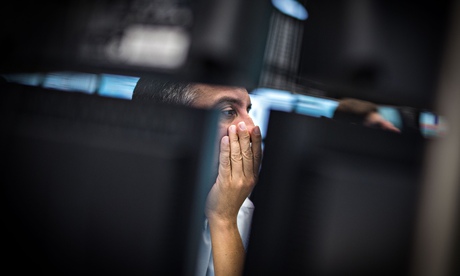
Leading shares in London and the rest of Europe staged a partial recovery after Wednesday’s turmoil, when fears about global growth prospects and anxiety about the spread of Ebola hit stock markets hard.
The FTSE 100 rose around 70 points in early trading – just over 1% – recouping around a third of the previous day’s 181 point tumble, which slashed £46bn from the value of Britain’s leading scompanies.
There were signs that the rally was running out of steam, however, as the FTSE 100 fell back after less than an hour’s trading, cutting the gain to less than 10 points at 6221. The index is down almost 10% since its recent peak on 4 September. Germany’s Dax index initially rose 0.6% and Italy’s FTSE MiB gained 0.8% but later moved into negative territory.
Global shares have been hard hit by mounting concerns about the prospects for economic growth, the spread of Ebola and geopolitical tensions, fears which have also hit the oil price, sending it to a four year low. Yields for US Treasuries, UK gilts and other government bonds fell as investors sought relative safety.
Overnight, Asian stock markets extended the losses seen in Europe and the US on Wednesday, with Japan’s Nikkei tumbling 2.2% and Hong Kong’s Hang Seng down 0.7%.
Michael Hewson, chief market analyst at CMC Markets, said in a note to clients: “The reasons for this new jitteriness are not hard to find with the global economic outlook turning darker, and growth downgrades coming thick and fast from all angles, while concerns about the spread of Ebola are inducing fears about travel bans prompting changes in consumer behaviour across the US.”
The catalyst for Wednesday’s market ructions was data indicating the US economy was feeling the effects of a global fall in demand. US retail sales fell 0.3% in September, the first decline since January, while producer prices fell by 0.1%, the first decline since August 2013.
The US updates followed weaker than expected inflation data from China, prompting fears of a slowdown unless the central bank acted to revive the country’s slowing economy.
The stagnating eurozone economy has also been in the spotlight after Germany showed signs that it could slide into recession.
The protests in Hong Kong, turmoil in the Middle East, the effect of sanctions against Russia and the spread of Ebola have also unsettled the markets.