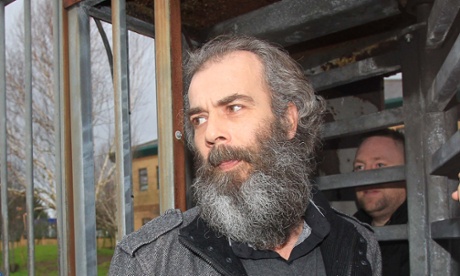
Three suspects who were held for 12 days in Northern Ireland under anti-terrorism legislation have failed in a human rights challenge to prove that their detention was unlawful.
The European court of human rights dismissed the applications by Colin Duffy, a prominent republican activist, Gabriel Magee and Teresa Magee. They were arrested in 2009 after the killing of two soldiers and a police officer during an upsurge in dissident IRA attacks.
The ruling comes as the UK’s continued link to the Strasbourg court is under threat from the incoming Conservative government. David Cameron’s new administration wants to reduce the impact of ECHR judgments and ensure they are no longer legally binding on British courts.
A decision against the UK on this case could have provoked a fresh round of protest. Some commentators have claimed that Strasbourg has recently adopted a less critical approach in UK cases in order to mend relations with London.
The Magees were arrested in 2009 on suspicion of involvement in the murder of a police officer. Duffy was arrested on the same day on suspicion of involvement in the murder of two soldiers killed outside Massereene army barracks in County Antrim.
The director of public prosecutions had twice applied successfully under the Terrorism Act (2000) for warrants to extend their detention beyond the normal limit of 48 hours.
The DPP sought the extra time for forensic tests and to carry out further questioning once the results of the additional forensic tests had been received.
Laywers for the detainees had meanwhile sought a judicial review opposing their continued detention. The high court eventually ordered their release after 12 days.
No charges were brought against the Magees. Duffy was subsequently charged with the murder of the two soldiers as well as five attempted murders. He was acquitted on all counts in 2012.
In its decision, the Strasbourg court found there had been no violation of the Magees’ entitlement to trial within a reasonable time or to release pending trial. It declared Duffy’s application “inadmissable”.